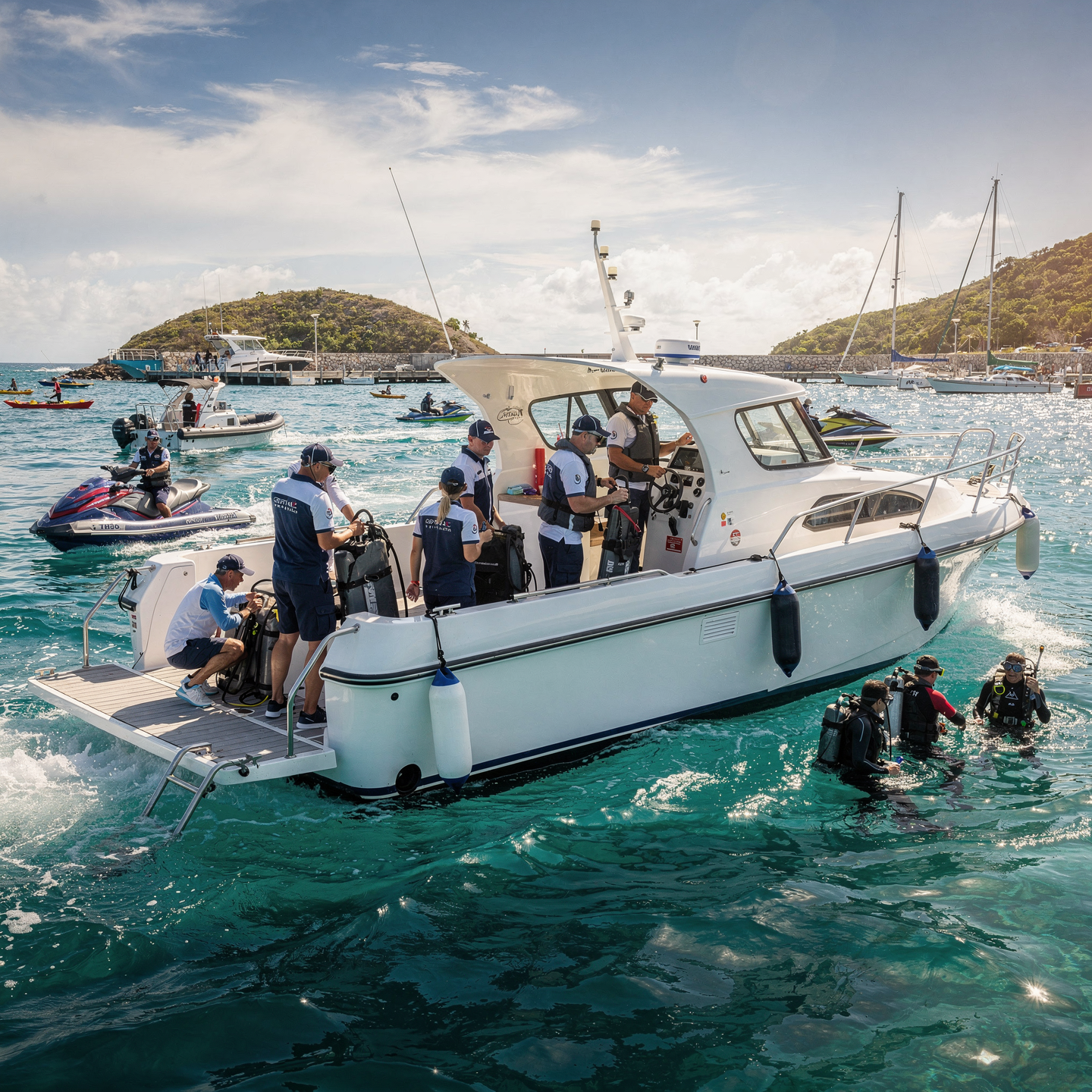
Diploma in Management of Marine Tourism Activities
Why this certificate program?
The Diploma in Marine Tourism Activities Management
This program provides you with the essential tools to lead and optimize operations in the maritime tourism sector. Learn to develop innovative and sustainable experiences, from strategic planning to resource management and safety. Master current regulations and market trends to drive your business growth and ensure customer satisfaction. This program equips you to face the challenges of a constantly evolving sector, with a practical and results-oriented approach.
Differentiating Advantages
- Comprehensive Management: addresses key aspects such as marketing, finance, operations, and sustainability.
- Practical Approach: real-world case studies, simulations, and tools applicable from day one.
- Networking: interact with industry professionals and expand your career opportunities.
- Marine Sustainability: learn to minimize environmental impact and promote responsible practices.
- Flexibility: online format with content accessible 24/7 to adapt to your pace.
- Modality: Online
- Level: Diplomado
- Hours: 800 H
- Start date: 01-10-2026
Availability: 1 in stock
Who is it aimed at?
- Tourism professionals seeking to specialize in the management of nautical and coastal activities.
- Entrepreneurs interested in developing sustainable and innovative marine tourism businesses.
- Tourism destination managers wishing to optimize the supply of water activities and boost local development.
- Tour guides and customer service staff seeking to expand their knowledge of the marine environment and related tourism activities.
- Students of tourism, marine biology, or related fields seeking practical specialization in the management of marine tourism activities.
Flexibility and practical learning
Designed for professionals and Students: flexible online format, real-world case studies and networking with industry experts.
Objectives and competencies

Optimizing the marine tourism experience:
“To effectively manage passenger safety, applying emergency protocols and coordinating with maritime rescue services.”

Implement maritime tourism safety protocols:
Establish clear emergency procedures and communicate them effectively to the crew and passengers, including regular drills and risk assessments specific to the tourism operation.

Efficiently manage marine tourism resources:
“Optimize routes, reduce environmental impact, and ensure the safety of passengers and vessels through the application of regulations and best practices in navigation and marine tourism operations.”

Effectively marketing marine tourism products:
“Identify and segment markets, designing customized offers and effective promotional strategies through digital and traditional channels.”

Assess and mitigate the environmental impacts of marine tourism activities:
Implement waste and spill management protocols, ensuring compliance with current environmental regulations and promoting responsible tourism practices among users and operators.

Develop and innovate sustainable marine tourism offerings:
Implement certified ecotourism practices, minimizing the environmental impact on marine flora and fauna, through tourist education and collaboration with local communities.
Curriculum - Modules
- Comprehensive Maritime Incident Management: protocols, roles, and chain of command for coordinated response
- Operational Planning and Execution: briefing, routes, weather windows, and go/no-go criteria
- Rapid Risk Assessment: criticality matrix, scene control, and decision-making under pressure
- Operational Communication: VHF/GMDSS, standardized reports, and inter-agency liaison
- Tactical Mobility and Safe Boarding: RHIB maneuvers, approach, mooring, and recovery
- Equipment and Technologies: PPE, signaling, satellite tracking, and field data logging
- Immediate Care of the Affected: primary assessment, hypothermia, trauma, and stabilization for evacuation
- Adverse Environmental Conditions: swell, Visibility, flows, and operational mitigation
Simulation and training: critical scenarios, use of VR/AR, and exercises with performance metrics
Documentation and continuous improvement: lessons learned, indicators (MTTA/MTTR), and SOP updates
- Introduction to Maritime Tourism: Types, trends, and the global market.
- Maritime Tourism Legislation: National and international regulations, safety, and licenses.
- Design of Maritime Tourism Products: Cruises, excursions, charters, and water sports.
- Strategic Planning in Maritime Tourism: SWOT analysis, objectives, strategies, and KPIs.
- Port Operations for Tourism: Terminal management, services for ships and passengers.
- Digital Marketing for Maritime Tourism: SEO, SEM, social media, and email marketing.
- Customer Experience Management: Service quality, customer service, and loyalty.
- Sustainability in Tourism Maritime: Environmental impact, social responsibility, and sustainable practices.
Risk and Safety Management: Emergency plans, safety protocols, and accident prevention.
Finance and Accounting for Maritime Tourism: Budgets, costs, revenue, and profitability.
‘
- Fundamentals of Tourism Marketing: Evolution, trends, and segmentation of the nautical ecotourism market.
- Nautical Ecotourism: Definition, principles, benefits, and challenges. Types of activities and destinations.
- Environmental Analysis: PESTEL, SWOT, and competitive analysis in the nautical ecotourism sector.
- Development of Nautical Ecotourism Products and Services: Design, innovation, differentiation, and sustainability.
- Digital Marketing for Nautical Ecotourism: SEO, SEM, social media, email marketing, and content marketing.
- Branding and Online Reputation: Brand building, reputation management, and communication of sustainable values.
- Pricing and Distribution Strategies: Strategic pricing, online and offline distribution channels, commissions, and partnerships.
- Sustainable Communication and Promotion: Storytelling, influencer marketing, public relations, and corporate social responsibility.
- Measuring and Analyzing Results: KPIs, marketing metrics, ROI analysis, and continuous improvement.
- Legislation and Certifications in Nautical Ecotourism: Environmental regulations, quality seals, sustainability certifications, and best practices.
‘
- Introduction to Maritime Tourism: Types, Trends, and Challenges
- Market Segmentation: Identifying Niches and Customer Profiles
- Digital Tourism Marketing: SEO, SEM, Social Media, and Content Marketing
- Tourism Branding Strategies: Brand Creation and Positioning
- Maritime Tourism Distribution: Online and Offline Channels, OTAs, and Travel Agencies
- Destination Promotion: Trade Fairs, Events, Press Trips, and Familiarization Tours
- Product Marketing: Cruises, Excursions, Charters, and Nautical Experiences
- Customer Experience Management: Quality, Personalization, and Loyalty
- Analysis of Competition: Benchmarking, Differentiation, and Value Proposition
Measurement and Analysis of Results: KPIs, ROI, and Continuous Improvement
‘
- Introduction to Nautical Tourism: Types, Trends, and Markets
- Legal and Regulatory Framework: National and International Regulations
- Nautical Infrastructure: Marinas, Ports, and Anchorages
- Vessels: Types, Characteristics, and Selection for Tourist Activities
- Safety in Nautical Tourism: Risk Prevention and Emergency Protocols
- Environmental Management: Sustainable Practices in Nautical Activities
- Route and Activity Planning: Designing Tourist Experiences
- Marketing and Promotion: Strategies for Nautical Tourism
- Quality Management: Standards and Certifications in the sector
- Economic and financial feasibility analysis of nautical tourism projects
‘
- System Architecture and Components: Structural design, materials, and subsystems (mechanical, electrical, electronic, and fluid) with selection and assembly criteria for marine environments
- Fundamentals and Principles of Operation: Physical and engineering foundations (thermodynamics, fluid mechanics, electricity, control, and materials) that explain performance and operating limits
- Safety and Environmental (SHE): Risk analysis, PPE, LOTO, hazardous atmospheres, spill and waste management, and emergency response plans
- Applicable Regulations and Standards: IMO/ISO/IEC requirements and local regulations;
- Conformance criteria, certification, and best practices for operation and maintenance
- Inspection, testing, and diagnostics: Visual/dimensional inspection, functional testing, data analysis, and predictive techniques (vibration, thermography, fluid analysis) to identify root causes
- Preventive and predictive maintenance: Hourly/cycle/seasonal plans, lubrication, adjustments, calibrations, consumable replacement, post-service verification, and operational reliability
- Instrumentation, tools, and metrology: Measuring and testing equipment, diagnostic software, calibration and traceability; selection criteria, safe use, and storage
- Onboard integration and interfaces: Mechanical, electrical, fluid, and data compatibility; Sealing and watertightness, EMC/EMI, corrosion protection, and interoperability testing.
Quality, acceptance testing, and commissioning: process and materials control, FAT/SAT, bench and sea trials, go/no-go criteria, and evidence documentation.
Technical documentation and integrated practice: logs, checklists, reports, and a complete case study (safety ā diagnosis ā intervention ā verification ā report) applicable to any system.
- Introduction to nautical marketing: characteristics and trends of the sector.
- Analysis of the nautical market: segmentation, targeting, and positioning.
- The nautical product: life cycle, branding, and value proposition.
- Pricing strategies: costs, margins, and pricing models in the nautical sector.
- Distribution channels: direct sales, distributors, brokers, and nautical trade shows.
- Communication and promotion: advertising, public relations, and digital marketing.
- Content marketing for the nautical sector: blogs, videos, and social media.
- CRM and customer management: loyalty and loyalty programs in the sector.
- Measurement and analysis of results: KPIs and ROI in nautical marketing campaigns.
- Legal and ethical aspects of nautical marketing and sales.
‘
Career opportunities
- Marine Tourism Product Manager: Design, marketing, and management of marine-based tourism experiences.
- Nautical Tourism Consultant: Advising companies and institutions on the planning and development of sustainable tourism activities in the marine environment.
- Technician in Maritime Tourism Companies: Operation and maintenance of vessels, reservation management, and customer service.
- Specialized Marine Tour Guide: Leading groups and explaining the natural and cultural values āāof the marine environment.
- Marine Tourism Destination Promoter: Development of marketing and communication strategies for the promotion of coastal and marine tourist destinations.
- Marina and Port Manager: Administration and coordination of services in port facilities dedicated to tourism. Nautical.
- Cruise Ship and Pleasure Craft Entertainer: Organization of entertainment and activities on board tourist vessels.
- Quality Inspector in Marine Tourism Services: Verification of compliance with quality and safety standards in companies within the sector.
“`
Admission requirements

Academic/professional profile:
Degree/Bachelor's degree in Nautical Science/Maritime Transport, Naval/Marine Engineering, or a related field; or proven professional experience in bridge/operations.

Language proficiency:
Recommended functional maritime English (SMCP) for simulations and technical materials.

Documentation:
Updated resume, copy of degree or seaman's book, ID card/passport, letter of motivation.

Technical requirements (for online):
Equipment with camera/microphone, stable connection, ā„ 24ā monitor recommended for ECDIS/Radar-ARPA.
Admission process and dates

1. Online
application
(form + documents).

2. Academic review and interview
(profile/objectives/schedule compatibility).

3. Admission decision
(+ scholarship proposal if applicable).

4. Reservation of place
(deposit) and registration.

5. Induction
(access to campus, calendars, simulator guides).
Scholarships and grants
- Strategic Planning: Master the tools to design and execute successful marine tourism plans.
- Safe and Sustainable Operations: Learn best practices in maritime safety and environmental management for responsible tourism.
- Marketing and Promotion: Develop effective strategies to attract and retain clients in the nautical tourism sector.
- Maritime Tourism Legislation: Understand the current legal framework to operate with confidence and comply with regulations.
- Experience Management: Create unforgettable experiences for your clients, differentiating yourself from the competition and increasing satisfaction.
Testimonials
This diploma program provided me with the necessary tools to boost my marine ecotourism business. I applied the knowledge I gained in digital marketing and sustainability, achieving a 30% increase in bookings in just six months and establishing strategic alliances with local communities for ecosystem conservation.
The Diploma in Water Sports & Marine Activities exceeded my expectations. I acquired solid theoretical and practical knowledge in various disciplines, from sailing to diving, which allowed me to obtain instructor certification in several specialties. The quality of the teaching staff and the practical experience in real-world settings were key to my professional development. Today, thanks to this training, I run my own kitesurfing school.
This diploma program provided me with the necessary tools to develop a successful business plan for a whale watching tourism company. I was able to integrate environmental sustainability with profitability, attracting investment and generating local jobs, while minimizing our impact on the marine ecosystem.
This diploma program provided me with the necessary tools to develop a successful business plan for a marine ecotourism company. By applying the knowledge I gained about sustainability, marketing, and resource management, I was able to secure funding, and we are currently operating with a positive impact both economically and environmentally.

Frequently asked questions
Yes. The itinerary includes ECDIS/Radar-ARPA/BRM with harbor, ocean, fog, storm, and SAR scenarios.
Online with live sessions; hybrid option for simulator/practical placements through agreements.
Recommended functional SMCP. We offer support materials for standard phraseology.
Yes, with a relevant degree or experience in maritime/port operations. The admissions interview will confirm suitability.
Optional (3ā6 months) through Companies & Collaborations and the Alumni Network.
Simulator practice (rubrics), defeat plans, SOPs, checklists, micro-tests and applied TFM.
A degree from Navalis Magna University + operational portfolio (tracks, SOPs, reports and KPIs) useful for audits and employment.
- Introduction to Nautical Tourism: Types, Trends, and Markets
- Analysis of the Tourism Environment: PESTEL, SWOT, and Demand Analysis
- Market Segmentation in Nautical Tourism: Criteria and Customer Profiles
- Defining the Value Proposition: Differentiation and Positioning
- Marketing Objectives: SMART and Relevant KPIs in the Nautical Sector
- Digital Marketing Strategies for Nautical Tourism: SEO, SEM, and Social Media
- Content Marketing: Creating Relevant Content for the Target Audience
- Communication and Public Relations Strategies in Tourism Nautical.
- Customer Experience Management: Service design and customer service.
- Measuring and Evaluating Results: ROI and analysis of the effectiveness of marketing actions.
‘
Request information
Complete the Application Form.
Attach your CV/degree certificate (if you have it to hand).
Indicate your preferred cohort (January/May/September) and whether you would like the hybrid option with simulator sessions.
An academic advisor will contact you within 24ā48 hours to guide you through the admission process, scholarships, and compatibility with your professional schedule.
Faculty
Eng. TomƔs Riera
Full Professor
Eng. TomƔs Riera
Full Professor
Eng. SofĆa Marquina
Full Professor
Eng. SofĆa Marquina
Full Professor
Eng. Javier BaƱuls
Full Professor
Eng. Javier BaƱuls
Full Professor
Dr. Nuria Llobregat
Full Professor
Dr. Nuria Llobregat
Full Professor
Dr. Pau Ferrer
Full Professor
Dr. Pau Ferrer
Full Professor
Cap. Javier Abaroa (MCA)
Full Professor
Cap. Javier Abaroa (MCA)
Full Professor

