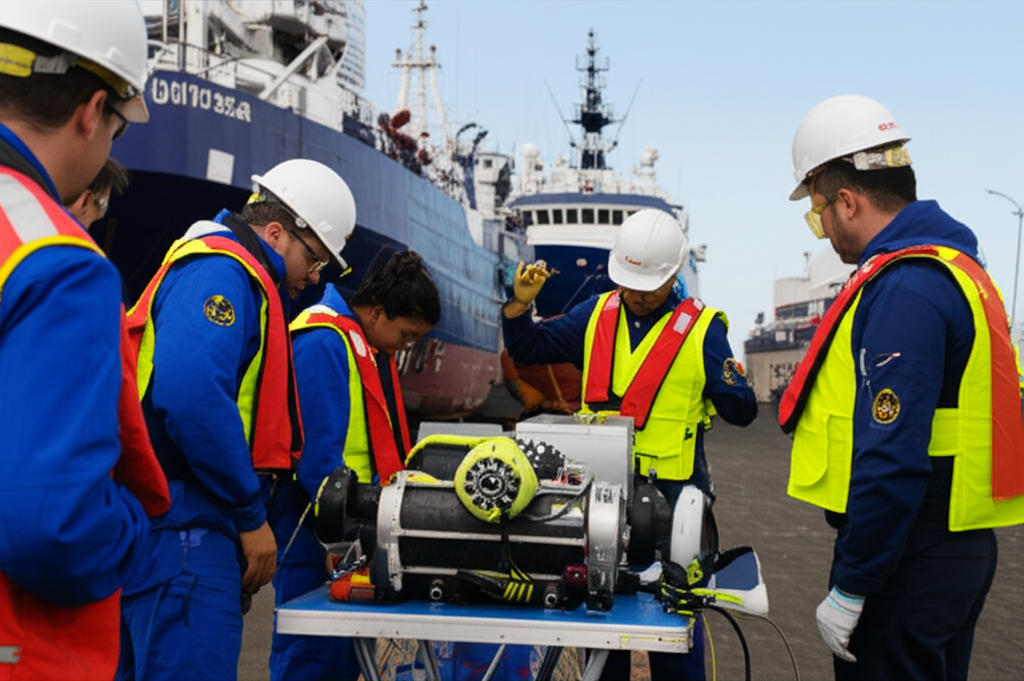
Diploma in Underwater Photography and Filming

Why this certificate program?

The Diploma in Underwater Photography and Filming

Immerse yourself in the exciting world of underwater imaging, combining technical knowledge and creative skills. Learn to master specialized equipment, lighting and composition techniques, and the principles of marine conservation to capture impactful and responsible images. This program provides you with the tools to create high-quality underwater photographs and videos, whether for artistic, scientific, or educational purposes.

Differentiating Advantages

  • Practical Dives: Experience real-world environments under the supervision of expert instructors.
  • Professional Equipment: Use state-of-the-art equipment for optimal results.
  • Editing and Post-Production: Learn to enhance your images and videos with specialized software.
  • Visual Storytelling: Develop skills to tell stories through your underwater images.
  • Professional Certification: Obtain a recognized diploma that validates your knowledge and skills.

Diploma in Underwater Photography and Filming

Availability: 1 in stock

Who is it aimed at?

  • Marine biologists and oceanographers who want to document underwater life with professional quality for research and outreach.
  • Recreational and technical divers who want to capture the beauty of the underwater world and share their experiences with stunning images.
  • Land-based photographers and filmmakers who want to expand their portfolio into the fascinating underwater environment.
  • Tourism and marketing professionals who need to create engaging visual content to promote diving destinations and water activities.
  • Audiovisual communication students who are looking for an innovative specialization in a constantly growing field.

Flexibility for your schedule
Online training with recorded classes and access 24/7, complemented by practical experience in real-world environments and personalized tutoring.

Objectives and competencies

Mastering underwater image and video capture techniques:

“Adjust white balance, ISO, and aperture according to depth and light, using corrective filters and artificial light sources.”

Apply marine safety and conservation protocols:

“Conduct routine inspections of safety equipment, documenting findings and correcting deficiencies according to regulations.”

To produce impactful visual narratives about the underwater world:

“Mastering underwater filming and photography techniques, optimizing light and composition to communicate the beauty and fragility of the marine ecosystem.”

Operate specialized photography and filming equipment in challenging underwater environments:

Ensure the watertightness, functionality and calibration of the equipment, adapting lighting and composition techniques to the turbidity, depth and local fauna.

Editing and post-producing high-quality underwater audiovisual material:

Apply LUTs and color corrections to achieve the desired aesthetic, optimizing for different platforms and delivery formats.

Develop underwater audiovisual projects with environmental and ethical awareness:

“Implement non-invasive filming protocols and minimize the acoustic impact on marine fauna.”

Curriculum - Modules

  1. Comprehensive Maritime Incident Management: protocols, roles, and chain of command for coordinated response
  2. Operational Planning and Execution: briefing, routes, weather windows, and go/no-go criteria
  3. Rapid Risk Assessment: criticality matrix, scene control, and decision-making under pressure
  4. Operational Communication: VHF/GMDSS, standardized reports, and inter-agency liaison
  5. Tactical Mobility and Safe Boarding: RHIB maneuvers, approach, mooring, and recovery
  6. Equipment and Technologies: PPE, signaling, satellite tracking, and field data logging
  7. Immediate Care of the Affected: primary assessment, hypothermia, trauma, and stabilization for evacuation
  8. Adverse Environmental Conditions: swell, Visibility, flows, and operational mitigation

    Simulation and training: critical scenarios, use of VR/AR, and exercises with performance metrics

    Documentation and continuous improvement: lessons learned, indicators (MTTA/MTTR), and SOP updates

  1. Introduction to underwater imaging: history, evolution, and applications.
  2. Physics of light underwater: absorption, scattering, and color.
  3. Self-contained underwater breathing apparatus (SCUBA): regulators, buoyancy compensators (BCDs), and tanks.
  4. Underwater cameras: types, housings, controls, and maintenance.
  5. Artificial lighting: spotlights, flashes, and strobes; Lighting techniques.
  6. Underwater photography techniques: composition, focus, exposure.

    Underwater video techniques: stabilization, white balance, audio.

    Safety in underwater photography/videography: specific risks, planning.

    First aid and emergency management in the underwater environment.

    Ethics and conservation: respect for the marine environment and wildlife.

  1. Introduction to Visual Narrative: The Language of Underwater Imagery.
  2. Principles of Photographic and Videographic Composition in Aquatic Environments.
  3. Basic Underwater Lighting Equipment: Lights, Flashes, Snoots, Modifiers.
  4. Color Theory in Water: Absorption, Scattering, and Color Temperature.
  5. Natural Lighting Techniques: Harnessing Sunlight and Refraction.
  6. Basic Artificial Lighting: Front Lighting, Side Lighting, Backlighting, and Their Effects.
  7. Lighting with Multiple Sources: Balancing Light and Shadows and Creating Depth.
  8. Macro and Wide-Angle Photography: Adapting Lighting to Different Perspectives.
  9. Safety Considerations When Handling Lighting Equipment Underwater water.
  10. Ethics and conservation: minimizing the impact of lighting on marine life.

  1. Introduction to Underwater Visual Storytelling: History and Evolution
  2. Principles of Underwater Photography and Videography: Lighting, Composition, Focus
  3. Equipment for Capturing Underwater Images: Cameras, Housings, Lights, Stabilizers
  4. Diving Techniques for Photographers and Videographers: Buoyancy Control, Safety, Communication
  5. Virtual Reality (VR) and Augmented Reality (AR) in Underwater Environments: Fundamentals and Applications
  6. Creating Immersive Content: 360° Video Recording, Photogrammetry, and 3D Modeling
  7. Editing and Post-Production Software for Underwater Content: Color Correction, Noise Reduction, Stitching
  8. Distribution and Viewing Platforms for Immersive Underwater Content: YouTube VR, Oculus, HTC Vive.
  9. Ethical and conservation considerations in underwater visual storytelling: environmental impact, respect for marine life.
  10. Case studies and best practices in creating immersive underwater experiences: documentaries, games, educational applications.

  1. Introduction to Underwater Photography: History, Evolution, and Current Trends
  2. Fundamentals of Underwater Light: Absorption, Scattering, Color, and Temperature
  3. Lighting Equipment: Flashes, Video Lights, Snoots, and Light Modifiers
  4. Stroboscopic Lighting Techniques: Positioning, Power, and Synchronization
  5. Underwater Composition: Rule of Thirds, Leading Lines, Symmetry, and Perspective
  6. Underwater Photography: The Use of Negative Space and Simplification
  7. Natural Lighting Techniques: Backlighting, Silhouettes, and Light Rays
  8. Macro Photography: Lighting, Focusing, and Composition of Small Subjects
  9. Wide-angle photography: lighting, perspective, and distortion correction.
  10. Post-processing of underwater images: color correction, sharpening, and backscatter removal.

  1. System Architecture and Components: Structural design, materials, and subsystems (mechanical, electrical, electronic, and fluid) with selection and assembly criteria for marine environments
  2. Fundamentals and Principles of Operation: Physical and engineering foundations (thermodynamics, fluid mechanics, electricity, control, and materials) that explain performance and operating limits
  3. Safety and Environmental (SHE): Risk analysis, PPE, LOTO, hazardous atmospheres, spill and waste management, and emergency response plans
  4. Applicable Regulations and Standards: IMO/ISO/IEC requirements and local regulations;
  5. Conformance criteria, certification, and best practices for operation and maintenance
  6. Inspection, testing, and diagnostics: Visual/dimensional inspection, functional testing, data analysis, and predictive techniques (vibration, thermography, fluid analysis) to identify root causes
  7. Preventive and predictive maintenance: Hourly/cycle/seasonal plans, lubrication, adjustments, calibrations, consumable replacement, post-service verification, and operational reliability
  8. Instrumentation, tools, and metrology: Measuring and testing equipment, diagnostic software, calibration and traceability; selection criteria, safe use, and storage
  9. Onboard integration and interfaces: Mechanical, electrical, fluid, and data compatibility; Sealing and watertightness, EMC/EMI, corrosion protection, and interoperability testing.

    Quality, acceptance testing, and commissioning: process and materials control, FAT/SAT, bench and sea trials, go/no-go criteria, and evidence documentation.

    Technical documentation and integrated practice: logs, checklists, reports, and a complete case study (safety → diagnosis → intervention → verification → report) applicable to any system.

  1. Introduction to Underwater Photography and Video: History and Evolution
  2. Basic and Advanced Equipment: Cameras, Housings, Lenses, Lighting
  3. Principles of Underwater Optical Physics: Absorption, Refraction, Dispersion
  4. Artificial Lighting Techniques: Flashes, Spotlights, White Balance
  5. Underwater Visual Composition: Rule of Thirds, Lines, Textures, Color
  6. Diving Techniques for Photographers: Buoyancy Control, Finning, Positioning
  7. Safety in Underwater Photography: Risks and Emergency Protocols
  8. Visual Storytelling: Telling Stories Through Images and Videos underwater.
  9. Basic underwater photo and video editing: color correction, sharpening, noise.
  10. Ethical and conservation considerations in underwater photography.

Career opportunities

  • Freelance Underwater Photographer/Videographer: Creating content for media outlets, travel agencies, NGOs, and research projects.
  • Specialized Diving Guide: Combining diving skills with photography and filmmaking to offer unique experiences.
  • Underwater Documentary Filmmaker: Producing documentaries about marine life, conservation, and exploration.
  • Underwater Researcher/Scientist: Visually documenting scientific research, environmental monitoring, and species studies.
  • Underwater Photography/Filming Instructor: Teaching techniques and skills to divers and enthusiasts.
  • Underwater Equipment and Technology Consultant: Advising on the selection and use of underwater photography and filmmaking equipment.
  • Creator Content Creator for Social Media and Online Platforms: Generating impactful visual content for platforms such as YouTube, Instagram, and Vimeo.

    Marine Conservation Project Contributor: Using photography and filming to raise awareness about the importance of conservation and document environmental impact.

    “`

Admission requirements

Academic/professional profile:

Degree/Bachelor's degree in Nautical Science/Maritime Transport, Naval/Marine Engineering, or a related field; or proven professional experience in bridge/operations.

Language proficiency:

Recommended functional maritime English (SMCP) for simulations and technical materials.

Documentation:

Updated resume, copy of degree or seaman's book, ID card/passport, letter of motivation.

Technical requirements (for online):

Equipment with camera/microphone, stable connection, ≥ 24” monitor recommended for ECDIS/Radar-ARPA.

Admission process and dates

1. Online
application

(form + documents).

2. Academic review and interview

(profile/objectives/schedule compatibility).

3. Admission decision

(+ scholarship proposal if applicable).

4. Reservation of place

(deposit) and registration.

5. Induction

(access to campus, calendars, simulator guides).

Scholarships and grants

  • Master the Art: Learn underwater photography and filming techniques from experts.
  • Professional Equipment: Gain in-depth knowledge of the use and maintenance of specialized cameras, lights, and accessories.
  • Challenging Environments: Capture the hidden beauty of reefs, shipwrecks, and marine life safely and respectfully.
  • Editing and Post-Production: Refine your images and videos with state-of-the-art software.
  • Build Your Portfolio: Develop impactful projects and build a professional career in the underwater world.
Fuel your passion and become a storyteller visual of the ocean.

Testimonials

Frequently asked questions

Yes. The itinerary includes ECDIS/Radar-ARPA/BRM with harbor, ocean, fog, storm, and SAR scenarios.

Online with live sessions; hybrid option for simulator/practical placements through agreements.

Recommended functional SMCP. We offer support materials for standard phraseology.

Yes, with a relevant degree or experience in maritime/port operations. The admissions interview will confirm suitability.

Optional (3–6 months) through Companies & Collaborations and the Alumni Network.

Simulator practice (rubrics), defeat plans, SOPs, checklists, micro-tests and applied TFM.

A degree from Navalis Magna University + operational portfolio (tracks, SOPs, reports and KPIs) useful for audits and employment.

  1. Physics of Light Underwater: Absorption, scattering, refraction, and color.
  2. Underwater Photography Equipment: Cameras, housings, lenses, artificial lighting (flashes and spotlights).
  3. Underwater Lighting Techniques: Backscatter, snoots, directed light, ambient light.
  4. Underwater Photographic Composition: Rule of thirds, guidelines, symmetry, and use of negative space.
  5. Underwater Camera Settings: Custom white balance, ISO, aperture, and shutter speed.
  6. Underwater Macro Photography: Focusing techniques, depth of field, and use of macro lenses.
  7. Underwater Wide-Angle Photography: Landscapes, shipwrecks, large animals, and people.
  8. Underwater Image Processing: Color correction, sharpening, particle removal, and creative editing.
  9. Diver Photographer Safety: Situational awareness, buoyancy control, respect for marine life, and emergency procedures.
  10. Ethics in Underwater Photography: Do not disturb marine life, do not alter the environment, and promote conservation.

Request information

  1. Complete the Application Form.

  2. Attach your CV/degree certificate (if you have it to hand).

  3. Indicate your preferred cohort (January/May/September) and whether you would like the hybrid option with simulator sessions.

    An academic advisor will contact you within 24–48 hours to guide you through the admission process, scholarships, and compatibility with your professional schedule.

Please enable JavaScript in your browser to complete this form.
Click or drag a file to this area to upload.

Faculty

0
    0
    Tu carrito
    Tu carrito esta vacíoRegresar a la tienda
    Scroll to Top


