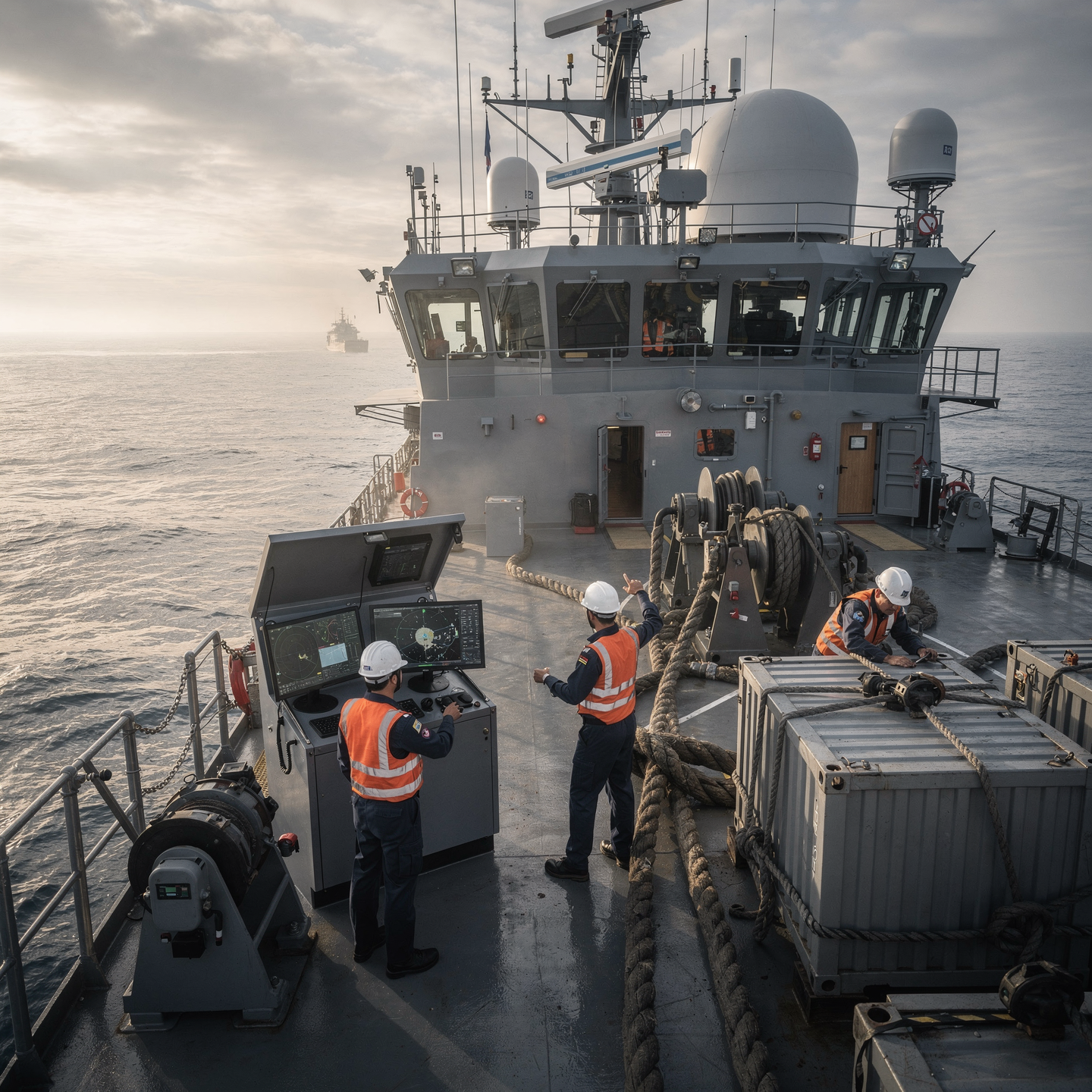
Diploma in Maritime Defense and Strategies

Why this certificate program?

The Diploma in Maritime Defense and Strategies

Offers an in-depth immersion into the complex maritime geopolitical landscape, equipping participants with the necessary tools to understand and address security and defense challenges in the naval environment. The program focuses on the analysis of emerging threats, the development of maritime security strategies, and the application of international legal frameworks. Through case studies and simulations, participants will develop skills in strategic decision-making and naval operations planning.

Differential Advantages

  • Geopolitical Analysis: Understanding the power dynamics in the oceans and their impact on global security.
  • Defense Strategies: Designing and implementing strategies to protect national maritime interests.
  • Legal Framework: In-depth knowledge of the international law of the sea and its application in conflict situations.
  • Simulations and Case Studies: Hands-on experience in solving complex problems in the maritime environment.
  • Expert Network: Access to a network of leading professionals in the field of maritime defense and security.
Defensa

Diploma in Maritime Defense and Strategies

Availability: 1 in stock

Who is it aimed at?

  • Navy, Coast Guard, and Merchant Marine officers seeking to deepen their knowledge of maritime geopolitics, the law of the sea, and defense strategies.
  • Security analysts, consultants, and journalists requiring a solid understanding of the challenges and opportunities in the maritime sphere.
  • Government officials and legislators involved in decision-making on maritime policy, international trade, and national security.
  • Logistics and port professionals interested in understanding the impact of maritime strategies on their operations.
  • Academics and researchers in political science, international relations, and naval studies seeking specialized and up-to-date training.

Flexibility of Study

Designed for professionals with demanding schedules: asynchronous modules available 24/7, discussion forums, and personalized online tutoring.

Defensa

Objectives and competencies

Design and implement maritime security policies:

“Assess specific risks of the vessel, cargo and route, establishing preventive measures and effective and auditable contingency plans.”

Analyze and anticipate threats in the maritime environment:

“Identify and assess vulnerabilities in critical port infrastructure, using intelligence information and risk analysis.”

Managing resources and leading teams in maritime operations:

Plan and execute safe and efficient maneuvers, considering environmental factors, regulations and risks, and adapting the strategy according to the situation.

Develop defense and projection strategies in the maritime domain:

“Implement proactive maritime security doctrine, anticipating threats and optimizing the use of resources (human, technological, logistical) in conflict or crisis scenarios.”

Understand and apply the national and international maritime legal framework:

“Interpret and apply the regulations of the SOLAS Convention, including its amendments, in emergency and safety situations on board.”

Optimizing decision-making in complex maritime scenarios:

Integrate information from multiple sources (radar, AIS, ECDIS) and dynamically assess risks, prioritizing navigational safety and regulatory compliance.

Curriculum - Modules

  1. Comprehensive Maritime Incident Management: protocols, roles, and chain of command for coordinated response
  2. Operational Planning and Execution: briefing, routes, weather windows, and go/no-go criteria
  3. Rapid Risk Assessment: criticality matrix, scene control, and decision-making under pressure
  4. Operational Communication: VHF/GMDSS, standardized reports, and inter-agency liaison
  5. Tactical Mobility and Safe Boarding: RHIB maneuvers, approach, mooring, and recovery
  6. Equipment and Technologies: PPE, signaling, satellite tracking, and field data logging
  7. Immediate Care of the Affected: primary assessment, hypothermia, trauma, and stabilization for evacuation
  8. Adverse Environmental Conditions: swell, Visibility, flows, and operational mitigation

    Simulation and training: critical scenarios, use of VR/AR, and exercises with performance metrics

    Documentation and continuous improvement: lessons learned, indicators (MTTA/MTTR), and SOP updates

  1. Introduction to hybrid threats: definition, characteristics, and actors
  2. Cyberattacks in the maritime sector: attack vectors, malware, and ransomware
  3. Physical threats: terrorism, sabotage, espionage, and organized crime
  4. Information warfare and disinformation: propaganda, fake news, and manipulation
  5. Geopolitical risks: armed conflicts, political instability, and sanctions
  6. Impact of hybrid threats on port security: vulnerabilities and consequences
  7. International legal and regulatory framework: ISPS Code, IMO, and IMO
  8. Prevention and mitigation strategies: risk analysis, contingency plans, and response
  9. Cooperation Public-private partnerships: information sharing, intelligence gathering, and training.

    Security technologies: electronic surveillance, access control, and cybersecurity.

  1. Introduction to Maritime Law: Sources, International Conventions, and National Legislation.
  2. United Nations Convention on the Law of the Sea (UNCLOS): Maritime Zones, Rights and Obligations of States.
  3. Legal Regime of Ships: Nationality, Registration, Flagging, and Ownership.
  4. Maritime Safety: SOLAS, ISPS, SAR, and Other International Regulations.
  5. Protection of the Marine Environment: MARPOL, Ballast Water Management, and Other Pollution Prevention Measures.
  6. Civil Liability for Maritime Damage: Collisions, Groundings, Pollution, and Other Claims.
  7. Contracts of Carriage: Chartering, Bills of Lading, and Their Legal Implications.
  8. Marine insurance: policies, covered risks, and claims procedures.
  9. Piracy and armed robbery at sea: preventive measures and legal response.
  10. Maritime salvage operations: salvor rights, reward, and procedure.

  1. Introduction to Hybrid Threats: Definition, Actors, and Scenarios
  2. Cyber ​​Threats in the Maritime Domain: Types, Attack Vectors, and Vulnerabilities
  3. Modern Naval Operations: Evolution, Capabilities, and Technological Dependencies
  4. Cybersecurity in Ships and Naval Systems: Data Protection, Communications, and Control
  5. Cyber ​​Threat Intelligence: Information Gathering, Analysis, and Dissemination
  6. Naval Electronic Warfare: Countermeasures and Cyberwarfare at Sea
  7. Naval Cyber ​​Defense: Strategies, Tactics, and Protection Technologies
  8. Legal and Ethical Aspects of Naval Cyber ​​Operations: International Law and Standards of Conduct
  9. Cybersecurity Risk Management in the Maritime Environment: Identification, Assessment, and Mitigation
  10. Naval Cybersecurity Drills and Exercises: Incident Preparedness and Response

  1. Introduction to Maritime Law: Sources, International Conventions, Jurisdiction
  2. Maritime Transport Contracts: Bill of Lading, Charter Party
  3. Law of the Sea: Maritime Zones, Sovereignty, Rights of Passage, Fishing
  4. Collisions: Liability, Determination of Fault, Maritime Salvage
  5. Marine Insurance: Policies, Covered Risks, Claims
  6. Liability for Pollution: Conventions, Compensation Funds
  7. Port Law: Concessions, Port Services, Fees
  8. Legal Regime of Ships: Registration, Nationality, Ship Mortgage
  9. Maritime Safety Legislation: SOLAS, ISM, ISPS
  10. Maritime Litigation: Judicial Proceedings and Arbitration

  1. System Architecture and Components: Structural design, materials, and subsystems (mechanical, electrical, electronic, and fluid) with selection and assembly criteria for marine environments
  2. Fundamentals and Principles of Operation: Physical and engineering foundations (thermodynamics, fluid mechanics, electricity, control, and materials) that explain performance and operating limits
  3. Safety and Environmental (SHE): Risk analysis, PPE, LOTO, hazardous atmospheres, spill and waste management, and emergency response plans
  4. Applicable Regulations and Standards: IMO/ISO/IEC requirements and local regulations;
  5. Conformance criteria, certification, and best practices for operation and maintenance
  6. Inspection, testing, and diagnostics: Visual/dimensional inspection, functional testing, data analysis, and predictive techniques (vibration, thermography, fluid analysis) to identify root causes
  7. Preventive and predictive maintenance: Hourly/cycle/seasonal plans, lubrication, adjustments, calibrations, consumable replacement, post-service verification, and operational reliability
  8. Instrumentation, tools, and metrology: Measuring and testing equipment, diagnostic software, calibration and traceability; selection criteria, safe use, and storage
  9. Onboard integration and interfaces: Mechanical, electrical, fluid, and data compatibility; Sealing and watertightness, EMC/EMI, corrosion protection, and interoperability testing.

    Quality, acceptance testing, and commissioning: process and materials control, FAT/SAT, bench and sea trials, go/no-go criteria, and evidence documentation.

    Technical documentation and integrated practice: logs, checklists, reports, and a complete case study (safety → diagnosis → intervention → verification → report) applicable to any system.

  1. Introduction to Maritime Law: sources, international conventions (SOLAS, MARPOL, etc.) and national legislation.
  2. Legal Regime of Ships: nationality, registration, ownership, ship mortgage.
  3. Contracts for the Use of Ships: chartering (types, rights and obligations), maritime transport (bill of lading).
  4. Maritime Civil Liability: collisions, groundings, pollution, salvage.
  5. Marine Insurance: types of policies, coverage, claims.
  6. Maritime Authorities and Jurisdiction at Sea: Coast Guard, Port Captaincies.
  7. Risk Management at Sea: identification, assessment, mitigation and transfer.
  8. Contingency Plans and emergency response: oil spills, fires, shipwrecks.
  9. Search and rescue (SAR): organization, procedures, and resources.

    Legal aspects of piracy and armed robbery at sea: prevention, defense, and response.

Career opportunities

  • Maritime Intelligence Analyst: Gathering and analyzing information for strategic decision-making.
  • Maritime Security Advisor: Developing and implementing security policies and procedures.
  • Maritime Strategic Planner: Designing strategies for the defense and security of national maritime interests.
  • Maritime Risk Manager: Identifying and assessing risks in the maritime sector and proposing mitigation measures.
  • Maritime Defense Consultant: Advising companies and governments on maritime defense and strategy.
  • Maritime Researcher: Analyzing trends and developments in the maritime sector, contributing to knowledge and innovation.
  • Maritime Interests Representative: Promoting and defending maritime interests in national and international organizations.
  • Public official in maritime defense and security areas: Performance of duties in government institutions related to maritime defense and security.

“`

Admission requirements

Academic/professional profile:

Degree/Bachelor's degree in Nautical Science/Maritime Transport, Naval/Marine Engineering, or a related field; or proven professional experience in bridge/operations.

Language proficiency:

Recommended functional maritime English (SMCP) for simulations and technical materials.

Documentation:

Updated resume, copy of degree or seaman's book, ID card/passport, letter of motivation.

Technical requirements (for online):

Equipment with camera/microphone, stable connection, ≥ 24” monitor recommended for ECDIS/Radar-ARPA.

Admission process and dates

1. Online
application

(form + documents).

2. Academic review and interview

(profile/objectives/schedule compatibility).

3. Admission decision

(+ scholarship proposal if applicable).

4. Reservation of place

(deposit) and registration.

5. Induction

(access to campus, calendars, simulator guides).

Scholarships and grants

  • Maritime Geopolitical Analysis: Understand the global dynamics that influence maritime security and the economy.
  • Naval Defense Strategies: Master the tactics and technologies for protecting national maritime interests.
  • International Law of the Sea: Understand the legal framework governing the oceans and its implications for conflict resolution.
  • Maritime Crisis Management and Security: Develop skills to respond to threats and challenges in the maritime environment.
  • Naval Planning and Logistics: Optimize the efficiency of naval operations and the deployment of strategic resources.
Boost your career in the defense sector with a specialized focus on the maritime domain.

Testimonials

Frequently asked questions

Yes. The itinerary includes ECDIS/Radar-ARPA/BRM with harbor, ocean, fog, storm, and SAR scenarios.

Online with live sessions; hybrid option for simulator/practical placements through agreements.

It depends on the specific diploma program, but they generally combine theoretical aspects with practical components such as simulations, case studies, and visits to naval facilities.

Recommended functional SMCP. We offer support materials for standard phraseology.

Yes, with a relevant degree or experience in maritime/port operations. The admissions interview will confirm suitability.

Optional (3–6 months) through Companies & Collaborations and the Alumni Network.

Simulator practice (rubrics), defeat plans, SOPs, checklists, micro-tests and applied TFM.

A degree from Navalis Magna University + operational portfolio (tracks, SOPs, reports and KPIs) useful for audits and employment.

  1. Introduction to International Maritime Law: Sources, Treaties, and Conventions.
  2. United Nations Convention on the Law of the Sea (UNCLOS): Maritime Zones, Navigation, Resources.
  3. International Maritime Organization (IMO): Structure, Functions, Relevant Conventions (SOLAS, MARPOL).
  4. Legal Regime of Ships: Nationality, Registration, Flagging, Ownership.
  5. Contracts of Maritime Transport: Chartering, Bills of Lading (B/L), Marine Insurance.
  6. Maritime Civil Liability: Collisions, Pollution, Salvage, Towing.
  7. Maritime Criminal Law: Piracy, Illicit Trafficking, Stowaways.
  8. Operations Naval Law: Law of War at Sea, Exclusion Zones, Maritime Interdiction.

    Jurisdiction and Competence at Sea: National and International Courts, Maritime Arbitration.

    Dispute Settlement in International Maritime Law: Negotiation, Mediation, Litigation.

Request information

  1. Complete the Application Form.

  2. Attach your CV/degree certificate (if you have it to hand).

  3. Indicate your preferred cohort (January/May/September) and whether you would like the hybrid option with simulator sessions.

    An academic advisor will contact you within 24–48 hours to guide you through the admission process, scholarships, and compatibility with your professional schedule.

Please enable JavaScript in your browser to complete this form.
Click or drag a file to this area to upload.

Faculty

0
    0
    Tu carrito
    Tu carrito esta vacíoRegresar a la tienda
    Scroll to Top


