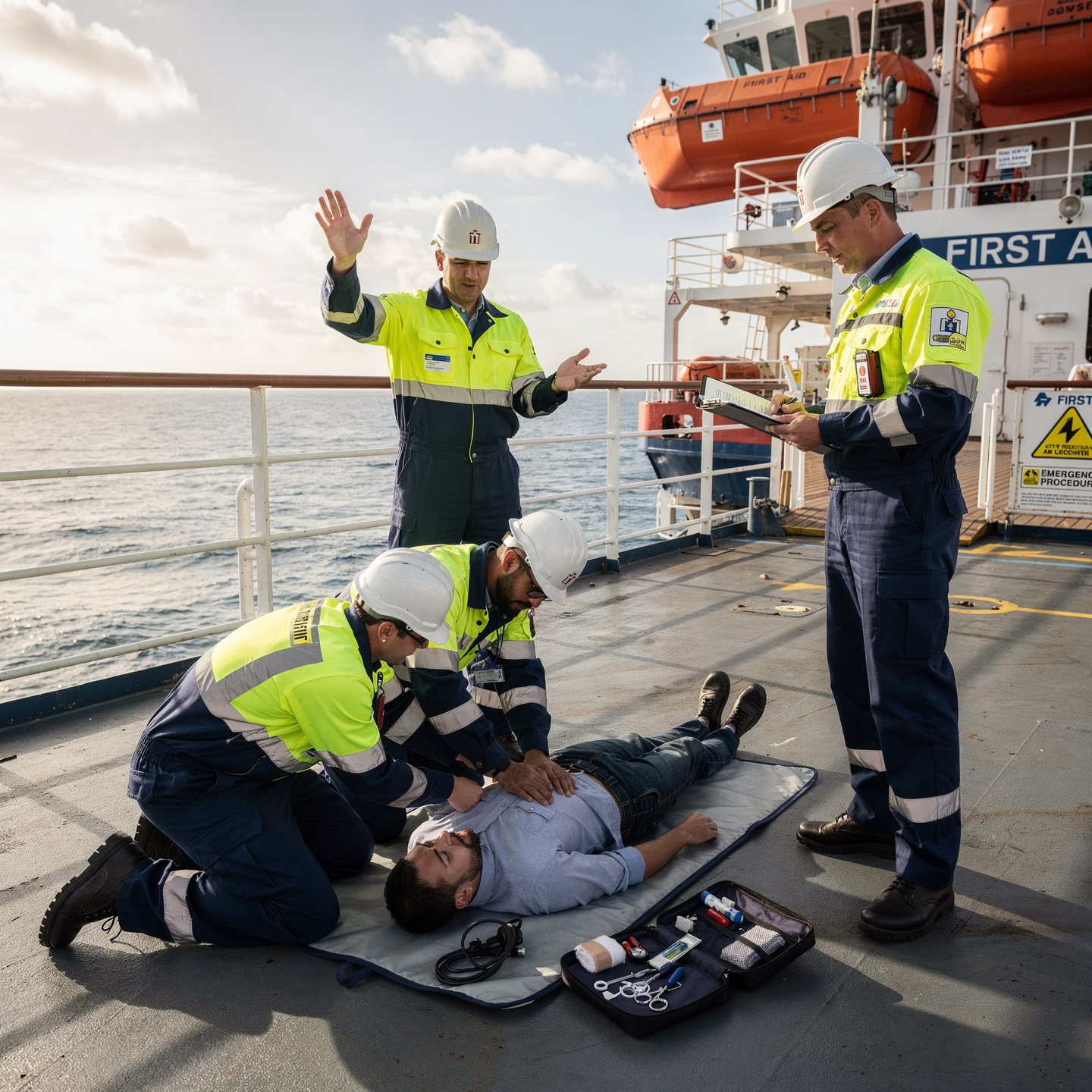
Diploma in First Aid on Board

Why this certificate program?

The Diploma in First Aid at Sea

This course provides you with the crucial skills to respond effectively to medical emergencies at sea. Learn to diagnose and treat common injuries, administer essential medications, and stabilize patients until professional care arrives. This intensive program combines theory and practice with realistic simulations to ensure your preparedness for critical situations.

The Diploma in First Aid at Sea

This course provides you with the crucial skills to respond effectively to medical emergencies at sea. Learn to diagnose and treat common injuries, administer essential medications, and stabilize patients until professional care arrives. This intensive program combines theory and practice with realistic simulations to ensure you are prepared for critical situations.

Differential Advantages

  • Practical Simulations: Realistic recreations of onboard emergencies to develop confidence and competence.
  • Recognized Certification: Meets international standards and enhances your maritime professional profile.
  • Expert Instructors: Learn from professionals with extensive experience in maritime medicine and rescue.
  • Up-to-Date Content: Protocols and techniques based on the latest recommendations from the World Health Organization.
  • Flexible Schedule: Online format with downloadable materials and discussion forums for learning at your own pace.
Primeros

Diploma in First Aid on Board

Availability: 1 in stock

Who is it aimed at?

  • Crew members of merchant and passenger ships seeking to acquire essential skills to respond effectively to medical emergencies at sea.
  • Cruise ship and ferry personnel interested in expanding their knowledge of pre-hospital care and handling critical situations on board.
  • Oil platform and offshore vessel workers needing specialized first aid training in isolated maritime environments.
  • Fishing and diving professionals who wish to be prepared to provide immediate assistance in case of accidents related to their activity.
  • Maritime safety supervisors and officers seeking to strengthen emergency protocols and ensure the health and safety of the crew.

Flexibility of Learning

Designed for professionals with demanding schedules: flexible online format, 24/7 access to content, and personalized tutoring to answer your questions.

Primeros

Objectives and competencies

Apply basic and advanced life support techniques in maritime emergency situations:

“To know and apply the AHA/ERC guidelines, prioritizing the safety of the patient and crew, and adapting the techniques to the limitations of the maritime environment.”

Assess and manage risks to prevent accidents and injuries in maritime environments:

“Implement security procedures (ISM) and evaluate their effectiveness through audits and drills, proactively correcting deficiencies.”

Effectively coordinate emergency communications and evacuation procedures on vessels:

“Establish clear protocols, conduct regular drills, and ensure the availability of communication and rescue equipment.”

Effectively administer medications and basic treatments according to medical indications and established protocols on board:

“To ensure the safe, documented and monitored administration of drugs, identifying possible adverse reactions and acting in accordance with contingency plans.”

Implement protocols for responding to specific medical emergencies that may arise on board, minimizing the impact on the health of the crew and passengers:

Establish effective communication with telemedicine services and maritime medical coordination centers for remote diagnosis and expert assistance.

Properly use the medical equipment and supplies available on board to stabilize and care for patients in emergency situations:

“Prioritize patient and personal safety by applying assessment, stabilization (ABCDE) and initial management protocols with available resources, effectively communicating the situation to the medical authority on the ground to optimize care.”

Curriculum - Modules

  1. Comprehensive Maritime Incident Management: protocols, roles, and chain of command for coordinated response
  2. Operational Planning and Execution: briefing, routes, weather windows, and go/no-go criteria
  3. Rapid Risk Assessment: criticality matrix, scene control, and decision-making under pressure
  4. Operational Communication: VHF/GMDSS, standardized reports, and inter-agency liaison
  5. Tactical Mobility and Safe Boarding: RHIB maneuvers, approach, mooring, and recovery
  6. Equipment and Technologies: PPE, signaling, satellite tracking, and field data logging
  7. Immediate Care of the Affected: primary assessment, hypothermia, trauma, and stabilization for evacuation
  8. Adverse Environmental Conditions: swell, Visibility, flows, and operational mitigation

    Simulation and training: critical scenarios, use of VR/AR, and exercises with performance metrics

    Documentation and continuous improvement: lessons learned, indicators (MTTA/MTTR), and SOP updates

  1. Introduction to Basic Life Support (BLS) in the maritime environment: particularities and challenges.
  2. Initial patient assessment: primary and secondary ABCDE adapted to the marine environment.
  3. CPR in adults, children, and infants: adaptations for confined spaces and ship movements.
  4. Management of the obstructed airway: maneuvers and devices available on board.
  5. Hemorrhage and shock: control of external bleeding, fluid resuscitation, and management of hypovolemic shock.
  6. Trauma: immobilization, transport, and initial treatment of fractures, sprains, and dislocations.
  7. Burns: classification, initial treatment, and special considerations in marine environments.
  8. Common medical emergencies in
  9. Onboard: chest pain, respiratory distress, seizures, and allergic reactions.
  10. Communications and Telemedicine: communication protocols with land-based medical centers and use of telemedicine equipment.
  11. Legal and Ethical Aspects: responsibility of onboard personnel and documentation of medical care.

  1. Basic Anatomy and Physiology Applied to Maritime Emergencies
  2. Patient Assessment: ABCDE in the Maritime Environment
  3. Basic Life Support (BLS) and Automated External Defibrillation (AED) at Sea
  4. Airway Management and Oxygen Therapy in Emergency Situations
  5. Hemorrhage and Shock: Control and Management in the Maritime Environment
  6. Trauma: Management of Fractures, Dislocations, and Injuries at Sea
  7. Burns: Assessment and Initial Treatment in Maritime Emergencies
  8. Drowning and Near-Drowning: Rescue and Resuscitation in the Water
  9. Wildlife Injuries Marine: Identification, Treatment, and Prevention
  10. Hypothermia and Hyperthermia: Management in Maritime Rescue and Evacuation Situations

  1. Introduction to Basic Life Support (BLS) and Advanced Life Support (ALS) in the maritime environment.
  2. Initial patient assessment: ABCDE, taking vital signs, and assessing level of consciousness.
  3. Airway management: opening techniques, suctioning, placement of devices (Guedel airway, laryngeal mask airway).
  4. Ventilation: bag-valve-mask ventilation (Ambu bag), oxygen administration.
  5. Circulation: chest compressions, defibrillation (AED).
  6. Recognition and management of acute myocardial infarction and stroke at sea.
  7. Trauma: assessment, immobilization, and initial management of fractures, dislocations, Sprains and spinal cord injuries.
  8. Hemorrhages: control of external and internal bleeding, use of tourniquets and compression bandages.
  9. Burns: assessment of extent and depth, initial management, and prevention of hypothermia.
  10. Maritime evacuation: preparation of the patient for evacuation, communication with emergency services, logistical considerations.

  1. Initial Patient Assessment: Offshore Triage, ABCDE, Vital Signs
  2. Basic Life Support (BLS) and Advanced Life Support (ALS): CPR, AED, Airway Management
  3. Offshore Trauma: Fractures, Wounds, Burns, Spinal Cord Injuries
  4. Cardiovascular Emergencies: Myocardial Infarction (MI), Arrhythmias, Acute Pulmonary Edema
  5. Respiratory Emergencies: Asthma, COPD, Pneumothorax, Drowning
  6. Neurological Emergencies: Stroke, Seizures, Traumatic Brain Injury
  7. Environmental Emergencies: Hypothermia, Hyperthermia, Wildlife Injuries
  8. marine

  9. Common Illnesses at Sea: Infections, gastroenteritis, allergic reactions
  10. Emergency Pharmacology: Essential medications, administration, and precautions
  11. Medical Evacuation Coordination: Communication, patient preparation, transfer procedures

  1. System Architecture and Components: Structural design, materials, and subsystems (mechanical, electrical, electronic, and fluid) with selection and assembly criteria for marine environments
  2. Fundamentals and Principles of Operation: Physical and engineering foundations (thermodynamics, fluid mechanics, electricity, control, and materials) that explain performance and operating limits
  3. Safety and Environmental (SHE): Risk analysis, PPE, LOTO, hazardous atmospheres, spill and waste management, and emergency response plans
  4. Applicable Regulations and Standards: IMO/ISO/IEC requirements and local regulations;
  5. Conformance criteria, certification, and best practices for operation and maintenance
  6. Inspection, testing, and diagnostics: Visual/dimensional inspection, functional testing, data analysis, and predictive techniques (vibration, thermography, fluid analysis) to identify root causes
  7. Preventive and predictive maintenance: Hourly/cycle/seasonal plans, lubrication, adjustments, calibrations, consumable replacement, post-service verification, and operational reliability
  8. Instrumentation, tools, and metrology: Measuring and testing equipment, diagnostic software, calibration and traceability; selection criteria, safe use, and storage
  9. Onboard integration and interfaces: Mechanical, electrical, fluid, and data compatibility; Sealing and watertightness, EMC/EMI, corrosion protection, and interoperability testing.

    Quality, acceptance testing, and commissioning: process and materials control, FAT/SAT, bench and sea trials, go/no-go criteria, and evidence documentation.

    Technical documentation and integrated practice: logs, checklists, reports, and a complete case study (safety → diagnosis → intervention → verification → report) applicable to any system.

  1. Introduction to Maritime Emergencies: Types, Causes, and Consequences
  2. Initial Patient Assessment: Vital Signs, ABCDE, Medical History
  3. Onboard First Aid Kit: Contents, Maintenance, Legislation
  4. Immobilization and Mobilization Equipment: Cervical Collars, Splints, Stretchers
  5. Hemorrhage and Shock: Hemorrhage Control, Shock Treatment
  6. Trauma: Management of Fractures, Dislocations, Sprains
  7. Burns: Classification, Treatment, Infection Prevention
  8. Drowning and Immersion Syndrome: Rescue, Resuscitation, Complications
  9. Preparation for Transfer: Communication, Stabilization, Documentation
  10. Coordination with emergency services: protocols, roles, and responsibilities

Career opportunities

  • Crew Member: Immediate application of first aid in onboard emergency situations.
  • Maritime Emergency Support Personnel: Collaboration with rescue and medical assistance teams at sea.
  • Offshore Platform/Maritime Facility Worker: Response to medical emergencies in isolated environments.
  • Onboard Safety Officer: Implementation of protocols and first aid training for the crew.
  • Nautical Activities Monitor/Instructor: Ensuring the safety of participants and providing first aid when necessary.
  • Cruise Ship/Ferry Personnel: Providing care to passengers and crew in medical emergencies.
  • Volunteer in Maritime Rescue Organizations: Participation in search and rescue operations, providing first aid First aid.
  • Fishing/aquaculture personnel: Attention to accidents and common illnesses in the maritime sector.

“`

Admission requirements

Academic/professional profile:

Degree/Bachelor's degree in Nautical Science/Maritime Transport, Naval/Marine Engineering, or a related field; or proven professional experience in bridge/operations.

Language proficiency:

Recommended functional maritime English (SMCP) for simulations and technical materials.

Documentation:

Updated resume, copy of degree or seaman's book, ID card/passport, letter of motivation.

Technical requirements (for online):

Equipment with camera/microphone, stable connection, ≥ 24” monitor recommended for ECDIS/Radar-ARPA.

Admission process and dates

1. Online
application

(form + documents).

2. Academic review and interview

(profile/objectives/schedule compatibility).

3. Admission decision

(+ scholarship proposal if applicable).

4. Reservation of place

(deposit) and registration.

5. Induction

(access to campus, calendars, simulator guides).

Scholarships and grants

  • Essential Fundamentals: Learn vital techniques to act quickly and effectively in medical emergencies at sea.
  • Response Protocols: Master standardized procedures for stabilizing patients and managing critical situations on board.
  • Medical Equipment: Familiarize yourself with the use and maintenance of the emergency first aid kit and available medical devices.
  • Realistic Simulations: Participate in practical exercises that simulate real-life scenarios to strengthen your skills and decision-making.
  • Professional Certification: Earn a recognized diploma that validates your ability to provide first aid in maritime environments.
Prepare to protect the health and safety of crew and passengers with specialized knowledge and practical skills.

Testimonials

Frequently asked questions

To train the crew to provide initial medical care for emergencies and illnesses on board vessels, stabilizing patients until professional medical care can be obtained.

Yes. The itinerary includes ECDIS/Radar-ARPA/BRM with harbor, ocean, fog, storm, and SAR scenarios.

Online with live sessions; hybrid option for simulator/practical placements through agreements.

Yes, this diploma specifically prepares you to provide first aid in maritime or aerial environments.

Recommended functional SMCP. We offer support materials for standard phraseology.

Yes, with a relevant degree or experience in maritime/port operations. The admissions interview will confirm suitability.

Optional (3–6 months) through Companies & Collaborations and the Alumni Network.

Simulator practice (rubrics), defeat plans, SOPs, checklists, micro-tests and applied TFM.

A degree from Navalis Magna University + operational portfolio (tracks, SOPs, reports and KPIs) useful for audits and employment.

  1. Introduction to Basic and Advanced Life Support in the Maritime Environment: Peculiarities and Challenges.
  2. Initial Patient Assessment: ABCDE in the Maritime Context.
  3. Basic CPR in Adults, Children, and Infants: Adaptations to the Maritime Environment (Limited Space, Movement).
  4. Automated External Defibrillation (AED): Equipment Maintenance and Onboard Protocols.
  5. Airway Management: Basic and Advanced Devices (Oropharyngeal Airways, Nasopharyngeal Airways, Laryngeal Mask Airway).
  6. Oxygen Therapy: Devices, Indications, and Contraindications in the Maritime Environment.
  7. Hemorrhage and Shock: Control of External Bleeding, Management of Hypovolemic and Distributive Shock.
  8. Trauma in the Maritime environment: Immobilization, transport, and special considerations.

    Common medical emergencies at sea: Angina pectoris, acute myocardial infarction, stroke, asthma attack, allergic reactions.

    Coordination with maritime rescue services: Communication, telemedicine, and evacuation preparation.

Request information

  1. Complete the Application Form.

  2. Attach your CV/degree certificate (if you have it to hand).

  3. Indicate your preferred cohort (January/May/September) and whether you would like the hybrid option with simulator sessions.

    An academic advisor will contact you within 24–48 hours to guide you through the admission process, scholarships, and compatibility with your professional schedule.

Please enable JavaScript in your browser to complete this form.
Click or drag a file to this area to upload.

Faculty

0
    0
    Tu carrito
    Tu carrito esta vacíoRegresar a la tienda
    Scroll to Top


