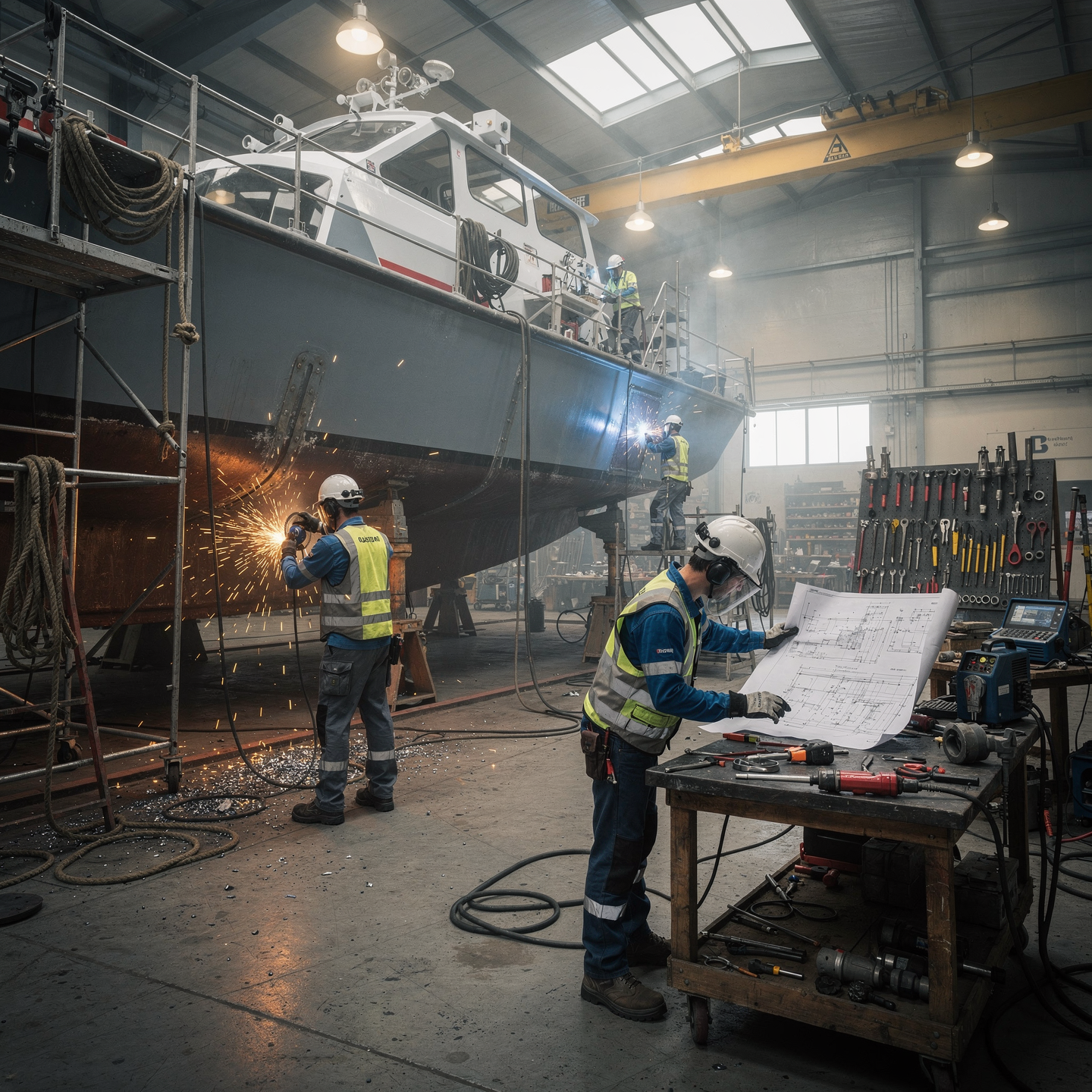
Diploma in Naval Workshop Tools and Techniques

Why this certificate program?

The Diploma in Naval Workshop Tools and Techniques

This course provides you with the practical skills and essential technical knowledge to excel in vessel repair and maintenance. Learn everything from the fundamentals of naval mechanics to the use of specialized tools and cutting-edge techniques in welding, boilermaking, and fitting. Master blueprint reading, troubleshooting, and the application of safety procedures in a demanding workshop environment.

Differentiating Advantages

  • Practical Approach: Extensive workshop sessions with real equipment and repair projects.
  • Expert Instructors: Professionals with extensive experience in shipyards and naval workshops.
  • Professional Certification: Recognition of your skills and knowledge in the naval industry.
  • Networking: Opportunity to connect with companies and professionals in the sector.
  • Flexibility: Option of in-person and/or virtual classes to suit your schedule.
Herramientas

Diploma in Naval Workshop Tools and Techniques

Availability: 1 in stock

Who is it aimed at?

  • Naval technicians and operators seeking to master new techniques in repair, welding, and preventive maintenance.
  • Workshop supervisors and maintenance managers who need to optimize processes, manage resources, and ensure operational efficiency.
  • Naval and mechanical engineers who wish to update their knowledge of the latest trends and technologies applied to the naval workshop.
  • Students of technical careers and professionals in the maritime sector interested in developing practical skills and specialized knowledge in the naval field.
  • Entrepreneurs and owners of naval workshops seeking to improve the quality of their services, expand their offerings, and differentiate themselves from the competition.

Flexibility and Applicability

Designed for active professionals: flexible schedules, relevant case studies, and tools for immediate application in the workplace.

Herramientas

Objectives and competencies

Diagnosing and repairing naval systems:

“Use technical manuals and diagnostic tools to identify and troubleshoot faults in electronic, hydraulic and mechanical equipment, ensuring the vessel’s operability.”

Apply specialized naval welding techniques:

“Master SMAW, GMAW and GTAW welding on naval steels, aluminum and special alloys, ensuring watertight and structurally sound joints according to AWS D1.1 and naval standards.”

Interpreting naval technical drawings:

“Identify symbols, scales, projections, and views to understand the ship’s general layout, systems, equipment, and construction details.”

Manage preventive and corrective maintenance of vessels:

“Plan and supervise maintenance tasks, ensuring regulatory compliance and resource optimization, to minimize vessel downtime.”

Use marine workshop tools and equipment safely and efficiently:

“Interpret technical manuals, perform basic preventive maintenance, and report anomalies following standardized procedures.”

Select and use appropriate materials for shipbuilding and repair:

“Considering physical, chemical, and mechanical properties and their impact on the durability and structural safety of the vessel.”

Curriculum - Modules

  1. Comprehensive Maritime Incident Management: protocols, roles, and chain of command for coordinated response
  2. Operational Planning and Execution: briefing, routes, weather windows, and go/no-go criteria
  3. Rapid Risk Assessment: criticality matrix, scene control, and decision-making under pressure
  4. Operational Communication: VHF/GMDSS, standardized reports, and inter-agency liaison
  5. Tactical Mobility and Safe Boarding: RHIB maneuvers, approach, mooring, and recovery
  6. Equipment and Technologies: PPE, signaling, satellite tracking, and field data logging
  7. Immediate Care of the Affected: primary assessment, hypothermia, trauma, and stabilization for evacuation
  8. Adverse Environmental Conditions: swell, Visibility, flows, and operational mitigation

    Simulation and training: critical scenarios, use of VR/AR, and exercises with performance metrics

    Documentation and continuous improvement: lessons learned, indicators (MTTA/MTTR), and SOP updates

  1. Introduction to welding in the shipbuilding industry: materials, processes, and applications.
  2. Welding metallurgy: naval steels, aluminum alloys, and other materials.
  3. Welding processes: SMAW, GMAW, GTAW, SAW, FCAW, fundamentals, and applications in shipbuilding repair.
  4. Joint preparation: design, cleaning, alignment, and fit for welding.
  5. Welding techniques: passes, positions, sequences, and distortion control.
  6. Welding defects: causes, identification, evaluation, and repair.
  7. Visual inspection of welds: acceptance and rejection criteria according to standards.
  8. Non-destructive testing (NDT): penetrant testing, particle testing Magnetic resonance imaging, ultrasound, radiography.
  9. Repair of naval components: welding of plates, pipes, structures, and equipment.
  10. Welding quality control: documentation, records, traceability, and certification.

  1. Introduction to Naval Systems Maintenance: Types and Strategies.
  2. Fundamentals of Predictive Maintenance: Techniques, Advantages, and Disadvantages.
  3. Vibration Analysis: Equipment, Data Collection, and Diagnosis.
  4. Infrared Thermography: Applications in Electrical and Mechanical Systems.
  5. Oil Analysis: Types of Tests, Interpretation of Results, and Corrective Actions.
  6. Visual Inspection and NDT: Non-Destructive Techniques in Naval Components.
  7. Planned Corrective Maintenance: Procedures and Documentation.
  8. Repair and Replacement of Components: Best Practices and Safety.
  9. Spare Parts Management and Inventory: Optimization and Cost Control.

    Regulations and Standards in Naval Maintenance: Compliance and Audits.

  1. Introduction to Naval Repair: Types of Vessels, Repair Areas, and Regulations.
  2. Safety in Naval Welding and Boilermaking: PPE, Specific Risks, and Prevention.
  3. Materials Used in Shipbuilding: Naval Steel, Alloys, Identification, and Properties.
  4. SMAW (Shielded Metal Arc Welding) Processes: Fundamentals, Equipment, Techniques, and Applications in Naval Construction.
  5. GMAW/FCAW (MIG/MAG) Welding Processes: Fundamentals, Equipment, Techniques, and Applications in Naval Construction.
  6. GTAW (TIG) Welding Processes: Fundamentals, Equipment, Techniques, and Applications in Naval Construction.
  7. Thermal Cutting: Oxyfuel Cutting, Plasma Cutting, and Applications in Naval Repair.
  8. Naval Boilermaking: Layout, Cutting, Forming, and Assembly of parts.
  9. Interpretation of drawings and technical specifications in naval repair.
  10. Quality control in naval welding and boilermaking: Visual inspection, basic NDT.

  1. Introduction to welding: Types, applications, and safety.
  2. Base materials: Carbon steels, alloy steels, stainless steels, and non-ferrous steels. Identification and properties.
  3. SMAW (Shielded Metal Arc Welding) Processes: Equipment, welding techniques, positions, and variables.
  4. GMAW/MIG (Gas Metal Arc Welding) Processes: Equipment, shielding gases, metal transfer, and applications.
  5. GTAW/TIG (Gas Tungsten Arc Welding) Processes: Equipment, tungsten electrodes, shielding gases, and applications on special materials.
  6. Basic Boilermaking: Welded joints, thickness calculations, and non-destructive testing (NDT).
  7. Naval Layout: Definitions, shipbuilding drawings, surface development, and staking out.
  8. Interpretation of Welding and Boilermaking Drawings: Symbols, tolerances, and specifications.
  9. Safety in welding and boilermaking: Personal protective equipment (PPE), electrical hazards, fumes and gases.
  10. Workshop practices: Welding exercises in different positions and with different materials.

  1. System Architecture and Components: Structural design, materials, and subsystems (mechanical, electrical, electronic, and fluid) with selection and assembly criteria for marine environments
  2. Fundamentals and Principles of Operation: Physical and engineering foundations (thermodynamics, fluid mechanics, electricity, control, and materials) that explain performance and operating limits
  3. Safety and Environmental (SHE): Risk analysis, PPE, LOTO, hazardous atmospheres, spill and waste management, and emergency response plans
  4. Applicable Regulations and Standards: IMO/ISO/IEC requirements and local regulations;
  5. Conformance criteria, certification, and best practices for operation and maintenance
  6. Inspection, testing, and diagnostics: Visual/dimensional inspection, functional testing, data analysis, and predictive techniques (vibration, thermography, fluid analysis) to identify root causes
  7. Preventive and predictive maintenance: Hourly/cycle/seasonal plans, lubrication, adjustments, calibrations, consumable replacement, post-service verification, and operational reliability
  8. Instrumentation, tools, and metrology: Measuring and testing equipment, diagnostic software, calibration and traceability; selection criteria, safe use, and storage
  9. Onboard integration and interfaces: Mechanical, electrical, fluid, and data compatibility; Sealing and watertightness, EMC/EMI, corrosion protection, and interoperability testing.

    Quality, acceptance testing, and commissioning: process and materials control, FAT/SAT, bench and sea trials, go/no-go criteria, and evidence documentation.

    Technical documentation and integrated practice: logs, checklists, reports, and a complete case study (safety → diagnosis → intervention → verification → report) applicable to any system.

  1. Introduction to Naval Maintenance: Types, Objectives, and Benefits
  2. Fundamentals of Naval Electricity and Electronics: Circuits, Components, and Measurements
  3. Main Propulsion Systems: Diesel Engines, Gas Turbines, and Auxiliary Systems
  4. Predictive Engine Maintenance: Vibration Analysis, Thermography, and Lubrication
  5. Electrical Generation and Distribution Systems: Alternators, Transformers, and Electrical Panels
  6. Corrective Generator Maintenance: Troubleshooting and Repair
  7. Refrigeration and Air Conditioning Systems: Cycles, Components, and Maintenance
  8. Pumps and Piping Systems: Types, Materials, Maintenance, and Repair
  9. Automation and Control: Sensors, Actuators, and PLCs

    Regulations and Safety in Naval Systems Maintenance

Career opportunities

  • Marine Maintenance Technician: Repair and maintenance of mechanical, electrical, and hydraulic systems on vessels.
  • Marine Boilermaker/Welder: Fabrication, repair, and welding of metal structures on ships and other naval constructions.
  • Marine Fitter: Assembly and adjustment of mechanical components on engines, pumps, and other onboard equipment.
  • Marine Pipefitter: Installation and maintenance of piping systems on vessels, including plumbing, HVAC, and fuel systems.
  • Marine Electrician: Installation, repair, and maintenance of electrical and electronic systems on ships.
  • Marine Painter: Surface preparation and application of paints and protective coatings on vessels.
  • Shipyard Quality Inspector: Verification of compliance with quality standards in Naval construction and repair.
  • Naval Workshop Supervisor: Coordination and supervision of workshop activities, personnel and resource management.

“`

Admission requirements

Academic/professional profile:

Degree/Bachelor's degree in Nautical Science/Maritime Transport, Naval/Marine Engineering, or a related field; or proven professional experience in bridge/operations.

Language proficiency:

Recommended functional maritime English (SMCP) for simulations and technical materials.

Documentation:

Updated resume, copy of degree or seaman's book, ID card/passport, letter of motivation.

Technical requirements (for online):

Equipment with camera/microphone, stable connection, ≥ 24” monitor recommended for ECDIS/Radar-ARPA.

Admission process and dates

1. Online
application

(form + documents).

2. Academic review and interview

(profile/objectives/schedule compatibility).

3. Admission decision

(+ scholarship proposal if applicable).

4. Reservation of place

(deposit) and registration.

5. Induction

(access to campus, calendars, simulator guides).

Scholarships and grants

  • Comprehensive Mastery: Learn to use the essential tools and the most advanced techniques in the shipyard.
  • Maintenance and Repair: Acquire the necessary skills for the diagnosis, repair, and maintenance of vessels.
  • Safety and Quality: Implement safety protocols and ensure quality in every process in the shipyard.
  • Practical Projects: Apply your knowledge in simulations and real-world cases, developing effective solutions.
  • Professional Certification: Obtain a recognized diploma that will boost your career in the industry Naval.
Prepare to become a naval workshop expert, leading projects and ensuring the optimal functioning of vessels.

Testimonials

Frequently asked questions

Yes. The itinerary includes ECDIS/Radar-ARPA/BRM with harbor, ocean, fog, storm, and SAR scenarios.

Online with live sessions; hybrid option for simulator/practical placements through agreements.

It focuses on the construction and repair of ships, using tools and techniques specific to naval workshops.

Recommended functional SMCP. We offer support materials for standard phraseology.

Yes, with a relevant degree or experience in maritime/port operations. The admissions interview will confirm suitability.

Optional (3–6 months) through Companies & Collaborations and the Alumni Network.

Simulator practice (rubrics), defeat plans, SOPs, checklists, micro-tests and applied TFM.

A degree from Navalis Magna University + operational portfolio (tracks, SOPs, reports and KPIs) useful for audits and employment.

  1. Introduction to Naval Welding: Types, Applications, and Standards
  2. Fundamentals of Welding Metallurgy: Steels, Alloys, and Heat Treatments
  3. SMAW/GMAW/GTAW Welding Processes: Techniques, Variables, and Equipment
  4. Joint Preparation and Weld Geometry: Beveling, Adjustment, and Alignment
  5. Welding in Different Positions: Horizontal, Vertical, and Overhead
  6. Visual Inspection of Welds and Non-Destructive Testing (NDT): VT, PT, MT, UT, RT
  7. Introduction to the Calibration of Naval Measuring Equipment: Standards, Traceability, and Regulations
  8. Dimensional Metrology: Measuring Instruments, Tolerances, and Fits
  9. Application of Metrology in Shipbuilding and Repair: Quality Control and Conformity
  10. Safety in Welding, Calibration, and Metrology: Risks, Prevention, and Personal Protective Equipment (PPE)

Request information

  1. Complete the Application Form.

  2. Attach your CV/degree certificate (if you have it to hand).

  3. Indicate your preferred cohort (January/May/September) and whether you would like the hybrid option with simulator sessions.

    An academic advisor will contact you within 24–48 hours to guide you through the admission process, scholarships, and compatibility with your professional schedule.

Please enable JavaScript in your browser to complete this form.
Click or drag a file to this area to upload.

Faculty

0
    0
    Tu carrito
    Tu carrito esta vacíoRegresar a la tienda
    Scroll to Top


