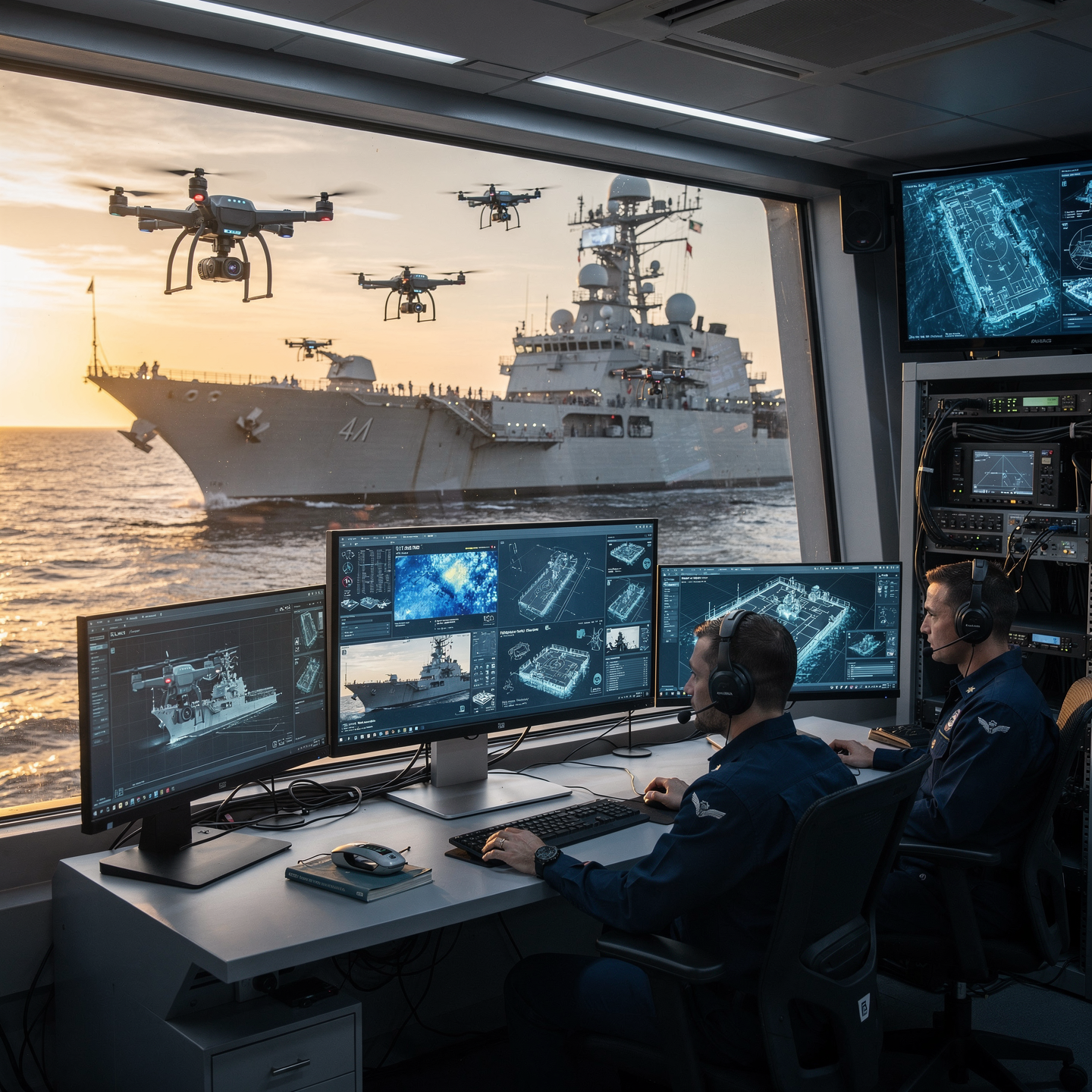
Master’s Degree in Drones and Aerial Systems for Naval Inspection

Why this master’s programme?

The Master’s Degree in Marine and Aerial Drones for Naval Inspection

Prepares you to lead the technological revolution in the maritime industry. Master advanced visual inspection techniques using state-of-the-art drones, both aerial and underwater. Learn to plan missions, operate equipment, analyze data, and generate accurate reports for the structural condition assessment of ships, offshore platforms, and other naval infrastructure.

Differential Advantages

  • Practical Approach: Intensive training with flight simulators and real drone operation.
  • Specialized Software: Use of programs for image processing, 3D modeling, and data analysis.
  • Professional Certification: Obtain a recognized qualification in the naval drone inspection sector.
  • Expert Teaching Team: Learn from professionals with extensive experience in drone operation and naval inspection.
  • Real-World Applications: Develop practical projects and case studies based on real inspection scenarios.
Drones

Master’s Degree in Drones and Aerial Systems for Naval Inspection

Availability: 1 in stock

Who is it aimed at?

  • Naval, marine, and aeronautical engineers seeking to specialize in the integration of drones into naval inspections and vessel maintenance.
  • Maritime inspectors and classification societies wishing to incorporate drone technologies to optimize efficiency and safety in their inspection processes.
  • Drone operators and professional pilots seeking to expand their skills in the maritime environment, including structural inspection and onboard safety.
  • Maritime and energy service companies interested in implementing drone solutions for the inspection of offshore infrastructure, oil platforms, and offshore wind farms.
  • Students and recent graduates in STEM (science, technology, engineering, and mathematics) fields seeking training Advanced in marine and aerial robotics applied to the naval industry.

    Learning flexibility

    Adapted for working professionals: online format with live classes, access to recordings, and personalized tutoring.

Drones

Objectives and skills

Efficiently manage the collection and analysis of marine and aerial data.

“Implement standardized data quality control protocols, using specialized software tools for data validation, cleaning, and secure storage.”

Mastering drone inspection techniques in naval environments, optimizing safety and efficiency.

Plan inspection missions, considering environmental and operational factors, and complying with maritime and safety regulations.

Implement predictive maintenance strategies on vessels using data analysis obtained with drones.

Identify failure patterns in critical components (motors, electrical systems, propellers) using machine learning algorithms and optimize drone inspection routes.

Develop and implement innovative solutions for the monitoring and evaluation of naval infrastructures.

Integrate advanced sensor systems (IoT, drones, satellites) and predictive data analytics to detect anomalies and optimize preventive maintenance.

Design and operate drone systems adapted to the specific conditions and challenges of the maritime environment.

Adapt flight and preventive maintenance strategies considering salt corrosion, swells, and autonomy limitations in offshore operations.

Comply with current regulations and legislation regarding operations with marine and aerial drones.

“Document operations according to AESA/DGMM requirements and internal company protocols.”

Study plan – Modules

  1. Fundamentals of drone operation in naval environments: classification, types, and specific applications in maritime inspection
  2. Propulsion and control systems for marine and aerial drones: turbines, propellers, stabilization systems, and autonomous flight
  3. Principles of hydrodynamics and aerodynamics applied to drones: water resistance, lift, maneuverability, and energy efficiency
  4. Deployment and recovery protocols on naval platforms: integration with deck operations, safety, and crew coordination
  5. Advanced operational planning: analysis of inspection areas, risk zoning, and trajectory optimization
  6. Telemetry and real-time communication: RF systems, satellite links, and secure transmission protocols in hostile maritime environments
  7. Predictive and corrective maintenance: life cycle analysis, fault detection, sensor calibration, and component renewal critical
  8. Energy management and recharging in naval environments: high-capacity batteries, wireless charging, and thermal management to maximize uptime
  9. International regulations and standards for drone operations in maritime environments: compliance with SOLAS, MARPOL, and IMO guidelines
  10. Simulator training and field training: developing skills for safe and effective operation, contingency scenarios, and emergency procedures
  11. Integration of drones with non-destructive testing (NDT) systems: LIDAR techniques, multispectral cameras, ultrasound, and thermography for structural assessment
  12. Data logging and analysis: storage systems, image interpretation, and generation of technical reports for predictive naval maintenance
  13. Operational risk assessment and mitigation plans: identification of environmental threats, technical failures, and corrective actions
  14. Implementation of cybersecurity protocols for drones: protection against Hacking, interference, and unauthorized access in inspection networks

    Case studies and real-world projects of naval inspection with drones: detailed analysis of results, lessons learned, and advanced best practices

  1. Fundamentals of sensors for marine and aerial drones: types, physical principles, and technical characteristics
  2. Advanced optical sensors: multispectral, hyperspectral, and thermal imaging cameras and their integration for naval inspection
  3. LIDAR and RADAR: operating principles, configuration for underwater mapping and aerial surveillance in naval environments
  4. Integration of inertial (IMU) and high-precision GNSS sensors for stable and redundant navigation in tactical missions
  5. Autonomous navigation systems: SLAM (Simultaneous Localization and Mapping) algorithms and sensor fusion applied to drones in adverse maritime conditions
  6. Real-time sensor communication and synchronization: protocols, latency, and mitigation of electromagnetic interference in naval environments
  7. Use of navigation systems based on
  8. Differentiated satellite signals (DGPS, RTK) to guarantee centimeter-level accuracy in inspection operations
  9. Calibration and validation methodologies for sensor data to ensure the quality and reliability of the information obtained
  10. Automation and control: design of redundant and fail-safe navigation systems for safe operations in critical naval scenarios
  11. Analysis of practical cases and application of advanced technologies in hull inspection, detection of structural anomalies, and marine environmental monitoring using drones
  1. Comprehensive systems architecture for the operation of marine and aerial drones: control, communication, and link protocol modules
  2. Drone platforms: structural design, hybrid propulsion, and adaptability to adverse marine conditions
  3. Advanced sensing principles: LIDAR sensors, hyperspectral cameras, multibeam sonar, and IMU inertial measurement units (IMUs)
  4. Sensor integration for autonomous navigation: fusion of GNSS, INS, Doppler radar, and ultrasonic systems
  5. Predictive and preventive maintenance protocols based on vibration, temperature, and wear analysis of key components
  6. Real-time diagnostics using advanced telemetry and machine learning algorithms for early fault detection
  7. Operation in maritime environments: mission planning based on hydrodynamic, meteorological, and traffic flow conditions maritime
  8. Risk Management and safety protocols for remote operation: exclusion zones, interference mitigation, and emergency response
  9. Specialized software for monitoring and control: HMI interfaces, maritime flight simulators, and post-mission analysis
  10. Technological trends in drone automation and autonomy for naval inspection: applied artificial intelligence and neural networks
  11. International standards and certifications for drone operation and maintenance in professional maritime and aerial environments
  12. Sustainability and energy efficiency: advanced batteries, thermal management, and composite materials in marine and aerial drones
  1. Fundamentals and technical characteristics of UAVs and USVs used in naval inspection: types, platforms, sensors, and communication systems
  2. Advanced planning of integrated missions: definition of objectives, analysis of areas of interest, flight coordination, and simultaneous maritime routes
  3. Hydrographic mapping with state-of-the-art technology: use of multibeam echosounders, echosounders, and LiDAR for generating digital models of the seabed and high-resolution bathymetry
  4. Processing and analysis of obtained data: photogrammetry, artificial intelligence, and machine learning technologies for anomaly detection and 3D mapping of naval structures
  5. Structural integrity assessment through remote inspection: non-destructive techniques, corrosion monitoring, crack detection, and analysis of complex materials
  6. Implementation of operational safety protocols: risk management, system interoperability, contingencies in case of failure, and applicable international regulations (SOLAS, IMO)
  7. Real-time interaction and coordination between UAVs/USVs and human teams: secure communication, advanced remote control, and autonomous backup systems
  8. Integrated software and platforms for mission control and monitoring: dynamic planning, situational analysis, and automated report generation
  9. Simulation of complex scenarios and training in virtual environments to optimize decision-making in multi-level operations
  10. Emerging innovations and future trends in marine and aerial drone technology applied to naval inspection: hyperspectral sensors, 5G connectivity, and drone swarm networks
  1. Introduction to Artificial Intelligence (AI) Applied to Autonomous Marine and Aerial Systems: Concepts, History, and State of the Art for Naval Operations
  2. Intelligent Sensor Architectures: Design, Integration, and Real-Time Processing of Multi-Source Data for Marine and Aerial Drones
  3. Machine and Deep Learning Algorithms for Recognition, Classification, and Prediction in Complex Naval Environments
  4. Advanced Sensor Fusion: Combining Data from LiDAR, Radar, Sonar, Multispectral Cameras, and Inertial Sensors to Enhance Autonomous Perception
  5. Application of Computer Vision and Image Analysis Techniques for Structural Inspection and Anomaly Detection in Naval Hulls and Superstructures
  6. Neural Network Architecture and Protocols Implemented in Embedded Systems for Real-Time Decision Making
  7. Autonomous Navigation Systems: Using AI for route planning, obstacle avoidance, and stability maintenance in adverse maritime environments
  8. Energy optimization through artificial intelligence to extend the operational duration of marine and aerial drones in naval inspection missions
  9. Integrating AI with secure and encrypted communication systems for sensitive data transmission and coordination in drone fleets
  10. Simulation and virtual training: Digital models to predict drone behavior and control in real and critical naval scenarios
  11. Practical applications and case studies: Hull inspection, leak detection, environmental monitoring, and threat recognition using advanced AI
  12. Ethical, legal, and cybersecurity considerations in the development and use of AI in autonomous systems for naval operations
  13. Future perspectives and trends in technological innovation: Explainable AI, human-machine collaboration, and adaptability in marine and autonomous systems
  14. Aerial
  15. Evaluation and certification of intelligent systems: international standards and operational requirements for their safe and effective naval implementation
  16. Integrated project: development and presentation of a conceptual prototype of an autonomous AI system for targeted inspection in a simulated naval environment
  1. Marine and Aerial Drone Architecture and Components: Structural design, composite materials, propulsion systems, and aerodynamics applied to naval operations
  2. Navigation and Positioning Systems: Integration of GNSS, INS, inertial sensors, and advanced georeferencing techniques in hostile maritime and aerial environments
  3. Communication and Remote Control: Link protocols, real-time data transmission technologies, communications security, and interference mitigation in naval operations
  4. Command and Control (C2) Platforms: Software architecture, interoperability, UAV/UUV fleet management, and real-time management systems for naval inspection
  5. Advanced Sensors for Naval Inspection: Multispectral cameras, LiDAR, synthetic aperture radar (SAR), acoustic sensors, and remote sensing techniques on drones Marine and Aerial Systems
  6. Data Processing and Analysis: Artificial intelligence algorithms, machine learning for pattern recognition, 3D mapping, and predictive analytics in naval maintenance
  7. Preventive and Predictive Maintenance: Technical protocols, fault diagnosis in electronic and mechanical systems, lifecycle management, and ensuring operational availability
  8. Integration of Drones into Naval Operations: Coordination with manned naval platforms, deployment protocols, risk mitigation, and applicable international regulations
  9. Security and Resilience Systems: Redundancy, anti-interference mechanisms, and cybersecurity applied to marine and aerial drones to prevent sabotage and ensure mission integrity
  10. International Regulations and Standards: Compliance with IMCA, ICAO, and IMO regulations and specific recommendations for the operation of unmanned vehicles in maritime and air zones aerials
  1. Fundamentals of Autonomy in Unmanned Systems: Levels of Autonomy, Distributed and Centralized Architectures, and Real-Time Decision-Making Algorithms
  2. Advanced Sensing: Integration of Multispectral Optical Sensors, Underwater LiDAR, Side-Scan Sonar, and Hyperspectral Sensors for Detection and Analysis in Complex Marine and Aerial Environments
  3. Sensor Data Processing and Fusion: Filtering Techniques, Bayesian Estimation, Machine Learning for Correlating Heterogeneous Data, and Optimization of Information Quality
  4. Inertial Navigation and GNSS: High-Accuracy IMU Systems, Drift Error Mitigation, Use of Differential GNSS and RTK for Centimeter-Level Positioning in Maritime and Coastal Environments
  5. Advanced Navigation Algorithms: Visual Navigation Based on SLAM (Simultaneous Localization and Mapping), Force Field-Based Navigation, and Predictive Navigation for Maneuvers
  6. Automatic Systems

  7. Communication and Data Link: Specific protocols for real-time data transmission between drones, base stations, and vessels, with an emphasis on minimal latency and link redundancy
  8. Autonomous Control and Piloting: Design and implementation of PID, adaptive, and predictive controllers for complex maneuvers in environments with currents, variable winds, and dynamic obstacles
  9. Collision Avoidance Strategies: Detection and avoidance systems based on LIDAR, radar, and computer vision sensors, and their integration with COLREG systems for maritime regulatory compliance
  10. Energy Optimization and Operational Autonomy: Consumption management, wireless charging, and mission protocols to maximize inspection time and range
  11. Simulation and Validation of Autonomous Systems: Use of virtual environments and hardware-in-the-loop test benches to ensure robustness, safety, and reliability under real-world conditions and adverse
  1. Fundamentals of Autonomous Systems Integration: Hardware and Software Architecture in Marine and Aerial Drones
  2. Maritime and Aerial Communication Protocols: Linking Autonomous Systems and Naval Control Centers
  3. Implementation of Advanced Sensors: LiDAR, Multispectral Cameras, Ultrasonic and Acoustic Sensors for Precise Inspection
  4. Autonomous Navigation Algorithms: Route Planning, Obstacle Avoidance, and Adaptability in Dynamic Marine Environments
  5. Data Fusion and Recognition Systems: Real-Time Processing for Object and Threat Detection and Classification
  6. Multi-Drone Management and Coordination: Tactics for Simultaneous Operations and Synchronization in Complex Naval Environments
  7. Communication Security and Cybersecurity Protocols Applied to Autonomous Systems in Naval Inspection
  8. International Regulations and Standards Applicable to the Operation of Marine and Aerial Drones in Jurisdictional Airspaces
  9. and international waters

    Integration with naval command and control systems: interoperability, data transmission, and advanced visualization

    Operational risk assessment and contingency plans: emergency management and technological failures during missions

    Advanced predictive maintenance practices and remote software updates for autonomous platforms

    Real-world case studies and simulations of inspection and security operations in maritime and coastal scenarios

  1. Advanced Autonomous Systems Architecture: Modular Integration of Marine and Aerial Sensors for Naval Inspection
  2. Multispectral and LiDAR Sensing: Fundamentals, Calibration, and Real-Time Processing for Marine and Aerial Drones
  3. High-Accuracy Inertial Navigation Systems (INS) and GNSS: Applications in Complex Marine Environments and Anti-Jamming Tactics
  4. Sensor Data Fusion: Kalman Filtering Algorithms, SLAM, and 3D Modeling for Detailed Hydrographic Mapping
  5. Secure and Redundant Communication Protocols: Data Link, Telemetry, and Remote Control in Harsh Environments
  6. Intelligent Power Management and Operational Autonomy: Battery Optimization and Hybrid Systems for Extended Missions
  7. Embedded Software Development for Flight Control and Maritime Navigation: Robust Architectures and Fault Tolerance
  8. Route Implementation and Validation Autonomous systems: dynamic planning, obstacle avoidance, and real-time contingency response.

    Visual and thermographic inspection systems: integration, automated analysis, and early detection of structural anomalies.

    Operational safety and international regulations for the use of drones in naval navigation: certification, compliance, and risk mitigation.

  1. Final Project Design and Planning: Definition of objectives, scope, and technical specifications for the integration of marine and aerial drones in naval inspection
  2. Development of autonomous algorithms: Navigation, collision avoidance, and coordinated mission management between marine and aerial drones
  3. Implementation of multisensor systems: Hyperspectral cameras, LiDAR, multibeam sonar, inertial sensors, and GNSS for hydrographic mapping and structural assessment
  4. Advanced data processing: Machine learning techniques and artificial intelligence algorithms for image analysis and fault detection in naval infrastructure
  5. Integration of secure, real-time communication protocols between drones, control stations, and naval management systems
  6. Simulation and validation in real and virtual environments: Digital modeling, field testing, and calibration of inspection systems Autonomous operation
  7. Applicable regulations and standards: compliance with international and national regulations for drone operation in military and civilian maritime and aerial environments

    Operational efficiency assessment: analysis of autonomy, energy consumption, inspection coverage, and reliability of the integrated system

    Development of detailed technical reports: documentation of the process, results obtained, and recommendations for industrial implementation in naval inspections

    Presentation and defense of the final project: professional communication of results before academic committees and experts in naval technology and drones

Career prospects

“`html

  • Naval Inspector with Marine and Aerial Drones: Conducting comprehensive inspections of hulls, structures, and equipment, both on the surface and underwater, using drones equipped with advanced sensors.
  • Drone Operator Specialized in Marine Environments: Piloting and maintaining drones designed to operate in adverse maritime conditions, collecting accurate visual and environmental data.
  • Naval Inspection Data Analyst: Interpreting and analyzing data collected by drones to identify defects, corrosion, and other structural problems on ships and offshore platforms.
  • Drone Technology Consultant for the Naval Industry: Advising shipping companies and shipyards on the implementation of drone solutions to optimize inspection and maintenance processes.
  • Marine Drone Applications Researcher: Developing new techniques and technologies for The use of drones in the inspection, surveillance, and monitoring of the marine environment.

    Drone Inspection Project Manager: Planning, coordination, and execution of naval inspection projects using drones, ensuring compliance with quality and safety standards.

    Marine Drone Maintenance Technician: Repair and maintenance of drones specialized for marine environments, guaranteeing their proper functioning and extending their lifespan.

    Marine Drone Operation and Maintenance Trainer: Training personnel in the piloting, maintenance, and data analysis of drones used in naval inspection.

    “`

Entry requirements

Academic/professional profile:

Bachelor’s degree in Nautical Science/Maritime Transport, Naval/Marine Engineering or a related qualification; or proven professional experience on the bridge/in operations.

Language proficiency:

Functional Maritime English (SMCP) recommended for simulations and technical materials.

Documentation:

Updated CV, copy of qualification or seaman’s book, national ID/passport, motivation letter.

Technical requirements (for online):

Device with camera/microphone, stable internet connection, monitor ≥ 24” recommended for ECDIS/Radar-ARPA.

Admissions process and dates

Online
application

(form + documents).

Academic review and interview

Admissions decision

Admissions decision

(+ scholarship offer if applicable).

Place reservation

(deposit) and enrolment.

Induction

(access to the virtual campus, calendars, simulator guides).

Scholarships and financial support

  • Cutting-Edge Technology: Master the use of marine and aerial drones for efficient and accurate naval inspections.
  • Practical Applications: Learn to inspect hulls, tanks, decks, and port infrastructure with the latest technology.
  • Specialized Software: Manage data analysis and reporting software, optimizing your processes.
  • Regulations and Safety: Understand the current regulations and safety protocols for operating drones responsibly.
  • Career Opportunities: Boost your career in the naval sector by offering innovative inspection services. defendants.
Become an expert in the naval inspection of the future.

Testimonials

Frequently asked questions

Yes. The itinerary includes ECDIS/Radar-ARPA/BRM with harbor, ocean, fog, storm, and SAR scenarios.

Online with live sessions; hybrid option for simulator/practical placements through agreements.

It focuses on drones used in maritime and aerial environments, specifically for naval inspection.

Recommended functional SMCP. We offer support materials for standard phraseology.

Yes, with a relevant degree or experience in maritime/port operations. The admissions interview will confirm suitability.

Optional (3–6 months) through Companies & Collaborations and the Alumni Network.

Simulator practice (rubrics), defeat plans, SOPs, checklists, micro-tests and applied TFM.

A degree from Navalis Magna University + operational portfolio (tracks, SOPs, reports and KPIs) useful for audits and employment.

  1. Final Project Design and Planning: Definition of objectives, scope, and technical specifications for the integration of marine and aerial drones in naval inspection
  2. Development of autonomous algorithms: Navigation, collision avoidance, and coordinated mission management between marine and aerial drones
  3. Implementation of multisensor systems: Hyperspectral cameras, LiDAR, multibeam sonar, inertial sensors, and GNSS for hydrographic mapping and structural assessment
  4. Advanced data processing: Machine learning techniques and artificial intelligence algorithms for image analysis and fault detection in naval infrastructure
  5. Integration of secure, real-time communication protocols between drones, control stations, and naval management systems
  6. Simulation and validation in real and virtual environments: Digital modeling, field testing, and calibration of inspection systems Autonomous operation
  7. Applicable regulations and standards: compliance with international and national regulations for drone operation in military and civilian maritime and aerial environments

    Operational efficiency assessment: analysis of autonomy, energy consumption, inspection coverage, and reliability of the integrated system

    Development of detailed technical reports: documentation of the process, results obtained, and recommendations for industrial implementation in naval inspections

    Presentation and defense of the final project: professional communication of results before academic committees and experts in naval technology and drones

Request information

  1. Complete the Application Form.

  2. Attach your CV/degree certificate (if you have it to hand).

  3. Indicate your preferred cohort (January/May/September) and whether you would like the hybrid option with simulator sessions.

    An academic advisor will contact you within 24–48 hours to guide you through the admission process, scholarships, and compatibility with your professional schedule.

Please enable JavaScript in your browser to complete this form.
Click or drag a file to this area to upload.

Faculty

0
    0
    Tu carrito
    Tu carrito esta vacíoRegresar a la tienda
    Scroll to Top


