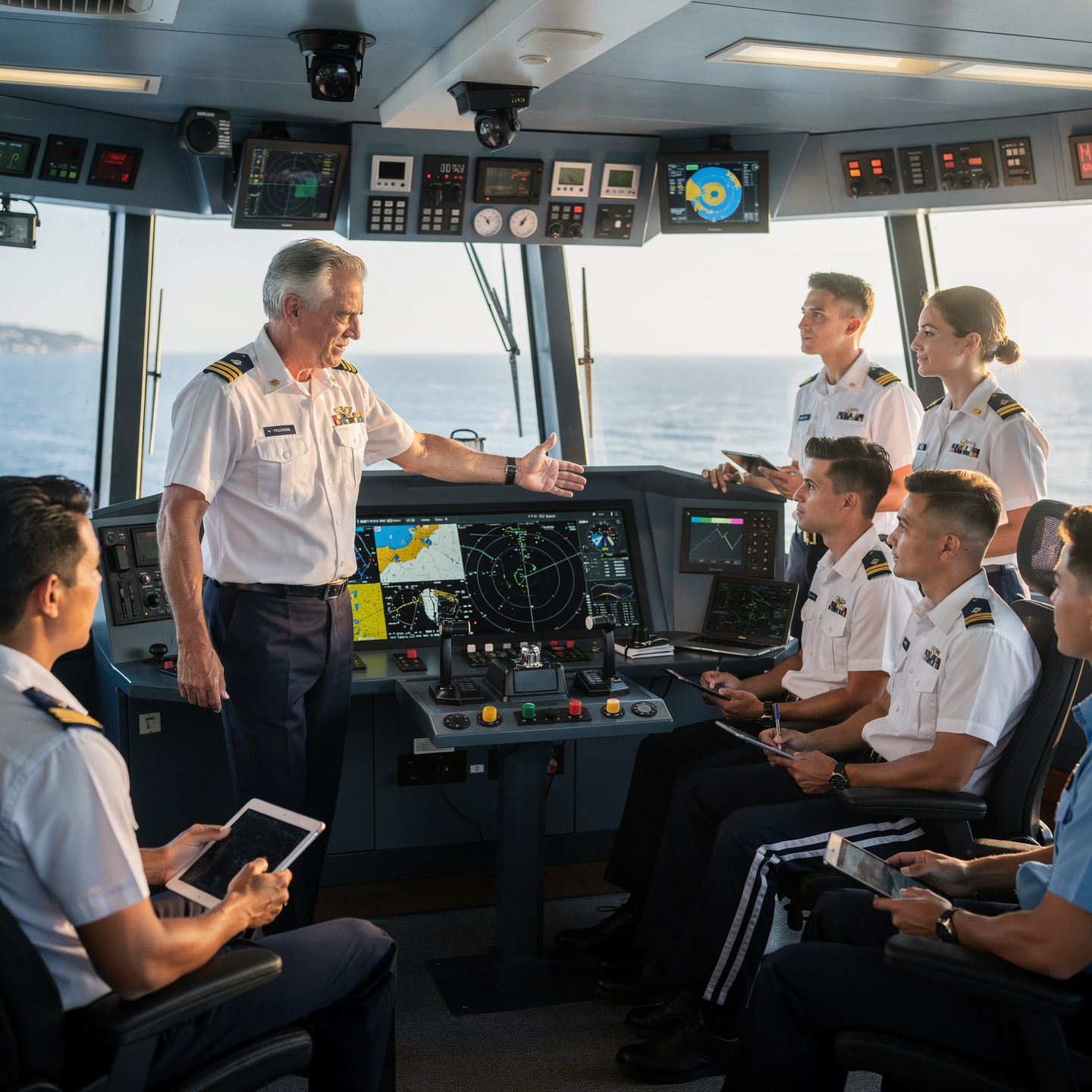
Master’s Degree in Didactics and Training of Captains
Why this master’s programme?
The Master in Didactics and Captain Training
This is an innovative program designed to train the future leaders of maritime education. You will learn the most effective pedagogical methodologies, the learning assessment techniques, and the communication strategies necessary to train the next generation of captains. You will master the creation of updated curricula, the use of state-of-the-art simulators, and the fostering of a safe and inclusive learning environment. This program will prepare you to inspire and guide your students to success in the maritime industry.
Differential Advantages
- Active Methodologies: Incorporation of role-playing, case studies, and project-based learning.
- Educational Technologies: Use of LMS platforms, simulators, and virtual/augmented reality tools.
- Professional Development: Workshops on leadership, team management, and effective communication.
- Industry Experts: Masterclasses with professionals in navigation and maritime education.
- Professional Internships: Opportunities to apply your knowledge in leading maritime institutions.
- Modality: Online
- Level: Masters
- Hours: 1600 H
- Start date: 26-04-2026
Availability: 1 in stock
Who is it aimed at?
- Nautical professionals who aspire to effectively transmit their experience and knowledge.
- Captains and deck officers seeking to develop pedagogical skills for onboard training.
- Maritime instructors who wish to update their methodologies and obtain a higher-level certification.
- Training managers in shipping companies who want to optimize their training programs.
- Graduates in Nautical Studies and Maritime Transport interested in a career as instructors in maritime institutions.
Flexibility for professionals
Curriculum adapted to the demands of the maritime sector: online format, 24/7 access to resources, and personalized tutoring.
Objectives and skills

Mastering innovative pedagogical strategies for the effective instruction of future captains:
Design and implement high-fidelity simulations that replicate complex maritime scenarios and emergencies, evaluating decision-making, leadership, and effective communication under pressure.

Develop leadership and team management skills in complex maritime and educational contexts:
Promote effective communication, decision-making under pressure, and conflict resolution, considering the cultural and hierarchical diversity inherent in these environments.

Design and evaluate maritime training programs that respond to the changing needs of the industry:
Integrate advanced simulation technologies to optimize skills acquisition and performance assessment in critical scenarios.

Implement simulations and practical scenarios that strengthen critical decision-making in real navigation situations:
To efficiently manage available resources (human and technical) in emergencies, prioritizing navigational safety and environmental protection.

Integrating emerging technologies into the teaching of navigation and ship management:
Implement Augmented Reality systems for the simulation of complex maneuvers and training in adverse weather conditions, optimizing decision-making based on data analyzed by AI.

Promote research and development of teaching methodologies that improve efficiency and safety in navigation:
Implement navigation simulations with complex and variable scenarios (weather, traffic, technical failures) to validate new teaching strategies and evaluate decision-making under pressure.
Study plan – Modules
- Fundamentals of Leadership in Maritime Navigation: Classical and Contemporary Theories Applied to Ship Command
- Developing Emotional Intelligence for Captains: Self-Awareness, Self-Control, and Empathy in High-Pressure Contexts
- Decision-Making Under Uncertainty: Analytical and Heuristic Models in Critical Maritime Operations
- Crisis Management and Conflict Resolution: Advanced Techniques for Leading Teams in Emergency Situations
- Effective Communication on the Bridge: Protocols, Active Listening, and Constructive Feedback
- Application of CRM (Crew Resource Management) and BRM (Bridge Resource Management) to Optimize Coordination and Safety
- Analysis of Human Factors: Fatigue, Stress, Cognitive Biases, and Their Impact on Nautical Decision-Making
- Strategic and Operational Planning for Captains: Goal Setting, Resource Allocation, and Results Monitoring
- Use of advanced technologies to support decision-making: integrated navigation systems, simulators, and real-time data analysis
- Risk assessment and ethical decision-making: balancing operational efficiency, safety, and regulatory compliance
- Developing skills for effective delegation and motivating the onboard team
- Real-world case studies: lessons learned and best practices in leadership and decision-making in complex maritime situations
- The captain’s role as a transformational leader: inspiring, innovating, and fostering a culture of safety and excellence
- Practical simulations and integrated exercises to strengthen leadership and problem-solving skills in dynamic scenarios
- Continuous evaluation and 360° feedback for the captain’s professional development and improved team performance
- Fundamentals of Maritime Leadership: Command Styles, Effective Communication, and Crew Motivation
- Advanced Operational Planning: Task Organization, Role Assignment, and Time Optimization on the Bridge
- Risk Assessment and Management in Maritime Operations: Identification, Analysis, and Mitigation to Ensure Safety
- Group Dynamics and Conflict Management: Techniques for Resolving Disputes and Fostering a Collaborative Environment on Board
- Implementation of Crew Resource Management (CRM) and Bridge Resource Management (BRM) Systems: Protocols and Practices for Improving Coordination and Decision-Making
- Optimizing Operational Performance Through the Use of Integrated Technologies: ECDIS, Radar, AIS, and Automation on the Bridge
- Standardized Procedures for Fatigue Management and Promoting Psychological Health in the Crew
- Strategic planning of maneuvers and operations in adverse conditions: meteorology, maritime traffic, and emergencies
- Supervision and control of regulatory compliance: SOLAS, ISM, STCW, and their impact on daily bridge management
- Ongoing evaluation of team performance: metrics, constructive feedback, and professional skills development
- Fundamentals of Leadership in the Maritime Sector: Contemporary Theories and Models Applied to Ship Command
- Development of Emotional and Cognitive Competencies for Captains: Emotional Intelligence, Self-Awareness, and Stress Management in Critical Situations
- Decision-Making in Dynamic and Highly Uncertain Environments: Analytical and Heuristic Methods and the Use of Advanced Simulators
- Comprehensive Management of Multidisciplinary Teams on Board: Effective Communication, Motivation, Conflict Resolution, and Situational Leadership
- Implementation of Command and Control Systems: Integration of Navigation Technologies, Emergency Protocols, and Onboard Resource Management (Applied CRM/BRM)
- Strategic and Operational Planning for Advanced Navigation: Risk Analysis, Maritime Scenario Assessment, and Contingency Planning
- Professional Ethics and Legal Responsibility of the Captain: International Standards, Safety Management, and a Culture of Prevention
- Optimization Decision-making under pressure: using simulation techniques, artificial intelligence, and real-time information systems support.
Methodologies for crew performance evaluation and effective feedback: key indicators, coaching, and mentoring for sustainable leadership.
Case studies and incident analyses in advanced navigation: critical analysis, lessons learned, and application of best practices.
- Fundamentals of pedagogical design applied to specialized maritime training for captains: learning theories, cognitive styles, and adaptive teaching strategies
- Professional competency model for captains: definition, breakdown, and prioritization of technical, cognitive, and attitudinal skills with an STCW approach
- Advanced simulation in captain training: design, application, and evaluation of real and critical navigation scenarios using full-mission bridge simulators
- Integration of virtual and augmented reality in instruction: immersion, interactivity, and real-time evaluation for the development of strategic and tactical command competencies
- Analysis of human factors in decision-making and risk management: bridge ergonomics, effective communication, leadership, stress management, and prevention of human error
- Formative and summative assessment based on competencies: instruments, techniques, and metrics for certifying operational skills, safety, and compliance
- Regulatory
- International STCW regulatory framework and its practical application in captain certification: requirements, minimum standards, and operational competency audits on the bridge
- Development of operational safety protocols: implementation of procedures, emergency drills, and contingency plans focused on ship and crew management
- Advanced use of bridge management support technologies: integration of ECDIS, radar, AIS, and maritime traffic management systems for accident prevention
- Innovative methodologies for feedback and continuous improvement: post-exercise analysis, reflective learning, and documentation of lessons learned to optimize the captain’s professional performance
- Current Landscape of Technological Innovation in Maritime Training: Emerging Trends and Impact Analysis
- Digital Learning Platforms: Design, Implementation, and Evaluation in Advanced Maritime Leadership and Management Contexts
- Augmented Reality (AR) and Virtual Reality (VR) Applied to Navigation Simulators and Tactical Decision-Making
- Integration of Artificial Intelligence Systems for Personalized Learning and Predictive Performance Analysis
- Big Data and Advanced Analytics: Data Extraction, Interpretation, and Application to Optimize Captain Training
- Collaborative Tools and Professional Social Networks: Facilitating Communities of Practice and Continuous Development
- Implementation of Next-Generation Simulators with Real-Time Feedback and High-Complexity Operational Scenarios
- Cybersecurity in Maritime Educational Environments: Protocols, Prevention, and Response to Digital Threats
- Knowledge Management and Digital Resources: Creation, Curation, and Update of specialized educational content
Strategies for formative and summative assessment using adaptive digital tools and their impact on professional certification
International regulations and technological standards applied to advanced captain training
The future of maritime education: disruptive trends, multidisciplinary integration, and the challenges of digitalization in naval management
- Advanced Foundations in Maritime Leadership: Contemporary Theories Applied to Naval Command and Their Impact on Operational Efficiency
- Bridge Management Models: Integration of Roles, Responsibilities, and Effective Communication Under Pressure
- Implementation of Digital Technologies on the Bridge: Automated Systems, Human-Machine Interfaces, and Big Data Analytics for Decision-Making
- Competency-Based Assessment in Captain Training: Design, Validation, and Application of Assessment Instruments Based on STCW Standards and International Regulations
- Advanced Simulation and Augmented Reality: Development of Critical Scenarios for Crisis Management and Rapid Response Training on the Bridge
- Change Management and Transformational Leadership: Strategies to Foster a Culture of Technological Innovation and Continuous Adaptation in High-Level Teams
- Risk Monitoring and Control Using Digital Systems: Use of Artificial Intelligence for the Prediction and Mitigation of Adverse Events During Navigation
- Interpersonal and cognitive skills: evaluating decision-making under fatigue, stress, and adverse conditions using neurodidactic techniques
- Advanced communication and coordination protocols with crew and external agents: practicing multilingual and multicultural scenarios on the bridge
- Evidence-based reporting and feedback: applying quantitative and qualitative methodologies to continuously improve the captain’s professional performance
- Advanced Foundations of Maritime Leadership: Contemporary Models and Theories Applied to Crew Management in Dynamic and Multicultural Environments
- Decision-Making Under Pressure: Cognitive Techniques, Risk Analysis, and Heuristics in Critical Navigation and Operational Safety Scenarios
- Implementation of Technology Management Systems: Integration of Digital Platforms, Process Automation, and Performance Optimization in Ship Management
- Innovation in Communication and Collaborative Leadership: Use of Digital Tools for Effective Coordination of Personnel Onboard and Ashore
- Change Management and Technological Adaptation: Strategies for Efficient Transition to Disruptive Technologies and Maintaining Operational Continuity
- Big Data Analysis and Decision Support Systems (DSS) in Navigation: Data Interpretation and Application in Voyage Planning and Monitoring
- Advanced Simulation and Augmented Reality for Captain Training: Design and Execution of Scenarios that Enhance Tactical and strategic
Cybersecurity in maritime technology management: threat identification, defense protocols, and ensuring the integrity of critical systems
Technological risk assessment and mitigation: development of contingency and response plans for failures or cyberattacks
Development of management skills for 21st-century captains: professional ethics, emotional intelligence, and transformational leadership in the modern shipping industry
- Fundamentals of Risk Management in Advanced Navigation: Identification, Quantitative and Qualitative Analysis of Maritime Threats
- Predictive Models and Technological Tools for Crisis Anticipation: Simulators, Advanced AIS Systems, and Real-Time Big Data Analysis
- Development of Robust Contingency Plans: Emergency Scenarios, Operational Protocols, and Crew Role Assignment
- Leadership at Sea: Key Competencies for Captains in Critical Situations, Emotional Management, and Assertive Communication Under Pressure
- Strategic Decision-Making in Dynamic Environments: Application of Game Theory, Cost-Benefit Analysis, and Residual Risk Assessment
- Integration of Crisis Management Systems (CMS) and Their Adaptation to Maritime Operations: Interagency Coordination and Rapid Response
- Stress and Cognitive Performance Management for Captains: Techniques for Mindfulness, situational self-awareness, and mitigation of human error
Case studies and analysis of maritime incidents: detailed analysis, lessons learned, and continuous improvement protocols
Impact of extreme weather and climate variables on risk management: advanced interpretation of meteorological data and proactive decision-making
Legal and regulatory aspects of crisis management: compliance with SOLAS, MARPOL, and ISM regulations, and the captain’s legal responsibilities
Multidisciplinary communication and leadership during emergencies: coordination with coast guards, crew, and shore-based teams
Advanced simulations of marine crisis situations: development of practical skills in critical decision-making and resource management under stress
- Advanced Foundations of Leadership in Maritime Contexts: Contemporary Theories, Adaptive Styles, and Transformational Leadership Applied to Captains
- Decision-Making Under Uncertainty: Rational and Heuristic Models and Risk Analysis in Critical Situations at Sea
- Technological Tools for Efficient Crew and Onboard Operations Management: Planning Software, Integrated Communication Systems, and Telemetry
- Innovation in Bridge Management: Integration of ECDIS, AIS, ARPA Radar, and Automation for Intelligent Decision-Making
- Big Data Analysis and Its Application in Incident Prevention, Predictive Maintenance, and Route Optimization in Modern Navigation
- Managing Technological and Cultural Change: Strategies for the Efficient Adoption of New Technologies by the Onboard Team
- Advanced Simulation and Virtual Reality as Tools for Continuing Education and the Development of Leadership and Crisis Management Skills
- Effective communication protocols for high-level accountability: conflict management, critical negotiations, and leadership in multicultural and multidisciplinary teams
- International regulatory framework and its impact on the adoption of innovative technologies and processes for captains
- Professional ethics, social responsibility, and sustainability: leading with a holistic vision in the digital age and green navigation
- Theoretical and Conceptual Framework: Fundamentals of Leadership Applied to Maritime Navigation and Analysis of Contemporary Models in Team Management in Critical Environments
- Advanced Teaching Methodologies: Pedagogical Techniques for Captain Training, Including Experiential, Simulated, and Competency-Based Learning
- Comprehensive Curriculum Design: Structuring of Specialized Content in Leadership, Risk Management, and Maritime Technology, Aligned with International STCW Regulations and Industry Requirements
- Risk Management and Operational Safety: Identification, Assessment, and Mitigation of Navigation Risks, with Emphasis on Predictive Analytics Tools and Decision-Making Under Pressure
- Advanced Technological Integration: Implementation and Management of ECDIS, AIS, ARPA Radar, Differential GNSS, and Other Essential Technologies for Effective Bridge Command
- Simulation and Practice in Virtual Environments: Development of Realistic Scenarios to Evaluate Competencies in Leadership, Crisis Management, and Technological Operation with Analytical Feedback
- Psychology of Leadership and Human Factors: A Study of Team Dynamics, Effective Communication, Stress Management, and Fatigue Prevention in Maritime Operations
- Change Management and Organizational Adaptation: Strategies for Implementing New Technologies and Procedures in Crews and Shipping Companies
- International Protocols and Regulations: An In-Depth Analysis of SOLAS, MARPOL, ISM, ISPS, and COLREG from the Perspective of Captain Training and Authority
- Evaluation and Monitoring: Development of Performance Indicators, Continuous Assessment, and Feedback Aimed at the Sustained Improvement of Capabilities and Competencies
- Preparation and Presentation of the Final Project: Design, Planning, and Implementation of a Comprehensive, Evidence-Based Training Program Focused on Operational and Human Transformation in Modern Maritime Leadership
Career prospects
“`html
- Instructor at maritime training institutions: teaching classes in the areas of naval didactics and captain training.
- Maritime training program designer: creating and adapting curricula for the training of future captains.
- Pedagogical advisor in companies in the maritime sector: optimizing teaching and learning processes in the training of naval personnel.
- Consultant in didactics applied to navigation: offering consulting services to improve the quality of training in the maritime industry.
- Researcher in the field of naval didactics: developing research projects to innovate teaching methodologies in the maritime sector.
- Training manager in shipping companies: managing and supervising training programs for captains and officers.
- Maritime Professional Competency Assessor: participating in assessment processes to certify the skills of professionals in the sector.
- Developer of Training Materials for Captains: creating innovative educational resources adapted to the needs of the sector.
“`
Entry requirements

Academic/professional profile:
Bachelor’s degree in Nautical Science/Maritime Transport, Naval/Marine Engineering or a related qualification; or proven professional experience on the bridge/in operations.

Language proficiency:
Functional Maritime English (SMCP) recommended for simulations and technical materials.

Documentation:
Updated CV, copy of qualification or seaman’s book, national ID/passport, motivation letter.

Technical requirements (for online):
Device with camera/microphone, stable internet connection, monitor ≥ 24” recommended for ECDIS/Radar-ARPA.
Admissions process and dates

Online
application
(form + documents).

Academic review and interview
Admissions decision

Admissions decision
(+ scholarship offer if applicable).

Place reservation
(deposit) and enrolment.

Induction
(access to the virtual campus, calendars, simulator guides).
Scholarships and financial support
- Master the latest methodologies: Learn to design and implement innovative training programs for captains.
- Develop leadership skills: Hone your ability to guide, motivate, and evaluate the performance of maritime teams.
- Delve into the legal and regulatory framework: Stay up-to-date on national and international regulations governing captain training.
- Access a faculty of experts: Learn from professionals with extensive experience in teaching and the maritime industry.
- Boost your career: Become a leader in captain training and access better job opportunities.
Testimonials
This Master’s program provided me with the tools and knowledge necessary to successfully lead captain training at my company. Thanks to the practical methodology and didactic approach, I was able to design and implement a training program that increased efficiency and safety in maritime operations, achieving a 95% pass rate on the final certification exam and a 15% increase in team productivity in the first quarter following the training.
I mastered the complexities of naval architecture, achieving the design of an innovative propulsion system that increased fuel efficiency by 12% in simulations, exceeding program expectations.
“This Master’s program provided me with the tools and knowledge necessary to lead teams effectively and safely. Thanks to the training I received, I was promoted to Captain and now I lead with confidence, applying teaching strategies that promote continuous learning and teamwork on board.”
This master’s program provided me with the tools and knowledge necessary to lead effectively. I significantly improved my communication, team management, and decision-making skills, which resulted in a promotion to Chief Captain just six months after completing the program.

Frequently asked questions
Both. It trains captains for the merchant marine and qualifies them to teach in the field.
Yes. The itinerary includes ECDIS/Radar-ARPA/BRM with harbor, ocean, fog, storm, and SAR scenarios.
Online with live sessions; hybrid option for simulator/practical placements through agreements.
It trains future captain trainers, not captains directly.
Recommended functional SMCP. We offer support materials for standard phraseology.
Yes, with a relevant degree or experience in maritime/port operations. The admissions interview will confirm suitability.
Optional (3–6 months) through Companies & Collaborations and the Alumni Network.
Simulator practice (rubrics), defeat plans, SOPs, checklists, micro-tests and applied TFM.
A degree from Navalis Magna University + operational portfolio (tracks, SOPs, reports and KPIs) useful for audits and employment.
- Theoretical and Conceptual Framework: Fundamentals of Leadership Applied to Maritime Navigation and Analysis of Contemporary Models in Team Management in Critical Environments
- Advanced Teaching Methodologies: Pedagogical Techniques for Captain Training, Including Experiential, Simulated, and Competency-Based Learning
- Comprehensive Curriculum Design: Structuring of Specialized Content in Leadership, Risk Management, and Maritime Technology, Aligned with International STCW Regulations and Industry Requirements
- Risk Management and Operational Safety: Identification, Assessment, and Mitigation of Navigation Risks, with Emphasis on Predictive Analytics Tools and Decision-Making Under Pressure
- Advanced Technological Integration: Implementation and Management of ECDIS, AIS, ARPA Radar, Differential GNSS, and Other Essential Technologies for Effective Bridge Command
- Simulation and Practice in Virtual Environments: Development of Realistic Scenarios to Evaluate Competencies in Leadership, Crisis Management, and Technological Operation with Analytical Feedback
- Psychology of Leadership and Human Factors: A Study of Team Dynamics, Effective Communication, Stress Management, and Fatigue Prevention in Maritime Operations
- Change Management and Organizational Adaptation: Strategies for Implementing New Technologies and Procedures in Crews and Shipping Companies
- International Protocols and Regulations: An In-Depth Analysis of SOLAS, MARPOL, ISM, ISPS, and COLREG from the Perspective of Captain Training and Authority
- Evaluation and Monitoring: Development of Performance Indicators, Continuous Assessment, and Feedback Aimed at the Sustained Improvement of Capabilities and Competencies
- Preparation and Presentation of the Final Project: Design, Planning, and Implementation of a Comprehensive, Evidence-Based Training Program Focused on Operational and Human Transformation in Modern Maritime Leadership
Request information
Complete the Application Form.
Attach your CV/degree certificate (if you have it to hand).
Indicate your preferred cohort (January/May/September) and whether you would like the hybrid option with simulator sessions.
An academic advisor will contact you within 24–48 hours to guide you through the admission process, scholarships, and compatibility with your professional schedule.
Faculty
Eng. Tomás Riera
Full Professor
Eng. Tomás Riera
Full Professor
Eng. Sofía Marquina
Full Professor
Eng. Sofía Marquina
Full Professor
Eng. Javier Bañuls
Full Professor
Eng. Javier Bañuls
Full Professor
Dr. Nuria Llobregat
Full Professor
Dr. Nuria Llobregat
Full Professor
Dr. Pau Ferrer
Full Professor
Dr. Pau Ferrer
Full Professor
Cap. Javier Abaroa (MCA)
Full Professor
Cap. Javier Abaroa (MCA)
Full Professor

