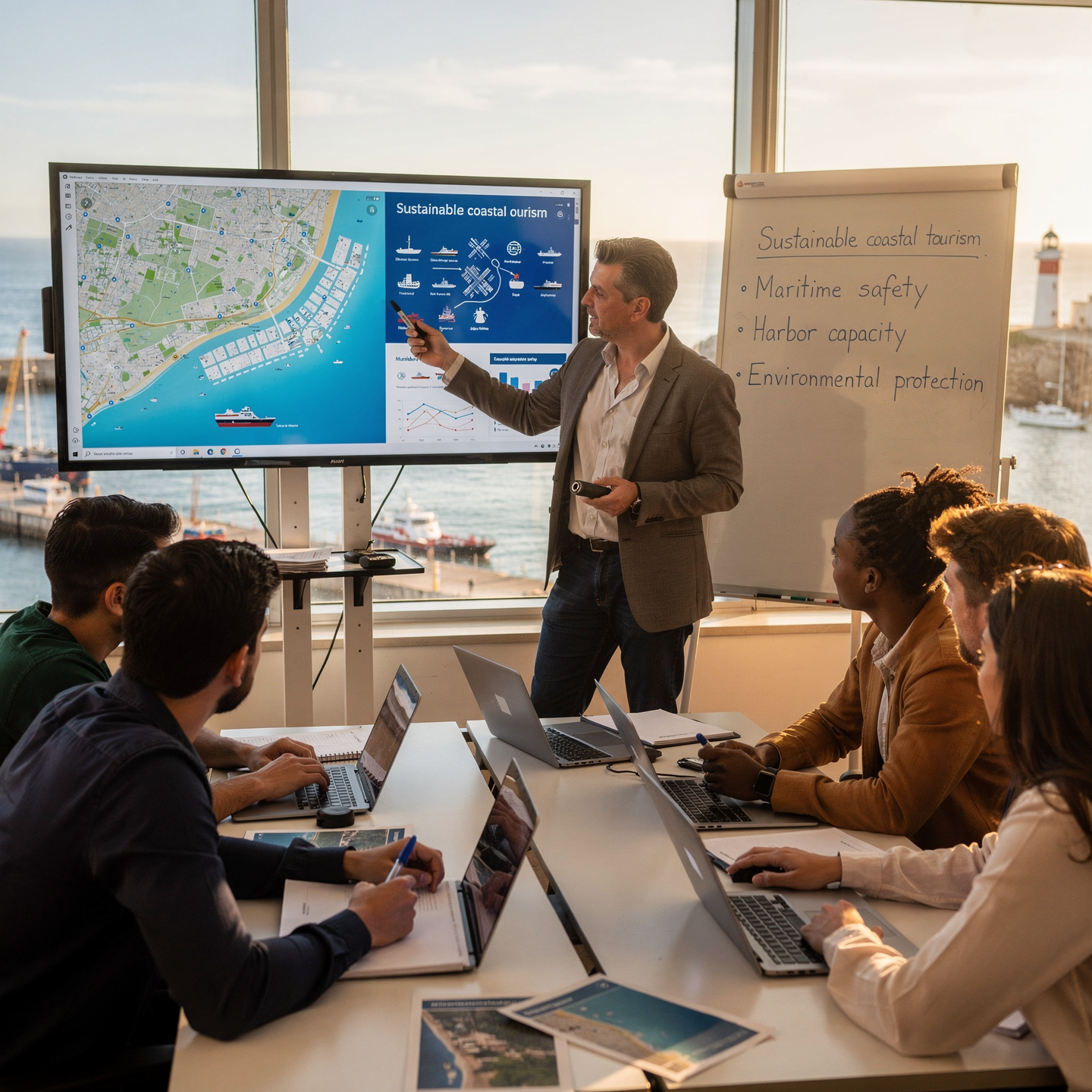
Master’s Degree in Coastal Tourist Destination Management
Why this masterās programme?
The Master in Coastal Tourism Destination Management
This program provides you with the tools and expert knowledge to lead the transformation of coastal destinations towards a sustainable and competitive future. Learn to design innovative tourism experiences, manage natural resources responsibly, and drive local economic development, all with a focus on sustainability and community engagement. This program equips you to meet the challenges of modern tourism and become a change agent in the sector.
Differentiating Advantages
- Specialization in Coastal Destinations: a unique focus on the challenges and opportunities of coastal tourism.
- Practical Methodology: real-world case studies, consulting projects, and management simulations.
- Networking: expert professors, industry professionals, and peers from around the world.
- Cutting-Edge Tools: tourism data analysis, digital marketing, and sustainability management.
- Skills Development: leadership, communication, negotiation, and project management.
- Modality: Online
- Level: Masters
- Hours: 1600 H
- Start date: 26-04-2026
Availability: 1 in stock
Who is it aimed at?
- Tourism professionals who want to lead the sustainable and efficient management of coastal destinations.
- Tourism planning managers who are looking for tools to optimize the development and promotion of coastal areas.
- Tourism sector entrepreneurs interested in innovating in products and services adapted to the specific characteristics of coastal tourism.
- Tourism consultants and technicians who aspire to specialize in the management of coastal tourist destinations and their challenges.
- Graduates in tourism, geography, environmental sciences, or economics who are looking for advanced training to boost their career in the coastal sector.
Flexibility for your development
Ā Designed For active professionals: adaptable online format, updated content and networking with experts in the coastal tourism sector.
Objectives and skills

Leading innovation in sustainable tourism products:
“Develop and apply creative and agile design methodologies to prototype tourist experiences that minimize environmental impact and maximize local socio-economic benefit.”

Optimizing the profitability of coastal destinations:
Diversify the tourism offer with innovative and sustainable experiences, attracting higher-spending market segments and extending the season.

Designing effective tourism marketing strategies:
“Segmenting markets, defining unique value propositions and selecting appropriate communication channels, measuring return on investment (ROI) and adjusting strategies according to the results.”

Effectively manage coastal natural and cultural resources:
Implement conservation and restoration strategies, balancing the economic and social needs of coastal communities.

Develop inclusive and resilient tourism policies:
Promote the active participation of local communities and marginalized groups in tourism planning and management.

Assess and mitigate the impacts of climate change on coastal tourism:
Implement nature-based adaptation strategies, such as mangrove and dune restoration, to protect key tourism infrastructure and coastal ecosystems.
Study plan ā Modules
- Fundamentals of strategic planning in coastal tourist destinations: definitions, objectives, and long-term benefits
- Comprehensive environmental analysis: social, economic, environmental, and cultural diagnosis for informed decision-making
- Advanced methodologies for territorial and coastal space analysis: GIS, remote sensing, and participatory mapping
- Design and formulation of strategic plans: establishing goals, key performance indicators (KPIs), and lines of action
- Collaborative governance models: integration of public administrations, the private sector, local communities, and international actors
- Sustainable management instruments: environmental impact assessment (EIA), land-use planning, and coastal regulations
- Strategies for the conservation of marine and coastal biodiversity in tourism contexts
- Development of sustainable tourism products: ecotourism, cultural tourism, and authentic local experiences
- Planning Adaptive strategies in the face of climate change: coastal risk management, resilience, and threat mitigation
Innovation and technologies applied to destination management: tourism information systems, Big Data, and predictive analytics
Strategic marketing for coastal destinations: positioning, market segmentation, and responsible communication
Financing and economic sustainability: business models, public-private partnerships, and attracting green investment
Sustainability and quality of life indicators: monitoring and reporting for continuous destination improvement
Stakeholder training and development: strengthening local capacities and raising environmental awareness
International and national case studies: lessons learned and best practices in sustainable planning and development
Implementation of public policies for the integrated management of coastal tourism areas
Development of emergency plans and crisis management: protocols for natural disasters and events Anthropogenic factors
Sustainability assessment and auditing in coastal tourist destinations: certification tools and processes
The role of blockchain technology and traceability in sustainable tourism management
Global trends and future perspectives in the planning and development of coastal tourist destinations
- Fundamentals of technological innovation applied to coastal tourist destinations: key concepts and current trends
- Application of Big Data and predictive analytics for strategic decision-making in destination management
- Digital platforms and technological ecosystems: integration of CRM, CMS, and tourism management systems for efficient promotion
- Geolocation tools and GIS systems: monitoring, land-use planning, and environmental impact in coastal areas
- Use of artificial intelligence and machine learning for personalizing the tourist experience and optimizing resources
- Implementation of augmented reality (AR) and virtual reality (VR) as innovative elements in the promotion and interpretation of coastal heritage
- Digital models and 3D simulations for urban planning and sustainable management of coastal territories
- Omnichannel Digital Marketing and Communication Strategies: SEO, SEM, Social Media, and Influencer Marketing for Coastal Destinations
- Automation and Intelligent Systems in Operational Management: Smart Destinations and the Internet of Things (IoT) Applied to Coastal Tourism Infrastructure
- Collaborative Management Platforms and Digital Citizen Participation to Strengthen Governance and Sustainability in Coastal Destinations
- Impact and Sustainability Assessment Using Digital Technologies: Indicator Systems, Reporting, and Real-Time Monitoring
- Digital Security and Data Privacy in the Tourism Sector: Regulations, Compliance, and Best Practices
- Case Studies and International Benchmarking of Coastal Destinations that Have Successfully Implemented Technological Innovations
- Development of Applied Technology Projects: From Conceptualization to Implementation in Coastal Tourism Destinations
- Formulation of Public Policies and Business Strategies Aimed at Digital Transformation and Innovation in Tourism coastal
- Fundamentals of Integrated Planning in Coastal Tourist Destinations: Conceptualization and Multidisciplinary Approaches
- Territorial Diagnostic Analysis: Environmental, Socioeconomic, and Cultural Assessment for Effective Strategic Planning
- Governance Models and Public-Private Partnerships in the Management of Coastal Destinations: Building Sustainable Alliances
- Design and Formulation of Environmental Sustainability Strategies: Criteria, Indicators, and Tools for the Preservation of Marine and Terrestrial Ecosystems
- Planning Responsible Tourism Infrastructure: Integrating Clean Technologies and Resilient Architecture
- Management of Renewable and Non-Renewable Natural Resources in Coastal Environments: Balancing Economic Development and Conservation
- Land Use Planning Instruments for the Regulation and Control of Land Use in Maritime Tourist Destinations
- Advanced Environmental Monitoring Tools: Remote Sensing, GIS, and Territorial Information Systems Applied to Tourism Coastal
Environmental Impact Assessment and Climate Risk: Methodologies for Anticipating and Mitigating Adverse Effects in Coastal Destinations
Strategies for Promotion and Sustainable Economic Diversification: Fostering Innovative and High Value-Added Tourism Experiences
International Regulatory Framework and Relevant Environmental Legislation: Compliance and Adaptation in Coastal Tourism Projects
Profitability and Sustainability Indicators: Quantitative and Qualitative Analysis for Managerial Decision-Making
Methodologies for Developing Master Plans for Tourism Development: Integrating Short-, Medium-, and Long-Term Objectives
Successful International Case Studies: Lessons Learned and Best Practices in Planning and Sustainability
Evaluation and Monitoring of Comprehensive Plans: Building Environmental Reporting and Auditing Systems
Innovations in Financing for Sustainable Tourism Projects: Public, Private, and Mixed Mechanisms
Training and Development
- Local capacity building: fostering host communities committed to sustainability
- Crisis management and planning for climate resilience in coastal destinations: emergency and post-event recovery protocols
- Emerging trends in sustainable coastal tourism: integrating new technologies, regenerative tourism, and the circular economy
- Designing public policies geared towards sustainability and competitiveness in international tourism markets
- Advanced tourism marketing strategies in coastal destinations: market segmentation, trend analysis, and competitive positioning
- Comprehensive revenue management in tourist destinations: dynamic pricing, revenue management, and distribution channel optimization
- Implementation of predictive models for coastal tourism demand using Big Data and visitor behavior analysis
- Design and development of visitor experiences: personalization, experiential economy, and innovation in coastal tourism products
- Efficient operations in coastal tourist destinations: logistical coordination, capacity management, and operational sustainability
- Strategic public-private partnerships: legal framework, collaboration mechanisms, and shared value creation for coastal tourism development
- Building and managing the territorial brand: identity, storytelling, and positioning of tourist destinations
- Application of disruptive technologies in tourism marketing and management: artificial intelligence, augmented reality, and omnichannel platforms
- Financial analysis and budget control: profitability assessment, key indicators, and audits applied to coastal destinations
- Multisectoral governance and management models to ensure competitiveness and sustainability in coastal tourist destinations
- Advanced digital marketing and social media strategies to attract and retain tourists in highly competitive coastal contexts
- Mechanisms for measuring and evaluating the visitor experience: KPIs, satisfaction surveys, and real-time feedback analysis
- Design and implementation of contingency and crisis management plans for coastal tourist destinations
- Sustainability and social responsibility protocols in the operation and promotion of coastal tourist destinations
- Success stories and international benchmarking in advanced marketing and Revenue management in coastal tourist destinations
High value-added services
- Conceptualization and theoretical framework of integrated risk management in coastal tourist destinations: definition, classification, and scope.
- Diagnosis and assessment of coastal risks: identification of natural (tsunamis, storms, erosion) and anthropogenic (pollution, mass tourism, climate change) hazards.
- Advanced methodologies for the quantitative and qualitative analysis of vulnerabilities in tourism infrastructure and local communities.
- Design and development of specific contingency plans for coastal tourist destinations: integration of national and international protocols.
- Managing crises in coastal environments: early warning, immediate response, effective communication, and post-crisis recovery phases.
- Implementation of monitoring and early warning systems: satellite technologies, environmental sensors, and predictive modeling for proactive risk management.
- Territorial and social resilience: capacity building
- Local factors, adaptability, and sustainability strategies for coastal tourist destinations affected by adverse events.
- Legal and regulatory framework for risk and emergency management in coastal tourist areas: analysis of international, regional, and local legislation.
- Integration of risk management into strategic tourism development planning: multisectoral approaches and community participation.
- International and national case studies: lessons learned, best practices, and critical evaluation of successful models of integrated risk management and resilience in coastal destinations.
- Innovation and technology applied to crisis management: use of drones, artificial intelligence, and Big Data for real-time decision-making.
- Communication management in crisis situations: protocols for the press, social media, and stakeholders; crafting clear messages; and inter-institutional coordination.
- Training and continuing education in risk management and resilience for stakeholders in the tourism sector and local communities.
- Simulation tools and practical exercises for emergency preparedness in coastal tourist destinations.
- Post-crisis assessment and impact measurement: key indicators, economic, social, and environmental analysis, and design of sustainable recovery plans.
- Fundamentals of strategic planning in coastal tourist destinations: environmental analysis, situational diagnosis, and definition of long-term objectives
- Models of competitiveness and tourism positioning: benchmarking, SWOT analysis, and formulation of sustainable competitive advantages
- Digital innovation applied to coastal tourism management: disruptive technologies, big data, artificial intelligence, and their integration into decision-making processes
- Digital tools for the promotion and marketing of destinations: experience platforms, digital marketing, social media, and online reputation management
- Comprehensive planning and management of sustainability in coastal destinations: environmental, sociocultural, and economic criteria to minimize impacts and maximize benefits
- Evaluation and certification of tourism sustainability: international standards, key performance indicators, and continuous monitoring systems
- Innovation in collaborative governance models: citizen participation, public-private partnerships, and inter-institutional cooperation networks
- Strategies for resilience to climate change and coastal risk management: adaptation, mitigation, and contingency planning
- Methodologies for designing sustainable and innovative tourism experiences geared towards emerging markets and high-profit segments
- Analysis of case studies and international comparative studies demonstrating the positive impact of strategic planning, digital innovation, and sustainability on coastal tourism competitiveness
- Fundamentals of sustainable development applied to coastal tourist destinations: principles, international regulations, and national regulatory frameworks
- Comprehensive diagnosis of coastal tourist destinations: environmental, sociocultural, and economic analysis for identifying opportunities and risks
- Digital innovation strategies in the management of coastal destinations: implementation of IoT technologies, Big Data, and smart management systems
- Design and application of territorial competitiveness management models with a focus on environmental and social sustainability
- Planning and implementation of public and private policies for sustainable development: integrated coastal zone management and adaptation to climate change
- Technological tools for real-time monitoring of natural resources and tourist flows: GIS, remote sensors, and collaborative digital platforms
- Innovation in tourism products and services: strategies for creating added value and differentiation in globalized markets
- Environmental and social impact analysis in destinations
- Social and technological innovation for improving the quality of life in coastal communities linked to tourism
- Development of skills for strategic planning: use of advanced foresight, forecasting, and change management methodologies
- Interoperability and data management on multi-sectoral digital platforms for coastal destinations: integrity, privacy, and security
- Evaluation of the ecological footprint and tourism carrying capacity in sensitive coastal environments
- Design of integrated action plans: environmental mitigation, technological innovation, and competitive strategies oriented toward sustainable results
Coastal Destinations: Advanced Methodologies for the Assessment and Mitigation of Negative Externalities
Participatory Management and Collaborative Governance: Involvement of Local Communities, Stakeholders, and Public Entities in Decision-Making Processes
Financing Models and Economic Evaluation of Sustainable Projects in Coastal Tourist Destinations: Investment, Return, and Risk
Digital Marketing Strategies and Online Positioning for Coastal Destinations: SEO, Web Analytics, and Personalized Experiences Based on Big Data
Competitiveness and Resilience in Coastal Destinations in the Face of Global Threats: Climate Crises, Pandemics, and Fluctuations in the Tourism Market
International Success Stories and Lessons Learned: Comparative Analysis of Leading Coastal Destinations in Innovation and Sustainability
Legal and Regulatory Framework for Sustainable Coastal Management: Marine and Coastal Planning, Environmental Regulations, and Tourism Regulations
Implementation of Certification Systems and Tourism Sustainability Standards: Criteria, Audit Processes, and Benefits competitiveness
- Fundamentals of socioeconomic analysis in coastal tourist destinations: macro and microeconomic variables, development indicators, and quantitative and qualitative methodologies
- Demographic dynamics and their impact on tourism sustainability: migration, seasonal employment, tourist profile, and residents
- Advanced models of collaborative governance: participatory structures, multi-institutional coordination mechanisms, and adaptive governance tools
- Key competencies and roles in destination management: local authorities, the private sector, communities, NGOs, and international organizations
- Optimization of natural and cultural resources: carrying capacity assessment, integrated coastal zone management, and evidence-based environmental protection
- Strategic and operational planning instruments for coastal destinations: land-use plans, environmental impact assessments, and climate risk analysis
- Circular economy applied to coastal tourism: strategies for minimizing waste, energy efficiency, and
- Promotion of sustainable practices in value chains
- Methodologies for the socioeconomic evaluation of tourism projects: cost-benefit analysis, distributive impact, and generation of decent employment
- Digital tools for governance and resource management: geographic information systems (GIS), collaborative platforms, and tourism big data analysis
- International and national case studies on effective collaborative governance and resource optimization in coastal tourism destinations
- Financial mechanisms and innovative business models for sustainability and competitiveness: public-private partnerships, investment funds, and responsible tourism
- Key performance indicators (KPIs) for the continuous measurement of sustainable development in coastal tourism destinations
- Communication and conflict management strategies in complex tourism environments: mediation, negotiation, and multisectoral consensus building
- Implementation of integrated public policies for conservation and socioeconomic development: Regulations, incentives, and effective monitoring
Emerging trends in coastal destination management: blue tourism, climate resilience, and digital citizen participation
- Fundamentals of digital innovation applied to coastal tourist destinations: emerging technologies, digital transformation, and their strategic impact
- Smart destination management models: IoT, Big Data, and advanced analytics for decision-making in coastal tourist environments
- Comprehensive sustainability: concepts, international regulations, and specific certifications for tourist destinations in coastal areas
- Strategies for sustainable competitiveness: developing competitive advantages based on ecological and social innovation
- Planning and designing personalized digital tourism experiences using augmented reality, virtual reality, and gamification
- Smart destinations and connectivity: technological infrastructure, management platforms, and interoperability protocols
- Analysis of the environmental and socioeconomic impact of tourism activity Coastal: Advanced Metrics and Continuous Monitoring Systems
Collaborative Governance Models for Sustainable Management, Integrating Public and Private Actors and Local Communities
Application of Blockchain and Decentralized Technologies for Traceability, Transparency, and Trust in the Destination’s Tourism Offerings
Design and Implementation of Digital Marketing Plans Focused on the Sustainability and Competitiveness of Coastal Destinations
GIS and Remote Sensing Tools Applied to Territorial Management, Coastal Planning, and Tourism Risk Prevention
Innovation in Smart Tourism Services: Flow Management, Customer Service, and Omnichannel Experience
Financing and Business Models for Innovation and Sustainability Projects in Coastal Tourism Destinations
Assessment and Management of Climate and Natural Risks: Resilient Strategies for Conservation and Sustainable Development
- European and international regulations and public policies related to the digitalization and sustainability of coastal tourist destinations
- Advanced methodologies for assessing the ecological and carbon footprint of tourism in coastal areas
- Case studies and international benchmarking on technological innovation and sustainability in the integrated management of coastal destinations
- Development of strategic sustainability and competitiveness plans with a focus on digital innovation and community participation
- Impact and management of the circular economy in the coastal tourism sector: opportunities and challenges
- Integration of ESG (Environmental, Social, Governance) criteria in the management and promotion of coastal tourist destinations
- Introduction to the concept of integrated management of coastal tourist destinations: principles, scope, and benefits
- International, national, and local regulatory framework for the sustainable management of coastal destinations
- Multidimensional diagnosis and analysis: environmental, socioeconomic, and cultural assessment of the coastal tourist destination
- Design of strategies for environmental sustainability: conservation of marine ecosystems, waste management, and impact mitigation
- Tools and methodologies for the digitalization of tourism management: geographic information systems (GIS), big data, and smart platforms
- Models of collaborative governance and citizen participation in the management of coastal destinations
- Strategic and operational planning: formulation of objectives, performance indicators, and integrated action plans
- Technological innovation applied to the tourist experience: augmented reality, smart tourism, and IoT solutions for coastal destinations
- Risk management and resilience in coastal tourist destinations in the face of climate change and extreme events
Economic and financial aspects: financing models, investment evaluation, and cost-benefit analysis
Sustainable marketing and digital positioning of coastal tourist destinations: strategies for responsible promotion and market segmentation
Metrics and continuous monitoring systems: sustainability indicators, real-time data analysis, and reporting for decision-making
Implementation of a comprehensive model: phases, digital tools, inter-institutional coordination, and change management
Case studies and international benchmarking: best practices and lessons learned in sustainable and digitized coastal tourist destinations
Preparation, presentation, and defense of the final project: complete development of a comprehensive sustainable and digitized management model for a selected coastal tourist destination
Career prospects
“`html
- Tourism Destination Manager: Planning, development, and promotion of coastal destinations.
- Tourism Consultant: Advising companies and institutions on sustainable tourism strategies.
- Tourism Product Director: Creation and management of innovative tourism experiences.
- Tourism Marketing Manager: Promotion of destinations and tourism products through various channels.
- Tourism Technician in Public Administrations: Planning and management of tourism policies at the local, regional, or national level.
- Tourism Entrepreneur: Creation and management of tourism businesses (accommodation, activities, etc.).
- Tourism Researcher: Analysis of trends and development of studies on coastal tourism.
- Tourism Sustainability Manager: Implementation of sustainable practices in tourism destinations and businesses.
“`
Entry requirements

Academic/professional profile:
Bachelorās degree in Nautical Science/Maritime Transport, Naval/Marine Engineering or a related qualification; or proven professional experience on the bridge/in operations.

Language proficiency:
Functional Maritime English (SMCP) recommended for simulations and technical materials.

Documentation:
Updated CV, copy of qualification or seamanās book, national ID/passport, motivation letter.

Technical requirements (for online):
Device with camera/microphone, stable internet connection, monitor ā„ 24ā recommended for ECDIS/Radar-ARPA.
Admissions process and dates

Online
application
(form + documents).

Academic review and interview
Admissions decision

Admissions decision
(+ scholarship offer if applicable).

Place reservation
(deposit) and enrolment.

Induction
(access to the virtual campus, calendars, simulator guides).
Scholarships and financial support
- Innovative Strategies: Master the latest trends in planning and development of coastal tourist destinations.
- Sustainable Management: Learn to balance economic growth with environmental preservation and local culture.
- Digital Tourism Marketing: Boost the promotion of your destination with advanced online marketing tools and techniques.
- Practical Experience: Participate in real-world case studies and applied projects to strengthen your skills.
- Networking: Connect with industry professionals, academic experts, and peers from around the world.
Testimonials
This master’s degree provided me with the tools and strategic knowledge to lead the sustainable development of an emerging coastal destination. I applied the planning and marketing principles I learned to attract investment, improve infrastructure, and diversify the tourism offerings, achieving a 30% increase in visitor numbers and a 20% increase in tourist satisfaction in the first year of implementing my strategy.
During my Master’s in Tourism & Cruises, I developed an itinerary optimization project for a cruise company, applying data analysis and sustainability strategies. This project not only received the highest possible grade but also sparked the company’s interest, leading to an internship and subsequently a position in their planning department.
This master’s program provided me with the tools and knowledge necessary to lead the sustainable development of an emerging coastal destination. I applied the principles of strategic planning and tourism marketing I learned, achieving a 30% increase in tourist arrivals in the first year and a 15% increase in visitor satisfaction, demonstrating the effectiveness of the comprehensive and sustainable approach that the program promotes.
The Master’s in Coastal Tourism Destination Management provided me with the tools and knowledge necessary to launch an ecotourism project in my coastal community. Thanks to the training I received, I was able to develop a sustainable management plan that attracted investment, generated local jobs, and, at the same time, protected our fragile ecosystem. Today, our destination is an example of responsible tourism development and a national benchmark.

Frequently asked questions
Coastal tourism.
Yes. The itinerary includes ECDIS/Radar-ARPA/BRM with harbor, ocean, fog, storm, and SAR scenarios.
Online with live sessions; hybrid option for simulator/practical placements through agreements.
In destinations located on the coast.
Recommended functional SMCP. We offer support materials for standard phraseology.
Yes, with a relevant degree or experience in maritime/port operations. The admissions interview will confirm suitability.
Optional (3ā6 months) through Companies & Collaborations and the Alumni Network.
Simulator practice (rubrics), defeat plans, SOPs, checklists, micro-tests and applied TFM.
A degree from Navalis Magna University + operational portfolio (tracks, SOPs, reports and KPIs) useful for audits and employment.
- Introduction to the concept of integrated management of coastal tourist destinations: principles, scope, and benefits
- International, national, and local regulatory framework for the sustainable management of coastal destinations
- Multidimensional diagnosis and analysis: environmental, socioeconomic, and cultural assessment of the coastal tourist destination
- Design of strategies for environmental sustainability: conservation of marine ecosystems, waste management, and impact mitigation
- Tools and methodologies for the digitalization of tourism management: geographic information systems (GIS), big data, and smart platforms
- Models of collaborative governance and citizen participation in the management of coastal destinations
- Strategic and operational planning: formulation of objectives, performance indicators, and integrated action plans
- Technological innovation applied to the tourist experience: augmented reality, smart tourism, and IoT solutions for coastal destinations
- Risk management and resilience in coastal tourist destinations in the face of climate change and extreme events
Economic and financial aspects: financing models, investment evaluation, and cost-benefit analysis
Sustainable marketing and digital positioning of coastal tourist destinations: strategies for responsible promotion and market segmentation
Metrics and continuous monitoring systems: sustainability indicators, real-time data analysis, and reporting for decision-making
Implementation of a comprehensive model: phases, digital tools, inter-institutional coordination, and change management
Case studies and international benchmarking: best practices and lessons learned in sustainable and digitized coastal tourist destinations
Preparation, presentation, and defense of the final project: complete development of a comprehensive sustainable and digitized management model for a selected coastal tourist destination
Request information
Complete the Application Form.
Attach your CV/degree certificate (if you have it to hand).
Indicate your preferred cohort (January/May/September) and whether you would like the hybrid option with simulator sessions.
An academic advisor will contact you within 24ā48 hours to guide you through the admission process, scholarships, and compatibility with your professional schedule.
Faculty
Eng. TomƔs Riera
Full Professor
Eng. TomƔs Riera
Full Professor
Eng. SofĆa Marquina
Full Professor
Eng. SofĆa Marquina
Full Professor
Eng. Javier BaƱuls
Full Professor
Eng. Javier BaƱuls
Full Professor
Dr. Nuria Llobregat
Full Professor
Dr. Nuria Llobregat
Full Professor
Dr. Pau Ferrer
Full Professor
Dr. Pau Ferrer
Full Professor
Cap. Javier Abaroa (MCA)
Full Professor
Cap. Javier Abaroa (MCA)
Full Professor

