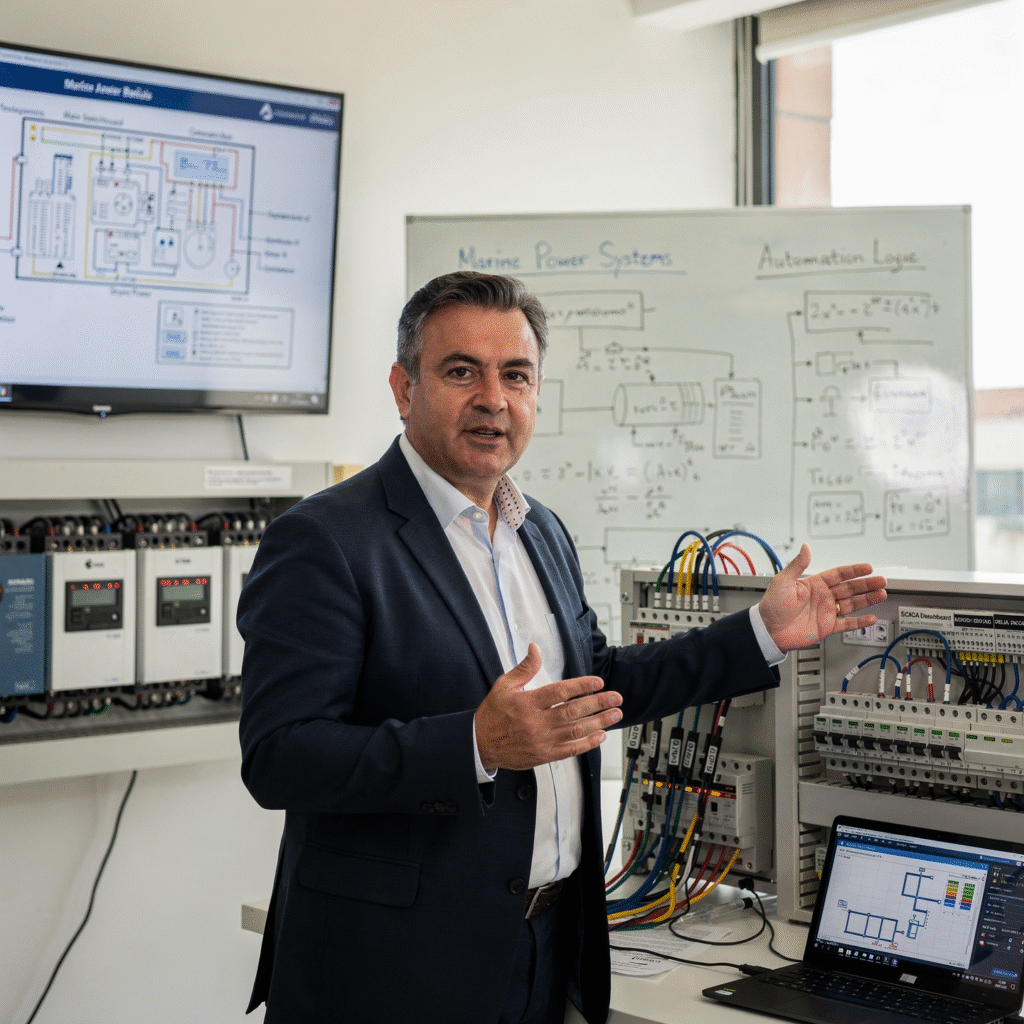
Master’s Degree in Maritime Occupational Health and Risk Prevention

Why this master’s programme?

The Master’s Degree in Maritime Occupational Health and Safety

This program provides you with the tools and knowledge necessary to lead safety in maritime environments. Gain a comprehensive understanding of national and international regulations, best practices in prevention, and industry-specific emergency management techniques. Develop skills in risk identification and assessment, the implementation of effective preventive measures, and the promotion of a robust safety culture both onboard and ashore.

Differential Advantages

  • Practical Approach: Real-world case studies and simulations to apply acquired knowledge.
  • Industry Experts: Instructors with extensive experience in maritime safety and occupational health.
  • Networking: Opportunities to connect with professionals and companies in the maritime sector.
  • Certification: Obtain a recognized qualification that boosts your professional career in the field of maritime safety.
  • Continuous Updates: Content updated with the latest trends and regulations in the sector.
Prevención

Master’s Degree in Maritime Occupational Health and Risk Prevention

Availability: 1 in stock

Who is it aimed at?

  • Maritime professionals (captains, officers, crew) who wish to specialize in occupational health and safety on board ships.
  • Health and safety managers in shipping companies who seek to implement effective preventive management systems and comply with international regulations.
  • Consultants and auditors in maritime occupational risk prevention who want to deepen their knowledge and offer specialized services.
  • Graduates in health sciences, engineering, or related fields interested in developing a career in occupational health and safety in the maritime environment.
  • Occupational risk prevention technicians seeking specialization in the maritime sector to expand their opportunities professionals.

Training flexibility
Ā Adapted to the demands of the sector: online modality, updated content and specialized tutoring to reconcile study with professional activity.

Prevención

Objectives and skills

Implement and maintain occupational health and safety management systems in maritime settings:

“Develop and implement maritime emergency procedures, including drills and crisis management.”

Assess and control specific occupational risks in the maritime environment:

Implement safety protocols (ISM/ISPS), drills and emergency plans, adapting them to the type of ship and weather conditions, ensuring continuous training of the crew.

Design and deliver training programs in maritime occupational risk prevention:

“Develop updated teaching materials (regulations, specific risks, preventive measures) and evaluate the effectiveness of the training using key indicators.”

Investigate and analyze maritime accidents and incidents to develop preventative measures:

“Identify root causes (human, technical, organizational) and propose improvements to procedures/equipment, communicating findings to the crew and authorities.”
Advising on the application of current regulations regarding maritime occupational safety and health:

Identify specific risks in the maritime environment and propose preventive measures adapted to operations and vessels.

Leading emergency response and rescue in maritime environments:

“Assess risks, prioritize actions, and communicate effectively with SAR teams and available resources (helicopters, ships, coastal units).”

Study plan – Modules

  1. International and national regulatory framework for maritime occupational risk prevention: ILO, SOLAS, and MARPOL conventions, and applicable local legislation
  2. Identification and classification of risks in the shipbuilding industry: physical, chemical, biological, ergonomic, and psychosocial risks specific to the maritime environment
  3. Advanced methodologies for occupational risk analysis: HAZID, HAZOP, Job Safety Analysis (JSA), and quantitative risk assessment techniques
  4. Design and implementation of occupational health and safety management systems (OHSMS) adapted to the maritime industry: integration with ISO 45001 standards and sector-specific certifications
  5. Protocols and procedures for the prevention of accidents and occupational diseases in maritime and naval activities: handling of hazardous substances, work at heights, confined spaces, and manual handling
  6. Planning and execution of maritime safety training programs: simulations, drills, and scenario-based training real-world emergency situations
  7. Evaluation and control of environmental and operational conditions: monitoring of explosive atmospheres, noise control, vibration control, and thermal exposure on board
  8. Technologies applied to risk management: smart sensors, IoT for real-time monitoring, use of drones for inspection and predictive analysis using big data
  9. Emergency management in the maritime industry: response plans, inter-institutional coordination, mitigation and evacuation techniques, and crisis management
  10. Audits, inspections, and continuous monitoring: key performance indicators (KPIs), incident reports, continuous improvement, and an organizational culture focused on safety and health
  1. Advanced ergonomic risk analysis in maritime environments: evaluation of postures, repetitive movements, and biomechanical loads under dynamic conditions
  2. Identification and quantification of critical environmental agents: noise, vibrations, temperature, humidity, and air quality in enclosed and open spaces of the vessel
  3. Predictive models and computational simulations for the multiparametric evaluation of ergonomic and environmental risks
  4. International regulations and specific standards applied to ergonomic and environmental prevention in the maritime industry (ILO, IMO, ISO, OSHA)
  5. Advanced environmental and ergonomic monitoring techniques: wearable devices, IoT sensors, and real-time analysis for preventive management
  6. Design and optimization of workstations and operational areas on ships and platforms: ergonomic criteria to minimize musculoskeletal risks and thermal stress
  7. Mitigation strategies based on technical and administrative controls and personal protective equipment Specialized for complex maritime environments

    Human-machine interaction in maritime environments: interface analysis and advanced ergonomic adaptation for navigation and handling equipment

    Integrated assessment of combined risks: simultaneous impact of ergonomic and environmental factors on occupational health and crew performance

    Emergency protocols and contingency plans for the rapid and efficient management of critical incidents related to ergonomic and environmental risks

    Training and continuing education in ergonomics and environmental safety applied to the maritime sector: methodologies, simulators, and experiential learning

    Case studies and statistical analysis of incidents related to ergonomic and environmental factors in international maritime operations

    Specialized audits and assessment of regulatory compliance in ergonomic and environmental prevention: inspection methodologies and tools

    Implementation of integrated maritime health, safety, and environmental management systems (HSE-MS) with a focus on Ergonomic and environmental risks

  8. Emerging technological innovations for the prevention and control of ergonomic and environmental risks: robotics, automation, and intelligent alert systems

  1. Fundamental principles of integrated risk management in the maritime sector: definition, importance, and applicable international regulatory framework (IMO, ILO, ISO 31000)
  2. Identification and classification of specific risks in the maritime and naval environment: physical, chemical, biological, ergonomic, and psychosocial risks
  3. Quantitative and qualitative risk analysis and assessment: advanced methodologies applied to ships, port facilities, and offshore platforms
  4. Implementation of occupational health and safety management systems: tools, processes, and best practices according to OHSAS 18001 and ISO 45001 standards
  5. Risk assessment and control in maritime loading and unloading operations: handling of hazardous substances, machinery operation, and accident prevention
  6. Advanced techniques for monitoring and controlling environmental and safety risks in confined spaces, decks, and machinery areas
  7. Management of
  8. Emergency and contingency plans in maritime environments: procedures, communication, and coordination with rescue services
  9. Ergonomic assessment and prevention of work-related injuries in crews: job design, physical workload, and human factors
  10. Application of cutting-edge technologies for risk monitoring: sensors, early warning systems, and real-time data analysis
  11. Case studies and analysis of maritime incidents related to risk management: lessons learned and development of an effective preventative culture
  1. Fundamentals of Operational Safety in the Maritime Environment: Basic Principles and International Regulatory Context (IMO, ILO, SOLAS, MARPOL)
  2. HSE Audits in the Maritime Industry: Types, Advanced Methodologies, Planning, Execution, and Follow-up of Internal and External Audits
  3. Advanced Simulation of Onboard Incidents: Design, Implementation, and Analysis of Drills for Risk Assessment and Effective Response
  4. Investigation of Maritime Accidents: Forensic Techniques, Evidence Collection and Analysis, Reporting, and Use for Future Prevention
  5. Regulatory Compliance in Maritime Occupational Health: International and National Standards, Certifications, and Inspection Requirements
  6. Comprehensive HSE Risk Management: Identification, Assessment, Mitigation, and Specific Control for Maritime and Naval Operations
  7. Implementation of Occupational Health and Safety (OHS) Management Systems according to ISO 45001 and their Adaptation to the Sector Maritime
  8. Digital tools and emerging technologies in maritime HSE management: audit software, 3D simulators, and real-time reporting platforms
  9. Safety training and culture on board: strategies to foster staff commitment and manage unsafe behaviors
  10. Legal and ethical responsibility in maritime risk prevention: case studies, sanctions, and best practices for compliance with current legislation
  1. Architecture and components of integrated maritime emergency management systems: sensors, communications, and central platform
  2. Advanced protocols for identifying and assessing specific risks in maritime operations: dynamic and predictive analysis
  3. Implementation of IoT technology and smart sensors for continuous monitoring of environmental and structural conditions on ships and platforms
  4. Automated early warning and decision-making systems based on artificial intelligence and machine learning applied to emergency scenarios
  5. Updated international regulations (IMO, SOLAS, ISM) on preventive management and rapid response to maritime incidents
  6. Integration of drones and unmanned vehicles in inspection, rescue, and spill containment operations
  7. Multi-agency operational communication and coordination protocols for effective emergency management in maritime and port areas
  8. Advanced contingency plans: simulations and practical exercises
  9. and performance evaluation in real and virtual environments

    Use of GIS systems for strategic planning of safe routes and assessment of areas of potential risk

    Development and evaluation of human and technological capabilities in the response chain, including virtual training and fatigue management

  1. Fundamentals of Integrated Maritime Risk Management: Definition, Importance, and International Regulatory Framework (IMO, ILO, SOLAS, ISM)
  2. Hazard Analysis and Assessment in Complex Naval Operations: Qualitative and Quantitative Methods (HAZID, HAZOP, FMEA, Bow-Tie)
  3. Advanced Risk Assessment Models in Maritime Environments: Probabilistic, Statistical, and Dynamic
  4. Identification and Classification of Specific Risks in the Maritime Industry: Physical, Chemical, Biological, Psychosocial, and Environmental Risks
  5. Design and Implementation of Prevention and Control Plans Adapted to Maritime and Offshore Operations: Technical, Administrative, and Personnel Barriers
  6. Occupational Health and Safety Management Systems (OHSMS) Applied to the Naval Industry: Integration with ISO 45001 and Sectoral Standards
  7. Audit and Continuous Monitoring Protocols for Early Detection
  8. Deviations and risk situations in ports, platforms, and vessels
  9. Evaluation of the effectiveness and efficiency of preventive strategies: key indicators and feedback mechanisms
  10. Operational risk management in adverse conditions: addressing emergencies, contingencies, and rapid response plans
  11. Implementation of advanced technologies for risk management: IoT sensors, real-time monitoring systems, and simulation software
  12. Training and development of professional skills for maritime risk prevention: continuing education and safety culture
  13. Multidisciplinary integration and inter-institutional coordination in risk management: collaboration among shipowners, authorities, crew, and emergency services
  14. Case studies and analysis of relevant naval accidents: lessons learned and best practices in prevention
  15. Psychosocial considerations and ergonomics in maritime work performance to minimize risks and promote well-being
  16. Environmental impact and associated risk management: spills, emissions, waste, and protection of marine biodiversity
  17. Document management and traceability in risk prevention: records, reports, and regulatory compliance
  18. Assessment of the influence of climate change and extreme weather events on maritime safety
  19. Innovation and trends in maritime risk management: artificial intelligence, big data, and automation of control processes
  1. International Foundations and Standards for Maritime Occupational Safety and Health Management Systems: ILO 2006, SOLAS, MARPOL, ISM, and ISO 45001 Applied to Maritime Environments
  2. Analysis of Specific Risks in Complex Maritime Operations: Identification, Assessment, and Prioritization of Hazards on Offshore Platforms, Cargo Ships, and Fishing Vessels
  3. Design and Structuring of a Maritime Occupational Safety and Health Management System (OSHMS): Policies, Objectives, Indicators, and Roles of Responsibility
  4. Advanced Risk Assessment Methodologies: Qualitative and Quantitative Analysis, and Predictive Tools Applied to Maritime Incidents
  5. Implementation of Emergency and Response Plans for Maritime Accidents: Drills, Inter-institutional Coordination, and Crisis Communication
  6. Integration of Technology for Preventive Management: Sensors, Real-Time Monitoring, Digital Platforms, and Automation in the
  7. Supervision of working conditions
  8. Human capital management: continuous training, safety culture, ergonomics, and stress management for maritime crews
  9. Internal and external audits of OHSMS: preparation, procedures, reports, and continuous improvement mechanisms in the maritime sector
  10. Document management and traceability: development, control, and updating of safety manuals, work protocols, and incident logs inherent to maritime operations
  11. Evaluation of the performance of the maritime OHSMS: analysis of key performance indicators (KPIs), review of accidents, near misses, and corrective actions to foster sustainable improvement
  1. Detailed risk analysis in maritime and offshore environments: identification, assessment, and quantitative methods
  2. Applicable international and national regulations: SOLAS, MARPOL, ISM, OSHMS, and ISO 45001 standards specific to the maritime sector
  3. Design of comprehensive safety plans: structure, scope, objectives, and KPIs for offshore operations
  4. Implementation of occupational health management systems on offshore platforms: roles, responsibilities, and protocols
  5. Advanced methodologies for the assessment and control of chemical, biological, and ergonomic risks in maritime environments
  6. Development of emergency and contingency procedures: evacuation, rescue, and first aid plans at sea
  7. Training and continuing education: competency-based training systems and realistic simulations for the crew
  8. Technological systems applied to maritime safety: sensors, remote monitoring, IoT and predictive analytics for incident prevention

    Internal and external audits: methodologies, specific checklists, and non-conformity management under ISO 19011 adapted to offshore operations

    Monitoring and continuous improvement: performance indicators, accident/incident analysis, and PDCA cycle to optimize occupational health and safety

  1. Fundamentals of Advanced Risk Management: Identification, Qualitative and Quantitative Analysis Applied to Maritime and Offshore Environments
  2. Evaluation and Prioritization of Specific Hazards: Chemical, Mechanical, Human, and Environmental Risks in the Maritime and Offshore Oil & Gas Industry
  3. Risk Assessment Models: Bowtie, HAZOP, FMEA, and Failure Mode and Effects Analysis in Complex Maritime Operations
  4. Design and Implementation of Integrated Emergency Management Systems: Protocols, Communication, and Inter-institutional Coordination
  5. Planning and Execution of Maritime and Offshore Drills: Scenario Design, Roles and Responsibilities, Evaluation, and Continuous Improvement
  6. Applicable International and Regional Regulations: MARPOL, SOLAS, ISM Code, ILO Maritime Labour Convention, OPRC Convention, and Specific Offshore Regulations
  7. Advanced Risk Prevention Audits: Planning, Execution, Inspection Techniques, and Digital Tools for Regulatory Compliance Controls
  8. Document management and regulatory reporting: development of manuals, incident logs, statistical analysis, and generation of technical reports for certifications
  9. Implementation of immediate emergency response systems: specialized brigades, handling of hazardous substances, and medical emergencies at sea
  10. Performance evaluation and continuous improvement in occupational safety and health: key indicators, benchmarking, and use of IoT and Big Data technologies for prevention
  1. Fundamentals and international regulatory framework for maritime risk prevention: IMO, ILO, MARPOL, and SOLAS conventions, and specific offshore regulations
  2. Advanced risk analysis and assessment in maritime and offshore environments: hazard identification, qualitative and quantitative analysis, risk matrices, and predictive models
  3. Design and implementation of integrated occupational health and safety management systems (SMS, OHSAS, ISO 45001) adapted to maritime operations and offshore platforms
  4. Ergonomics and human factors in maritime environments: workload assessment, fatigue, heat stress, and protocols for improving well-being and safe decision-making
  5. Emerging technologies for risk prevention and monitoring: IoT sensors, SCADA systems, drones, and predictive management software in maritime occupational health
  6. Development and application of emergency and contingency plans: design of
  7. Protocols for responding to fires, spills, hydrocarbon accidents, and offshore rescues
  8. Comprehensive occupational health and safety audits: advanced inspection techniques, regulatory compliance analysis, and preparation of technical reports for the maritime sector
  9. Strategies for promoting and promoting the well-being of the crew: mental health programs, abuse prevention, industrial hygiene, and anti-fatigue policies adapted to life at sea
  10. Document management and reporting in maritime systems: creation and maintenance of accident records, near misses, key performance indicators, and accident statistics
  11. Final applied project: detailed design of an integrated risk prevention and occupational health promotion model for a maritime or offshore company, including methodology, timeline, budget, and impact measurement

Career prospects

“`html

  • Senior Technician in Occupational Risk Prevention (ORP) in the Maritime Sector: Risk assessment, prevention planning, training, and emergency management on ships, in ports, and at maritime facilities.
  • Maritime Occupational Health Manager: Design and implementation of occupational health programs specifically for seafarers, including control of ergonomic, psychosocial, and environmental risks.
  • Occupational Health and Safety Management System (OHSMS) Auditor in the Maritime Sector: Verification of regulatory compliance and safety standards in companies within the sector.
  • Consultant in Maritime Occupational Health and Safety: Advising companies and organizations on hazard identification, risk assessment, and the design of preventive measures.
  • Trainer in Occupational Health and Safety Maritime Occupational Health and Safety: Delivery of training courses and programs for workers in the maritime sector.

    Maritime Accident Investigator: Analysis of the causes of workplace accidents at sea and proposal of corrective measures to prevent their recurrence.

    Occupational Health and Safety Technician in Ports and Maritime Facilities: Management of occupational health and safety in port terminals, shipyards, and naval repair facilities.

    Maritime Emergency Plan Manager: Design, implementation, and coordination of response plans for emergency situations on ships and in ports.

    “`

Entry requirements

Academic/professional profile:

Bachelor’s degree in Nautical Science/Maritime Transport, Naval/Marine Engineering or a related qualification; or proven professional experience on the bridge/in operations.

Language proficiency:

Functional Maritime English (SMCP) recommended for simulations and technical materials.

Documentation:

Updated CV, copy of qualification or seaman’s book, national ID/passport, motivation letter.

Technical requirements (for online):

Device with camera/microphone, stable internet connection, monitor ≄ 24ā€ recommended for ECDIS/Radar-ARPA.

Admissions process and dates

Online
application

(form + documents).

Academic review and interview

Admissions decision

Admissions decision

(+ scholarship offer if applicable).

Place reservation

(deposit) and enrolment.

Induction

(access to the virtual campus, calendars, simulator guides).

Scholarships and financial support

  • Comprehensive Specialization: Master the key techniques and regulations in maritime occupational risk prevention and occupational health.
  • Practical Approach: Learn through simulations, case studies, and real-world projects, applicable to specific maritime environments.
  • Professional Certification: Earn a recognized master’s degree that boosts your career in health and safety management in the maritime sector.
  • Expert Instructors: Learn from professionals with extensive experience in the maritime industry and occupational risk prevention.
  • Strategic Networking: Connect with experts and peers in the sector to expand your professional network and opportunities Workplaces.
Prepare to lead safety and health in the maritime sector, protecting people and the environment.

Testimonials

Frequently asked questions

Yes. The itinerary includes ECDIS/Radar-ARPA/BRM with harbor, ocean, fog, storm, and SAR scenarios.

Online with live sessions; hybrid option for simulator/practical placements through agreements.

It focuses on risk prevention and occupational health specifically in maritime environments.

Recommended functional SMCP. We offer support materials for standard phraseology.

Yes, with a relevant degree or experience in maritime/port operations. The admissions interview will confirm suitability.

Optional (3–6 months) through Companies & Collaborations and the Alumni Network.

Simulator practice (rubrics), defeat plans, SOPs, checklists, micro-tests and applied TFM.

A degree from Navalis Magna University + operational portfolio (tracks, SOPs, reports and KPIs) useful for audits and employment.

  1. Fundamentals and international regulatory framework for maritime risk prevention: IMO, ILO, MARPOL, and SOLAS conventions, and specific offshore regulations
  2. Advanced risk analysis and assessment in maritime and offshore environments: hazard identification, qualitative and quantitative analysis, risk matrices, and predictive models
  3. Design and implementation of integrated occupational health and safety management systems (SMS, OHSAS, ISO 45001) adapted to maritime operations and offshore platforms
  4. Ergonomics and human factors in maritime environments: workload assessment, fatigue, heat stress, and protocols for improving well-being and safe decision-making
  5. Emerging technologies for risk prevention and monitoring: IoT sensors, SCADA systems, drones, and predictive management software in maritime occupational health
  6. Development and application of emergency and contingency plans: design of
  7. Protocols for responding to fires, spills, hydrocarbon accidents, and offshore rescues
  8. Comprehensive occupational health and safety audits: advanced inspection techniques, regulatory compliance analysis, and preparation of technical reports for the maritime sector
  9. Strategies for promoting and promoting the well-being of the crew: mental health programs, abuse prevention, industrial hygiene, and anti-fatigue policies adapted to life at sea
  10. Document management and reporting in maritime systems: creation and maintenance of accident records, near misses, key performance indicators, and accident statistics
  11. Final applied project: detailed design of an integrated risk prevention and occupational health promotion model for a maritime or offshore company, including methodology, timeline, budget, and impact measurement

Request information

  1. Complete the Application Form.

  2. Attach your CV/degree certificate (if you have it to hand).

  3. Indicate your preferred cohort (January/May/September) and whether you would like the hybrid option with simulator sessions.

    An academic advisor will contact you within 24–48 hours to guide you through the admission process, scholarships, and compatibility with your professional schedule.

Please enable JavaScript in your browser to complete this form.
Click or drag a file to this area to upload.

Faculty

0
    0
    Tu carrito
    Tu carrito esta vacĆ­oRegresar a la tienda
    Scroll to Top