Master’s Degree in Marine Instrumentation
Why this master’s programme?
The Master in Marine Instrumentation
This program prepares you to lead the way in the monitoring and control of marine systems. Gain comprehensive mastery of the sensors, data acquisition systems, and communication protocols used in the naval and offshore industries. This program equips you to design, implement, and maintain state-of-the-art instrumentation, optimizing the performance, safety, and sustainability of maritime operations. Delve into key areas such as measuring oceanographic variables, analyzing machinery vibrations, and controlling onboard processes, all with a practical approach focused on the needs of the industry.
Differential Advantages
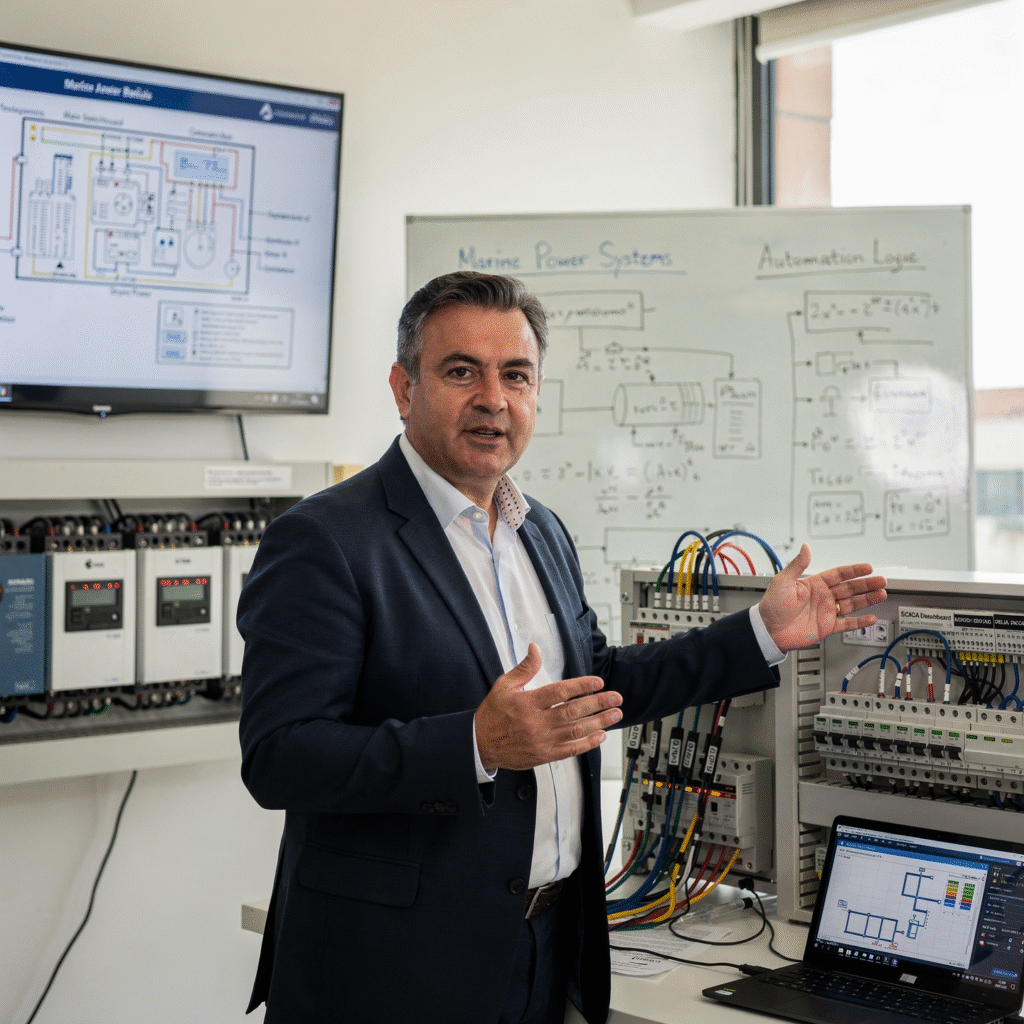
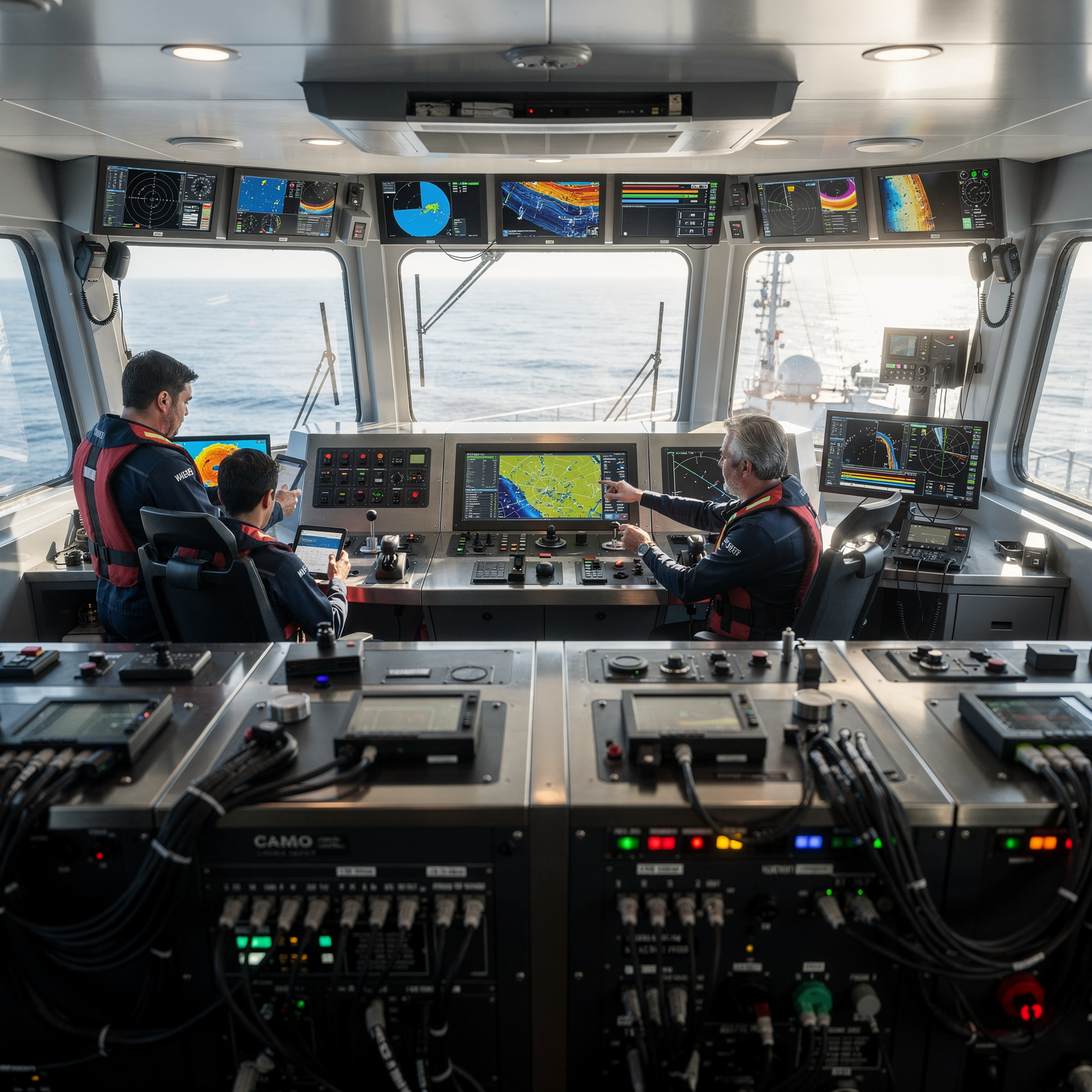
- Marine Instrumentation Laboratory: experimentation with real equipment and simulation software.
- Real-World Case Studies: analysis of instrumentation projects on ships, platforms, and ports.
- Industry Experts: masterclasses and mentoring with leading professionals in marine instrumentation.
- Professional Certification: preparation for obtaining industry-recognized certifications.
- Networking: access to a network of key contacts for professional development.
- Modality: Online
- Level: Masters
- Hours: 1600 H
- Start date: 25-04-2026
Availability: 1 in stock
Who is it aimed at?
- Electronic and control engineers who wish to specialize in the design and maintenance of naval instrumentation systems.
- Graduates in marine and nautical engineering who seek to acquire in-depth knowledge of the sensors and equipment used in ship navigation and operation.
- Naval maintenance and repair technicians who need to update their skills in the calibration and troubleshooting of marine instrumentation.
- Maritime professionals (shipowners, shipyards, insurers) interested in improving the efficiency and safety of operations through instrumentation.
- Researchers and developers who seek to innovate in the field of marine instrumentation for applications such as environmental monitoring, emissions control, and ship automation.
Flexibility and applicability: Combines advanced theory with hands-on laboratory practice and real-world projects.
adapting to the needs of working professionals and recent graduates, with options for part-time and full-time learning.
Objectives and skills

Manage global positioning systems:
Integrate data from multiple GNSS and inertial sensors for precise and redundant navigation, validating signal integrity and mitigating atmospheric or trajectory errors.

Interpreting and applying oceanographic data:
Analyze trends, anomalies, and patterns to optimize routes and anticipate adverse weather conditions, effectively communicating the information to the crew.

Calibrate and maintain marine measuring equipment:
Following international standards (IMO, IEC) and manufacturer procedures, ensuring metrological traceability and technical documentation.

Supervise and coordinate oceanographic research projects:
“Manage human and material resources, ensuring compliance with scientific objectives, deadlines and budgets.”
Develop and implement technologies for marine environmental monitoring:
Integrate advanced sensors (acoustic, optical, chemical) into autonomous platforms (AUVs, buoys) and adapt AI algorithms to process data in real time, optimizing the detection of anomalous events and facilitating informed decision-making.
Design and implement oceanographic data acquisition systems:
“Integrate sensors (CTD, ADCP, buoys) and platforms (ships, drones) considering accuracy, power supply, and bidirectional communication.”
Study plan – Modules
- Fundamental principles of marine instrumentation system design: analysis of operational and environmental requirements
- Advanced technologies in marine sensors: integration of acoustic, optical, electromagnetic, and chemical sensors
- Communication interfaces and protocols in marine instrumentation: NMEA 0183, NMEA 2000, MODBUS, and wireless systems
- System architecture and redundancy: ensuring reliability and availability in harsh marine environments
- Advanced marine electronics: design of circuits resistant to corrosion, electromagnetic interference, and vibrations
- In-situ and laboratory calibration methodologies for naval measuring equipment
- Predictive diagnostics and preventive maintenance based on data analysis and artificial intelligence techniques
- Corrective maintenance procedures in instrumentation systems: diagnostic, repair, and replacement techniques Components
Integration and synchronization of navigation systems: GPS, gyroscopes, echo sounders, and radar systems for safe and precise navigation
International standards applicable to marine instrumentation: SOLAS, IEC 62288, IEC 61162, and electronic device certifications
Impact of the marine environment: corrosion, biofouling, temperature, and pressure on instrument lifespan and performance
Power supply and energy management systems for marine instrumentation: redundant power supplies, batteries, and renewable energy sources
Implementation of remote monitoring and automation systems for real-time monitoring and predictive analytics
Advanced practices in the installation, configuration, and commissioning of instrumentation systems on vessels and offshore platforms
Document management and maintenance records: specialized software and compliance with operating standards
Real-world case studies: failure analysis, optimization of Systems and improvements in operational safety through advanced instrumentation
Emerging innovations in marine instrumentation: smart sensors, digital twins, and the use of big data in naval operations
- Fundamentals of oceanographic sensors: physical principles, types, and classification (optical, acoustic, electrochemical, biogeochemical, and multispectral)
- Emerging technologies in marine instrumentation: development and application of autonomous sensors and underwater wireless networks
- Integration of sensors on oceanographic platforms: modular design, interoperability, and communication protocols (MODBUS, CAN, NMEA, RS-485)
- Optimization of data acquisition: strategies for noise reduction, dynamic calibration, and advanced time synchronization
- Real-time environmental monitoring systems: architecture, edge computing, and satellite transmission
- Practical applications in maritime management: early detection of hydrological phenomena, water quality, and marine habitat assessment
- Development of algorithms for multisensor data fusion: artificial intelligence, machine learning, and Predictive modeling
Predictive and preventive maintenance protocols for sensors: failure analysis, in-situ calibration, and self-diagnostic techniques
International regulations and standards for marine instrumentation: ISO, OGC-SWE, and recommendations of the Intergovernmental Oceanographic Commission (IOC-UNESCO)
Advanced case studies: practical integration in oceanographic buoys, autonomous underwater vehicles (AUVs), and permanent marine observatories
- Fundamentals of Marine Instrumentation: Physical and Chemical Principles of Oceanographic Sensors
- Design and Selection of Oceanographic Sensors: Current Profilers, CTDs, Fluorometers, and Optical Spectrometers
- Systems Integration: Modular Architecture and Communication Protocols for Autonomous Marine Platforms
- Data Interfaces and Networks: NMEA, Modbus, and OPC-UA Protocols and Interoperability Standards in Marine Instrumentation
- Laboratory and Field Calibration: Advanced Techniques to Ensure Sensor Accuracy and Reliability
- Predictive and Corrective Maintenance: Diagnosis, Repair, and Lifecycle Management of Instrumentation Equipment
- Energy Management in Instrumented Systems: Solutions for Renewable Sources and Optimization of Consumption in Marine Environments
- Implementation of Safe Navigation Systems: Integration of Sensors for Positioning, Navigation, and Real-Time Environmental Monitoring
- Data quality assessment protocols: anomaly detection and cross-validation in oceanographic sensor networks
- Advanced applications: climate change monitoring, marine resource management, and decision support for critical maritime operations
- Fundamentals of marine instrumentation: types of sensors, measurement principles, and their application in coastal and oceanic environments
- Real-time oceanographic data acquisition: system architectures, communication protocols, and signal timing synchronization
- Advanced in-situ instrument calibration: static and dynamic methods, cross-validation, and systematic error correction
- Automated quality control: international standard criteria, anomaly detection, statistical filtering, and adaptive algorithms for oceanographic data
- Controlled lossy data compression: specific digital techniques for multidimensional data, impact on integrity, and transmission efficiency
- Satellite telemetry applied to oceanography: compatible systems, spectral bands used, latency, bandwidth, and robustness against atmospheric interference
- Multisensor data integration and fusion: combination algorithms, uncertainty modeling, and benefits for representation Environmental precision.
Implementation of artificial intelligence for advanced analysis: convolutional neural networks, supervised and unsupervised learning applied to the identification of oceanographic patterns.
Development of predictive models and operational decision-making tools: machine learning for forecasting critical marine phenomena and real-time logistics optimization.
Early warning systems and big data management: cloud architecture, cybersecurity, and protocols for immediate response to extreme oceanographic events.
- Fundamentals of emerging technologies in marine instrumentation: historical evolution, current state, and future trends
- Smart instruments for oceanographic measurement: design, accuracy, and calibration of multidisciplinary sensors
- Implementation of IoT (Internet of Things) systems on marine platforms: architecture, communication protocols, and real-time data management
- Advanced applications of underwater acoustics: multibeam sonar, underwater LIDAR, and their integration with dynamic positioning systems
- Use of autonomous underwater vehicles (AUVs) and remotely operated vehicles (ROVs) in scientific exploration and environmental monitoring
- Big Data and predictive analytics in marine instrumentation: algorithms for signal processing, anomaly detection, and marine ecosystem modeling
- Distributed sensor networks and their temporal synchronization using GNSS systems and error compensation methods
- Advanced strategies for environmental monitoring Intelligent: Oceanographic, Meteorological, and Biogeochemical Parameters
Integration of Artificial Intelligence and Machine Learning for Operations Optimization and Predictive Maintenance in Marine Instrumentation Systems
Specific Cybersecurity Protocols for Marine Instrumentation: Data Protection, Intrusion Prevention, and Incident Response in Remote Environments
Case Studies of Implementation in Real-World Projects: Design, Installation, Calibration, and Operation of Instrumentation Systems in Complex Environments
International Regulations and Technical Standards Applicable to Advanced Marine Instrumentation: Compliance and Certification
Methodologies for the Efficient Management of Hydrographic and Oceanographic Data: Storage, Visualization, and Reporting for Strategic Decision-Making
Sustainable Development and Environmental Considerations: Minimizing the Impact of Marine Instrumentation on Sensitive Ecosystems
The Future of Marine Instrumentation: Integration of Quantum Technologies, Bio-inspired Sensors, and Next-Generation Satellite Communications generation
- Advanced principles of marine instrumentation system design: sensor selection, redundancy, and modularity for harsh marine environments
- Innovative materials and technologies in the manufacture of oceanographic instruments resistant to corrosion, biofouling, and extreme pressures
- Calibration and certification methodologies for multi-parameter sensors to ensure accuracy in measurements of critical oceanographic variables (temperature, salinity, turbidity, pH, dissolved oxygen)
- Integration of instrumentation systems: network architectures, standard protocols (NMEA 0183, NMEA 2000, MODBUS, OPC UA), and interoperability solutions for floating, submersible, and seabed platforms
- Automation and control in marine instrumentation: implementation of SCADA, embedded systems, and advanced software for real-time monitoring and data processing
- Techniques Advanced predictive and corrective maintenance techniques for marine instrumentation systems, including vibration analysis, ultrasound, and thermography applied to electronic and mechanical components.
Design of autonomous power supply systems in ocean environments, incorporating solar, wind, and hybrid systems for extended operations.
Lifecycle management of instrumentation devices: upgrade strategies, on-site repair, and environmentally responsible disposal.
Implementation of smart sensors for navigation: integration of GNSS, INS, and high-precision acoustic positioning systems for coastal and deep-sea oceanography applications.
Application of remote sensing and underwater LIDAR technologies for mapping, current monitoring, and assessment of critical marine habitats.
Marine observation networks: design, deployment, and monitoring of distributed systems for environmental management and marine disaster prevention through early detection.
Security, cybersecurity, and resilience protocols for marine instrumentation: prevention of unauthorized access. Authorized and protection against electromagnetic interference
Advanced analysis of oceanographic data: filtering algorithms, artificial intelligence, and predictive modeling applied to integrated ocean management
Practical applications in coastal and ocean environmental monitoring: case studies in pollution control, monitoring of hydrometeorological events, and assessment of anthropogenic impacts
International regulations and technical standards applicable to marine instrumentation: compliance, certification, and adaptation to global regulatory frameworks for navigation and environmental management
- Fundamentals of marine instrumentation: physical principles, sensors, and transducers applied to ocean environments
- Advanced sensor technologies for oceanographic monitoring: multifrequency sonar, ADCP (Acoustic Doppler Current Meters), and underwater LIDAR
- Integrated maritime navigation systems: fusion of GNSS, INS, radar, echo sounders, and AIS data for real-time positioning and guidance
- Data acquisition platforms and networks: design, installation, and maintenance of automatic oceanographic stations and remote sensors
- Underwater communication and data transmission: acoustic, optical, and radio frequency methods in harsh marine environments
- Environmental data modeling and analysis: advanced algorithms for oceanographic parameter interpretation, anomaly detection, and weather forecasting
- Instrumentation for smart environmental management: quality monitoring
- Water quality, pollution, marine biodiversity, and protected habitats monitored using biochemical and chemical sensors
- Automation and control on offshore platforms: integration of SCADA systems for real-time monitoring, diagnostics, and response
- Emergencies and safety in marine instrumentation: redundancy protocols, field calibration, and contingency strategies for critical failures
- Future trends in marine instrumentation: artificial intelligence, machine learning for route optimization, and autonomous technologies in unmanned underwater vehicles (AUVs)
- Fundamentals of marine instrumentation: physical and chemical principles applied to underwater sensors
- Types and characteristics of marine sensors: pressure, temperature, salinity, dissolved oxygen, and current sensors
- Data acquisition systems: modular architectures, communication protocols, and industry standards (NMEA, MODBUS, CANbus)
- Advanced calibration methodologies: in-situ versus laboratory calibration and traceable certification techniques for marine sensors
- Implementation of self-tuning and adaptive correction algorithms in intelligent instrumentation systems
- Integration of instrumentation systems with navigation and oceanographic monitoring platforms: ECDIS, GNSS, radars, and acoustic data systems
- Optimizing measurement accuracy through sensor redundancy and real-time data fusion
- Predictive diagnostics and preventive maintenance based on trend analysis and machine learning applied to Marine Instrumentation
Development of dynamic calibration protocols for variable ocean conditions and environmental impacts (salinity, pressure, temperature)
International standards for calibration and quality control in marine instrumentation: ISO, IEC, and IMO recommendations
Impact of advanced instrumentation on improving navigational safety and the accuracy of marine environmental monitoring
Case studies for the application of smart calibration in real-world oceanography and offshore platform projects
Software tools for instrument calibration and control management: implementation, configuration, and data analysis
Risks associated with instrument failures and mitigation strategies using redundant and automatic control systems
Capacity to design and execute comprehensive calibration plans that ensure operational reliability in extreme marine environments
- Fundamentals of marine instrumentation: types of sensors and physical principles applied in ocean environments
- Instrumentation for measuring oceanographic parameters: temperature, salinity, pressure, and turbidity sensors
- Advanced acoustic sensors: multifrequency echosounders, ADCP (Acoustic Doppler Currents), and their integration into dynamic monitoring systems
- Integrated inertial and GNSS systems technology for high-precision navigation in marine environments
- Design and architecture of distributed sensor networks: considering topology, redundancy, and real-time data transmission
- LIDAR systems and their application in coastal mapping and high-resolution bathymetric mapping
- Automation and remote monitoring through fixed and floating oceanographic stations: design, calibration, and maintenance
- Advanced signal processing: filtering, Error compensation and real-time analysis for oceanographic data quality
Multimodal integration of sensors for early warning systems in extreme meteorological and oceanographic events
Communication protocols and technological standards in marine instrumentation: NMEA, MODBUS, SBE, and their application in interoperable networks
Implementation of IoT and Big Data analytics platforms in oceanographic data management for strategic decision-making
Development of specialized software for the visualization, interpretation, and predictive modeling based on marine instrumental data
International standards and technical certifications applicable to marine instrumentation: IEC, ISO, and IMO recommendations
Advanced in-situ and laboratory calibration techniques: ensuring accuracy and metrological traceability in oceanographic sensors
Practical implementation case studies in real-world projects for marine environmental monitoring, safe navigation, and sustainable resource management oceanic
- Conceptualization and objectives of the final project: multidisciplinary integration and practical application in complex marine environments
- Advanced methodologies for the design of instrumentation systems: requirements analysis, sensor selection, protocols, and integrated architecture
- Instrumentation for ocean navigation: next-generation GNSS, inertial systems, radar integration, echo sounders, and high-precision gyroscopes
- Real-time environmental monitoring: oceanographic sensors for physical, chemical, and biological variables, calibration, and data validation
- Application of IoT technologies and underwater communication networks for efficient data transmission and management
- Design and simulation of integrated systems on marine platforms: computational modeling, performance analysis, and optimization
- Energy management and autonomy in marine instrumentation systems: renewable sources, storage, and energy efficiency
- Implementation of security protocols, Redundancy and recovery to ensure continuous and reliable operation
Data analysis and visualization tools: advanced processing, machine learning, and decision support in ocean management
International regulations, technical standards, and certifications applicable to advanced marine instrumentation
Real-world case studies and practical applications: scientific vessels, oil platforms, environmental monitoring stations, and autonomous devices
Planning, execution, and documentation of the final project: agile methodologies, quality control, and professional presentation
Critical evaluation and ethical considerations in marine instrumentation: sustainability, environmental impact, and technological responsibility
Career prospects
“`html
- Marine Instrumentation Engineer: Design, development, installation, and maintenance of instrumentation systems on offshore platforms, oceanographic vessels, and other maritime infrastructure.
- Marine Sensor Specialist Technician: Calibration, repair, and optimization of sensors for measuring oceanographic, meteorological, and geophysical variables.
- Marine Technology Consultant: Advising companies and public organizations on the selection, implementation, and management of marine instrumentation technologies.
- Research Scientist: Participation in oceanographic and environmental research projects, using marine instrumentation for data collection and analysis.
- Oceanographic Data Manager: Processing, quality control, and archiving of data obtained with marine instrumentation, ensuring its accessibility and reliability.
- Software Developer for
- Marine Instrumentation: Creation of applications and tools for the management, visualization, and analysis of data from marine instrumentation systems.
- Offshore Wind Farm Instrumentation Manager: Monitoring the performance of wind turbines and environmental conditions in offshore wind farms, using specific sensors and instrumentation systems.
- Underwater Acoustics Expert: Design and implementation of acoustic monitoring systems for the study of marine fauna, the detection of ambient noise, and the assessment of the impact of human activities on the marine environment.
“`
Entry requirements

Academic/professional profile:
Bachelor’s degree in Nautical Science/Maritime Transport, Naval/Marine Engineering or a related qualification; or proven professional experience on the bridge/in operations.

Language proficiency:
Functional Maritime English (SMCP) recommended for simulations and technical materials.

Documentation:
Updated CV, copy of qualification or seaman’s book, national ID/passport, motivation letter.

Technical requirements (for online):
Device with camera/microphone, stable internet connection, monitor ≥ 24” recommended for ECDIS/Radar-ARPA.
Admissions process and dates

Online
application
(form + documents).

Academic review and interview
Admissions decision

Admissions decision
(+ scholarship offer if applicable).

Place reservation
(deposit) and enrolment.

Induction
(access to the virtual campus, calendars, simulator guides).
Scholarships and financial support
- Master Naval Technology: delve into marine sensors, navigation and control systems, and communication equipment.
- Design and Implementation: learn to design, install, and maintain instrumentation for all types of vessels.
- Marine Data Analysis: acquire skills in the processing and interpretation of oceanographic and meteorological data.
- Regulations and Safety: understand international regulations and best practices in marine instrumentation.
- Practical Applications: explore case studies and real-world projects in the naval and oceanographic industries.
Testimonials
This Master’s in Marine Instrumentation exceeded my expectations. I gained in-depth theoretical and practical knowledge in the design, calibration, and maintenance of oceanographic instrumentation. The laboratory sessions and field trips allowed me to apply what I learned in real-world situations, effectively preparing me for my current role as an engineer at a leading company in the sector. I would like to highlight the quality of the faculty, their experience, and the personalized attention I received. Thanks to this training, I feel highly qualified to face the challenges of the marine industry.
During my Master’s degree in Hydrography and Applied Oceanography, I developed a predictive model of coastal currents using machine learning techniques, which exceeded the accuracy of existing models by 15%, and was successfully implemented by a local maritime engineering company to optimize port logistics.
This master’s program provided me with the tools and knowledge necessary to lead the development of a new ocean monitoring system. Applying the principles I learned about sensors, platforms, and data analysis, we successfully implemented a network of smart buoys that provide crucial real-time data for marine research and coastal management, exceeding expectations for accuracy and efficiency.
This master’s program provided me with the tools and knowledge necessary to lead the development of a new multibeam sonar system. Its practical approach, combined with a solid theoretical foundation, allowed me not only to understand the principles of marine instrumentation but also to apply them effectively in a demanding professional context, resulting in a significant improvement in the accuracy and efficiency of our company’s system.

Frequently asked questions
Pressure, temperature, conductivity, salinity, dissolved oxygen, pH sensors, current meters, current profilers, sonar, echo sounders, remotely operated vehicles (ROVs) and acoustic positioning systems.
Yes. The itinerary includes ECDIS/Radar-ARPA/BRM with harbor, ocean, fog, storm, and SAR scenarios.
Online with live sessions; hybrid option for simulator/practical placements through agreements.
Recommended functional SMCP. We offer support materials for standard phraseology.
Yes, with a relevant degree or experience in maritime/port operations. The admissions interview will confirm suitability.
Optional (3–6 months) through Companies & Collaborations and the Alumni Network.
Simulator practice (rubrics), defeat plans, SOPs, checklists, micro-tests and applied TFM.
A degree from Navalis Magna University + operational portfolio (tracks, SOPs, reports and KPIs) useful for audits and employment.
- Conceptualization and objectives of the final project: multidisciplinary integration and practical application in complex marine environments
- Advanced methodologies for the design of instrumentation systems: requirements analysis, sensor selection, protocols, and integrated architecture
- Instrumentation for ocean navigation: next-generation GNSS, inertial systems, radar integration, echo sounders, and high-precision gyroscopes
- Real-time environmental monitoring: oceanographic sensors for physical, chemical, and biological variables, calibration, and data validation
- Application of IoT technologies and underwater communication networks for efficient data transmission and management
- Design and simulation of integrated systems on marine platforms: computational modeling, performance analysis, and optimization
- Energy management and autonomy in marine instrumentation systems: renewable sources, storage, and energy efficiency
- Implementation of security protocols, Redundancy and recovery to ensure continuous and reliable operation
Data analysis and visualization tools: advanced processing, machine learning, and decision support in ocean management
International regulations, technical standards, and certifications applicable to advanced marine instrumentation
Real-world case studies and practical applications: scientific vessels, oil platforms, environmental monitoring stations, and autonomous devices
Planning, execution, and documentation of the final project: agile methodologies, quality control, and professional presentation
Critical evaluation and ethical considerations in marine instrumentation: sustainability, environmental impact, and technological responsibility
Request information
Complete the Application Form.
Attach your CV/degree certificate (if you have it to hand).
Indicate your preferred cohort (January/May/September) and whether you would like the hybrid option with simulator sessions.
An academic advisor will contact you within 24–48 hours to guide you through the admission process, scholarships, and compatibility with your professional schedule.
Faculty
Eng. Tomás Riera
Full Professor
Eng. Tomás Riera
Full Professor
Eng. Sofía Marquina
Full Professor
Eng. Sofía Marquina
Full Professor
Eng. Javier Bañuls
Full Professor
Eng. Javier Bañuls
Full Professor
Dr. Nuria Llobregat
Full Professor
Dr. Nuria Llobregat
Full Professor
Dr. Pau Ferrer
Full Professor
Dr. Pau Ferrer
Full Professor
Cap. Javier Abaroa (MCA)
Full Professor
Cap. Javier Abaroa (MCA)
Full Professor