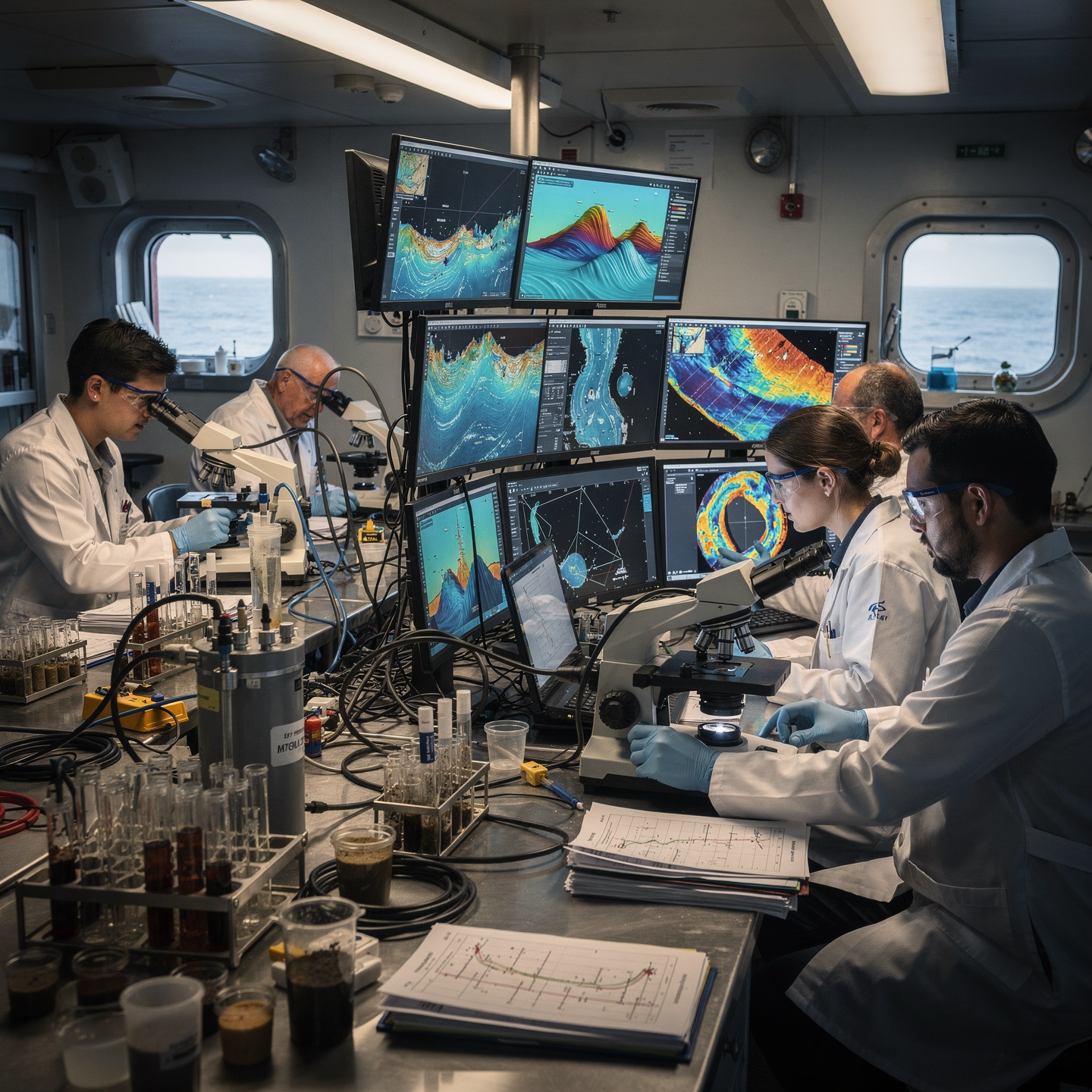
Master’s Degree in Physical Oceanography and Marine Modeling

Why this master’s programme?

The Master’s in Physical Oceanography and Marine Modeling

Immerse yourself in the study of the physical processes that govern the oceans, from surface currents to the abyssal depths. Learn to use and develop state-of-the-art numerical models to understand and predict ocean behavior, its interaction with the atmosphere, and its impact on the global climate. This program provides you with the necessary tools to address crucial challenges such as climate change, the sustainable management of marine resources, and the prediction of extreme events.

Differential Advantages

  • Comprehensive Training: Covers everything from fundamental theory to practical applications in oceanography.
  • Advanced Modeling: Master ocean modeling techniques and their implementation on supercomputers.
  • Oceanographic Data: Learn to analyze and interpret large observational and simulated datasets.
  • Applied Research: Participate in cutting-edge research projects in collaboration with leading institutions.
  • Career Opportunities: Open doors to careers in research, environmental management, marine energy, and consulting.
Oceanografía

Master’s Degree in Physical Oceanography and Marine Modeling

Availability: 1 in stock

Who is it aimed at?

  • Graduates in Marine Sciences, Physics, Mathematics, or Engineering seeking advanced specialization in ocean dynamics and numerical modeling.
  • Researchers and professionals in the maritime sector interested in understanding and predicting ocean behavior for coastal management, marine energy, or climate change.
  • Environmental consultants and public administration technicians who need tools and knowledge for coastal risk assessment and land-use planning.
  • Project and operations managers in energy or fishing companies who require accurate oceanographic data to optimize their activities.
  • Teachers and educators who wish to update their knowledge in physical oceanography and marine modeling for application in the Teaching.

Academic Flexibility
 Adapted to your needs: online and blended learning options, practical projects with real data, and personalized tutoring for your professional development.

Oceanografía

Objectives and skills

Develop oceanographic models to predict the behavior of ocean currents:

“Implement coupled atmosphere-ocean numerical models, validate them with observational data (in situ and satellite) and calibrate them to improve the predictive accuracy of currents at different spatial and temporal scales.”

Assess the impact of climate change on ocean circulation and marine ecosystems:

Analyze oceanographic data and climate models to predict changes in currents, temperature and salinity, and identify vulnerable species and changes in primary productivity.

Analyze and forecast extreme oceanographic events, such as storm surges or coastal upwellings:

Use numerical models and historical data to simulate events, calibrate results with real observations, and communicate risks to stakeholders.

Managing and optimizing marine resources through the modeling of physical processes:

“Develop predictive models of currents, tides and waves to optimize navigation routes, port operations and coastal risk mitigation strategies.”

Implement and validate oceanographic observation systems to improve model accuracy:

“Configure, deploy and maintain oceanographic buoys, profilers and remote sensors (satellite, aerial) to collect in situ and ex situ data, ensuring the quality of the information through calibration and error control.”

Design and implement coastal risk mitigation and adaptation strategies based on oceanographic models:

“Develop and implement early warning systems (EWS) for extreme events (storm surges, tsunamis) by integrating real-time oceanographic data and predictive models to optimize the evacuation and protection of critical infrastructure.”

Study plan – Modules

  1. Physical Foundations of Coastal Dynamics: Coriolis Forces, Ekman Effect, and Pressure Gradients in Coastal Zones
  2. Coastal Hydrodynamic Processes: Waves, Tidal Currents, Littoral Circulation, and Thermal Stratification
  3. Atmosphere-Ocean Interaction: Momentum Transfer, Heat Exchange, and Mixing Processes in Coastal Zones
  4. Numerical Modeling Applied to Coastal Dynamics: Mathematical Formulation, Discretization, and Resolution Techniques
  5. Implementation of Hydrodynamic Models: Input Parameters, Initial and Boundary Conditions in Open and Semi-Closed Systems
  6. Wave and Storm Prediction Models: Integration of Observational and Satellite Data for Improved Forecasting
  7. Numerical Simulation of Extreme Oceanic Phenomena: Storm Surges, Tsunamis, and Coastal Flooding Events
  8. Validation and calibration of coastal models: statistical techniques, sensitivity analysis, and uncertainty assessment

    Practical applications in risk management: design of early warning systems and mitigation plans for extreme events

    Case studies and analysis of recent events: methodology, results, and lessons learned for the continuous improvement of coastal modeling

  1. Fundamental principles of ocean hydrodynamics: analysis of Coriolis forces, hydrostatic pressure, and geostrophic gradients in marine environments
  2. Basic and advanced equations of motion: derivation and application of the Navier-Stokes equations in marine fluids and their simplification using geophysical approximations
  3. Vorticity and turbulence dynamics in ocean fluids: generation, transport, and dissipation mechanisms at meso- and submeso scales
  4. Mathematical models of ocean circulation: numerical techniques for solving three-dimensional and coupled hydrodynamic models
  5. Advanced computational simulation: use of finite element and finite volume methods in the spatial and temporal discretization of marine dynamics
  6. Analysis and validation of modeled data: integration of satellite observations, buoys, and CTD profiles for calibration and Verification of oceanographic models
  7. Modeling of tidal currents and coastal circulation: implementation of atmospheric, tidal, and thermohaline forcings to predict local and regional patterns

    Studies of ocean-atmosphere interaction: coupled modeling and analysis of physicochemical processes at the air-sea interface

    Use of supercomputing and scalability in marine modeling: code optimization and parallelization for simulations at high spatiotemporal resolutions

    Practical applications: prediction of extreme events, modeling of pollutant transport, and support for the sustainable management of marine resources

  1. Mathematical and physical foundations of numerical modeling applied to coastal dynamics: Navier-Stokes equations, conservation of mass and momentum, energy balances
  2. Numerical hydrodynamic models for coastal environments: configuration, parameterization, and validation of ADCIRC, ROMS, and Delft3D models
  3. Atmosphere-ocean interaction processes: dynamic couplings in marine surface and subsurface models
  4. Simulation of waves and coastal currents: spectral modeling, data assimilation techniques, and spatiotemporal analysis for areas of high geographical complexity
  5. Advanced prediction of extreme ocean phenomena: tropical cyclones, tsunamis, and storm surges using integrated hydrodynamic and hydraulic models
  6. Implementation and evaluation of numerical schemes: finite differences, elements Finite and finite volumes applied to coastal dynamics

    Incorporation of observational and remote sensing data into predictive models: management of buoy networks, coastal radars, and satellites

    Probabilistic analysis and uncertainty scenarios for coastal risk management based on numerical model output

    Computational optimization and parallelization of models for high-resolution temporal and spatial processing

    Practical applications: design of early warning systems for tsunamis and storm surges, modeling of erosion and sedimentation in beaches and estuaries

  1. Fundamentals of physical oceanography applied to modeling: thermohaline properties, coastal dynamics, and temporal and spatial scales of oceanic processes
  2. Principles and mathematical formulation of hydrodynamic models: Navier-Stokes equations, hydrostatic and non-hydrostatic approximations, turbulence parameterization, and dissipation processes
  3. Implementation and configuration of multiscale numerical models: coupling of regional, coastal, and high-resolution models for coherent and accurate simulations
  4. Advanced assimilation of oceanographic and atmospheric data: variational techniques, Kalman filters, optimization, and real-time uncertainty assessment
  5. Integration of in-situ and satellite observations for dynamic improvement of model states: floating platforms, buoys, high-frequency radars, and remote sensors
  6. Supercomputing applied to physical oceanography: architectures HPC, parallelization, scalability, and algorithm optimization for operational modeling

    Detailed study of extreme coastal events: waves, storms, storm surges, and their prediction using physical and statistical models

    Development and analysis of operational prediction products for decision-making in risk management: early warnings, impact simulations, and support for contingency plans

    Implementation of integrated modeling systems: coupling frameworks, data interoperability, and standards for multiscale prediction

    Applied cases and international experiences in coastal management using operational modeling: environmental impact assessments, land-use planning, and marine risk mitigation

  1. Fundamentals of remote sensing applied to oceans: physical principles, types of sensors, and satellite platforms
  2. Advanced satellite image processing: radiometric, atmospheric, and geometric correction for ocean data
  3. Spectral and multispectral analysis for characterizing ocean parameters: chlorophyll, surface temperature, and turbidity
  4. Application of SAR (Synthetic Aperture Radar) techniques for monitoring currents, waves, and marine surface structure
  5. Integration of remotely sensed data with numerical models of ocean dynamics: data assimilation and validation of results
  6. Development and analysis of time series for the study of complex ocean phenomena and their spatial variability
  7. Use of machine learning algorithms and artificial intelligence techniques for classification and segmentation of marine images
  8. Real-time monitoring of extreme ocean events using remote sensing systems and in-situ sensors
  9. Advanced interpretation and visualization of multidimensional data for decision-making in marine management
  10. Current and future trends in ocean remote sensing: hyperspectral satellites, autonomous sensor networks, and integrated modeling
  1. Advanced Foundations of Ocean Dynamics: Navier-Stokes Equations Applied to Geophysical Fluids and Hydrodynamic Simplifications for Marine Environments
  2. Numerical Hydrodynamic Models: Computational Meshes, Spatial and Temporal Discretization, Finite Methods and Finite Volumes, Stability and Convergence
  3. Simulation and Analysis of Extreme Oceanic Phenomena: Storm Surges, Extratropical Storms, Tsunamis, and Extreme Waves;
  4. Real-world case studies and validation with observational data
  5. Multiscale prediction in oceanography: integration of regional and global models, atmosphere-ocean coupling, dynamic and statistical downscaling for coastal and marine scenarios
  6. Advanced remote sensing technologies: altimetric satellites, radiometers, scatterometers, hyperspectral sensors, and LIDAR systems for continuous monitoring of oceanographic variables
  7. Remote data processing: calibration, atmospheric correction, multispectral analysis, and data fusion for accurate estimation of critical ocean parameters
  8. Sustainable management of marine ecosystems through modeling: integration of physical, chemical, and biological variables to assess climate and anthropogenic impacts on biodiversity and fisheries
  9. Development of early warning systems based on numerical modeling and remote sensing, validation protocols, and effective communication for coastal risk mitigation
  10. Specialized software and scientific platforms: expert use of ROMS, HYCOM, Delft3D, SWAN, and geospatial visualization tools for advanced modeling and analysis
  11. Applied case studies: marine planning, coastal land-use planning, adaptive management in the face of climate change, and restoration of vulnerable habitats
  1. Mathematical Foundations of Numerical Modeling in Oceanography: Partial Differential Equations, Discrete Methods, and Numerical Stability
  2. Geophysical Fluid Dynamics Applied to Oceanography: Scale Analysis, Earth’s Rotation, Coriolis Effect, and Tidal Forces
  3. Advanced Hydrodynamic Models: Navier-Stokes, Boundary Layer Models, and Turbulence Parametrization in Coastal and Oceanic Environments
  4. Implementation of Sophisticated Numerical Schemes: Finite Difference, Finite Volume, and Finite Element Methods for Current and Wave Simulation
  5. Integration of Observational Oceanographic Data: Assimilation of Satellite, Buoy, and Autonomous Sensor Data to Improve Modeling Accuracy
  6. Multiscale Prediction Systems: Coupling Regional and Global Models for the Dynamic Characterization of Marine Ecosystems
  7. Modeling Coupled biogeochemistry: simulation of biological processes and their interaction with oceanographic physics in vertical and horizontal structure

    Computational optimization and parallelization techniques: high-resolution simulations and reduction of computation times using HPC (High Performance Computing)

    Practical applications for sustainable management: environmental impact assessment, climate risk mitigation, and marine protected area planning

    Development and validation of operational early warning systems: integration of numerical modeling with real-time monitoring systems for ecosystem protection

  1. Fundamentals of Ocean Dynamics: Physical Properties of Water, Equations of Motion, and Conservation of Mass and Energy in Marine Fluids
  2. Multiscale Processes in Physical Oceanography: From Microscopic Turbulence to Global Thermohaline Circulation
  3. Coastal-Oceanic Interaction: Coastal Phenomena, Upwelling, and Their Impact on the Marine Ecosystem
  4. Integrated Numerical Modeling: Introduction to Discretization Techniques, Numerical Schemes, and Computational Methods Applied to Ocean Fluids
  5. Advanced Hydrodynamic Models: Implementation of 3D, Coupled, and Mesoscale Models for Simulating Currents, Tides, and Waves
  6. Data Assimilation in Oceanography: Techniques for Integrating In-Situ and Satellite Observations to Improve the Accuracy of Predictive Models
  7. Prediction and Monitoring of Critical Events: Modeling Extreme Phenomena such as Cyclones, tsunamis, red tides, and pollution spills
  8. Model-based environmental management tools: applications for coastal planning, impact mitigation, and marine habitat conservation

    Statistical and machine learning methods applied to multiscale analysis in physical oceanography

    Case studies and computational simulations: design, implementation, and validation of projects aimed at solving real-world problems in oceanography and marine management

  1. Theoretical foundations of numerical modeling in oceanography: Navier-Stokes equations, hydrostatic and non-hydrostatic approximations, and principles of geophysical fluid dynamics
  2. Advanced hydrodynamic models: implementation and parameterization of models such as ROMS, MITgcm, and FVCOM, with a focus on their adaptation to coastal areas and the open ocean
  3. Physical processes in the water column: simulation of turbulent mixing, thermal stratification, thermocline dynamics, and circulation generated by winds and tides
  4. Atmosphere-ocean coupling: techniques for integrating meteorological models with oceanographic models using information exchange and dynamic feedback techniques
  5. Modeling extreme scenarios: waves, storms, and storm surge events; Integration of predictive models for coastal risk assessment

    Introduction and advanced use of integrated oceanographic prediction systems (IOPS): architecture, oceanographic databases, assimilation of in-situ and remote data, and real-time operation

    Numerical methods and computational strategies for model optimization: discretization, solving partial differential equations, parallelization, and the use of high-performance computing (HPC) in oceanography

    Model validation and verification: statistical analysis, comparison with experimental data, resampling techniques, and performance metrics for marine physical modeling

    Applications in the sustainable management of marine ecosystems: current modeling for monitoring pollutants, nutrient dispersion, and prediction of critical habitats for fauna

    Practical cases of integrating predictive systems into decision-making: coastal management plans, sustainable marine planning, and responses to pollution and extreme weather events

    Development and design of oceanographic products for end users: visualization, early warning generation, dynamic maps, and technical reports tailored to government and private sector needs.

    Future perspectives and trends in numerical oceanographic modeling: artificial intelligence, stochastic modeling, and model adaptation for climate change scenarios.

  1. Advanced theoretical foundations in physical oceanography: fluid dynamics, ocean thermodynamics, and momentum transfer
  2. Mathematical and numerical modeling applied to ocean phenomena: Navier-Stokes equations, longshore drift, and turbulence modeling
  3. Integration of satellite and in-situ remote sensing data: image processing, SAR sensors, altimetry, and ocean fluorescence
  4. Development and calibration of 3D hydrodynamic models for simulating tides, currents, and extreme waves
  5. Implementation of numerical data assimilation algorithms to improve prediction accuracy in coastal and ocean systems
  6. Evaluation and modeling of extreme phenomena: tsunamis, intense storms, storm surges, and upwelling events
  7. Advanced statistical analysis for prediction Probabilistic and risk assessment in sensitive marine ecosystems

    Development of integrated GIS platforms for the real-time visualization and management of oceanographic data and forecasts

    Applications in sustainable management: design of adaptive plans for the conservation and management of marine protected areas in the face of climate threats

    Case studies and simulations focusing on public policy, maritime management, and environmental impact mitigation

    Writing and presentation of technical and scientific reports to support decision-making in coastal and maritime management

    Interdisciplinary collaborative work and use of advanced programming tools (Python, MATLAB, R) for the implementation of the integrated system

    Validation and implementation of prototypes through field campaigns and comparisons with real observational data

    International ethical and regulatory considerations related to the monitoring and sustainable exploitation of marine resources

    Defense Final project report and proposal for future lines of research to expand the predictive and adaptive management of marine systems.

    […]

Career prospects

“`html

  • Research Scientist in oceanographic research centers, developing models and data analysis.
  • Operational Oceanographer in government agencies or private companies, monitoring the state of the ocean and predicting its evolution.
  • Marine Environmental Consultant, evaluating the impact of human activities on the marine environment and proposing mitigation measures.
  • Marine Modeler, creating and calibrating numerical models to simulate oceanographic processes.
  • Marine Resource Manager, participating in the planning and sustainable management of marine protected areas.
  • Oceanographic Data Analyst, processing and analyzing large volumes of data to obtain relevant information.
  • Climate Change Specialist, investigating the impact of climate change on the oceans. and the coasts.
  • Oceanographic Instrumentation Technician, installing, maintaining, and calibrating measuring equipment at sea.
  • University Lecturer/Researcher, teaching classes and directing oceanographic research projects.
  • Marine Renewable Energy Project Manager, studying and evaluating resources and their environmental impact.

“`

Entry requirements

Academic/professional profile:

Bachelor’s degree in Nautical Science/Maritime Transport, Naval/Marine Engineering or a related qualification; or proven professional experience on the bridge/in operations.

Language proficiency:

Functional Maritime English (SMCP) recommended for simulations and technical materials.

Documentation:

Updated CV, copy of qualification or seaman’s book, national ID/passport, motivation letter.

Technical requirements (for online):

Device with camera/microphone, stable internet connection, monitor ≥ 24” recommended for ECDIS/Radar-ARPA.

Admissions process and dates

Online
application

(form + documents).

Academic review and interview

Admissions decision

Admissions decision

(+ scholarship offer if applicable).

Place reservation

(deposit) and enrolment.

Induction

(access to the virtual campus, calendars, simulator guides).

Scholarships and financial support

  • In-depth Analysis: Master ocean physics, from currents to tides, and their impact on global climate.
  • Advanced Modeling: Learn to create and use numerical models to predict the behavior of the ocean and its ecosystems.
  • Oceanographic Data: Acquire skills in managing and analyzing large oceanographic datasets.
  • Practical Applications: Develop innovative solutions for coastal management, climate change mitigation, and marine resource exploration.
  • Cutting-Edge Research: Participate in state-of-the-art research projects and contribute to the advancement of oceanographic knowledge.
Boost your career as an expert in the study and protection of our oceans.

Testimonials

Frequently asked questions

Ocean dynamics and its numerical modeling.

Yes. The itinerary includes ECDIS/Radar-ARPA/BRM with harbor, ocean, fog, storm, and SAR scenarios.

Online with live sessions; hybrid option for simulator/practical placements through agreements.

It focuses primarily on the physical processes of the ocean, including geophysical fluid dynamics, ocean circulation, waves and tides, and the numerical modeling of these processes. While there may be some elective courses related to marine biology or chemistry, the main focus is on physics.

Recommended functional SMCP. We offer support materials for standard phraseology.

Yes, with a relevant degree or experience in maritime/port operations. The admissions interview will confirm suitability.

Optional (3–6 months) through Companies & Collaborations and the Alumni Network.

Simulator practice (rubrics), defeat plans, SOPs, checklists, micro-tests and applied TFM.

A degree from Navalis Magna University + operational portfolio (tracks, SOPs, reports and KPIs) useful for audits and employment.

  1. Advanced theoretical foundations in physical oceanography: fluid dynamics, ocean thermodynamics, and momentum transfer
  2. Mathematical and numerical modeling applied to ocean phenomena: Navier-Stokes equations, longshore drift, and turbulence modeling
  3. Integration of satellite and in-situ remote sensing data: image processing, SAR sensors, altimetry, and ocean fluorescence
  4. Development and calibration of 3D hydrodynamic models for simulating tides, currents, and extreme waves
  5. Implementation of numerical data assimilation algorithms to improve prediction accuracy in coastal and ocean systems
  6. Evaluation and modeling of extreme phenomena: tsunamis, intense storms, storm surges, and upwelling events
  7. Advanced statistical analysis for prediction Probabilistic and risk assessment in sensitive marine ecosystems

    Development of integrated GIS platforms for the real-time visualization and management of oceanographic data and forecasts

    Applications in sustainable management: design of adaptive plans for the conservation and management of marine protected areas in the face of climate threats

    Case studies and simulations focusing on public policy, maritime management, and environmental impact mitigation

    Writing and presentation of technical and scientific reports to support decision-making in coastal and maritime management

    Interdisciplinary collaborative work and use of advanced programming tools (Python, MATLAB, R) for the implementation of the integrated system

    Validation and implementation of prototypes through field campaigns and comparisons with real observational data

    International ethical and regulatory considerations related to the monitoring and sustainable exploitation of marine resources

    Defense Final project report and proposal for future lines of research to expand the predictive and adaptive management of marine systems.

    […]

Request information

  1. Complete the Application Form.

  2. Attach your CV/degree certificate (if you have it to hand).

  3. Indicate your preferred cohort (January/May/September) and whether you would like the hybrid option with simulator sessions.

    An academic advisor will contact you within 24–48 hours to guide you through the admission process, scholarships, and compatibility with your professional schedule.

Please enable JavaScript in your browser to complete this form.
Click or drag a file to this area to upload.

Faculty

0
    0
    Tu carrito
    Tu carrito esta vacíoRegresar a la tienda
    Scroll to Top


