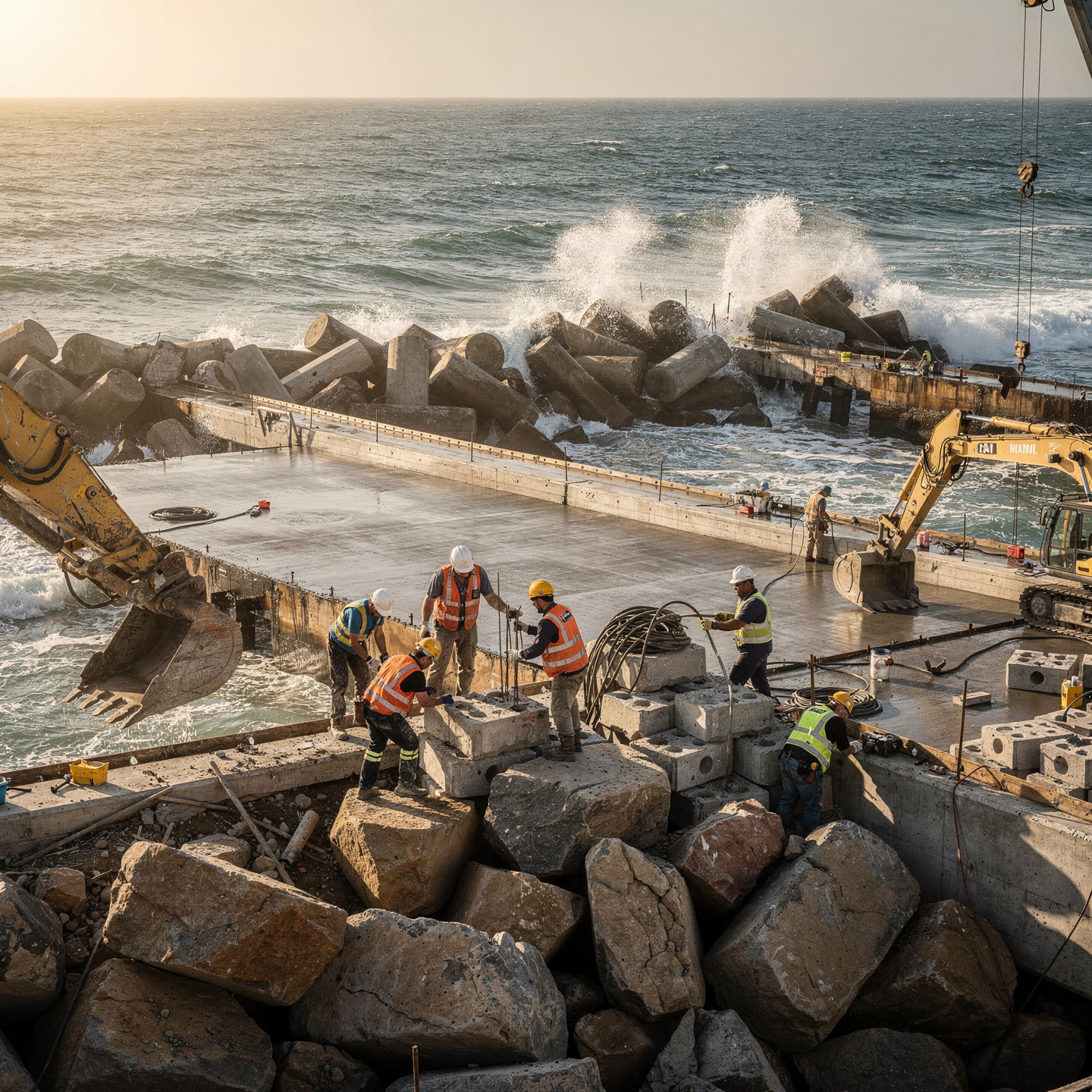
Master’s Degree in Construction of Breakwaters and Piers

Why this master’s programme?

The Master’s Degree in Breakwater and Pier Construction

This program offers comprehensive training in the design, construction, and maintenance of key maritime structures. You will learn to approach projects from planning and geotechnical studies to material selection and advanced construction techniques, including the use of BIM modeling and specialized software. Master risk management, environmental regulations, and economic aspects to lead port projects efficiently and sustainably.

Differential Advantages

  • Practical Approach: Real-world case studies and simulations to apply acquired knowledge.
  • Specialized Software: Proficiency in BIM tools and structural analysis software.
  • Sustainability: Incorporation of sustainability and environmental responsibility criteria into design and construction.
  • Networking: Networking with industry professionals and technical visits to relevant projects.
  • Certification: Awarding a recognized and industry-valued master’s degree.
Construcción

Master’s Degree in Construction of Breakwaters and Piers

Availability: 1 in stock

Who is it aimed at?

  • Civil and Road Engineers seeking specialization in the design and construction of maritime structures.
  • Architects and Technical Engineers interested in the planning and management of coastal and port projects.
  • Consultants and technicians from construction companies who need to deepen their knowledge of construction techniques and specific regulations.
  • Public administration officials (ports, coastal areas) who wish to optimize the management and maintenance of maritime infrastructure.
  • Recent Engineering graduates seeking advanced training with a practical focus and real-world application in the maritime-port sector.

Flexibility and Applicability

Adapted for working professionals: flexible online methodology, real-world case studies, and personalized tutoring with industry experts.

Construcción

Objectives and skills

Designing resilient maritime structures:

“Select innovative building materials and techniques to mitigate corrosion and the impact of extreme weather events.”

Managing port projects efficiently:

“Optimize planning, execution, and control using project management tools and agile methodologies.”

Optimizing the durability of coastal infrastructure:

“Implement erosion mitigation and corrosion protection strategies, selecting materials and construction techniques appropriate for the marine environment.”

Leading multidisciplinary teams in maritime works:

“Implement agile methodologies adapted to the maritime environment, fostering effective communication and conflict resolution among specialists.”

Mastering advanced marine foundation techniques:

“Evaluate complex geotechnical risks, select dynamic anchoring systems, and supervise installation with ROVs.”

Assessing and mitigating environmental risks in maritime construction:

“Implement environmental management plans and evaluate the effectiveness of mitigation measures during all phases of the project.”

Study plan – Modules

  1. Introduction to the design of groynes and piers: structural fundamentals, types, and specific functions in marine environments
  2. Characteristics and classification of adverse marine environments: analysis of waves, currents, storms, and extreme phenomena such as tsunamis and storm surges
  3. International and national standards applied to structural design in marine construction: PIANC and ISO recommendations, and civil-maritime design codes
  4. Materials and advanced techniques for groynes and piers: selection, corrosion resistance, durability, and sustainability in saline environments
  5. Hydrodynamic modeling applied to structural calculations: CFD (Computational Fluid Dynamics) simulations for shaft-sea interaction and hydrodynamic stress analysis
  6. Advanced structural design using finite elements: analysis of stresses, strains, and structural fatigue Dynamic and cyclic loads

    Technical criteria for optimizing geometry and materials in breakwaters and piers, considering wind, live load, and extreme dead load conditions

    Seismic analysis and exceptional actions: design for earthquake resistance in coastal areas and induced effects on maritime structures

    Deep foundations and special foundations: geotechnical studies, precast piles, design and verification under complex maritime conditions

    Integration of protection and maintenance systems: coatings, anti-corrosion systems, advanced structural monitoring, and predictive inspection strategies

    Computational design methodologies: BIM tools, specialized software (MIDAS, Plaxis, SAP2000) for maritime projects

    Case studies and analysis of landmark projects Breakwaters and piers built in extreme marine environments: a review of failures and lessons learned

    Construction planning and interdisciplinary coordination: integration of civil, environmental, maritime, and logistics engineering for efficient and safe execution

    Environmental impact assessment in construction: management of sedimentation, marine fauna, and sustainability regulations applied to design and construction

    Risk and contingency management: probabilistic modeling, structural vulnerability analysis, and response protocols for extreme events

  1. Fundamental principles of structural design in groins and piers: analysis of hydrodynamic forces and mechanical response to static and dynamic loads
  2. Advanced construction materials: properties, corrosion resistance, and selection of high-performance concrete, stainless steel, and reinforced polymer composites
  3. Innovative technologies for protection against marine erosion: special coatings, abrasion barriers, and self-integrating systems
  4. Computational modeling and simulation for structural behavior under extreme marine conditions: finite element methods and CFD (Computational Fluid Dynamics) analysis
  5. Design optimization using artificial intelligence and machine learning for service life prediction and predictive maintenance
  6. International regulations and technical standards applied to the construction and maintenance of coastal infrastructure: Eurocodes, ASTM, and recommendations of PIANC
  7. Integration of real-time monitoring systems: strain sensors, accelerometers, and IoT technologies for the intelligent management of groins and piers
  8. Resilient design against extreme weather events: mitigating the impact of storm surges, tsunamis, and changes in the coastline
  9. Sustainable and eco-efficient construction techniques: use of recycled materials, reduction of carbon footprint, and environmental compatibility
  10. Case studies and comparative analysis of flagship international projects, with performance evaluation and implemented best practices
  1. Coastal Engineering Fundamentals: Characterization of Marine Environments and Criteria for Material Selection in the Construction of Groynes and Piers
  2. Hydrodynamic Analysis: Modeling of Waves, Marine Currents, and Their Effects on Submerged and Emerged Structures
  3. Advanced Structural Design Methodologies under International Standards (Eurocodes, API RP 2A, AASHTO) Applied to High-Strength Marine Structures
  4. Stability and Foundations: Geotechnical Analysis, Soil-Structure Interaction, Design of Piles and Footings on Complex Marine Substrates
  5. Design of Structural Components: Piles, Pile Caps, Riprap Walls, and Reinforced and Prestressed Concrete Slabs, with Special Attention to Durability and Corrosion Resistance
  6. Corrosion Protection and Predictive Maintenance: Selection of Coatings, Methods of Galvanizing and non-destructive testing techniques to maximize the service life of structures.

    Structural evaluation using numerical simulations (Finite Element Analysis) and fatigue and dynamic load criteria under extreme storm and earthquake conditions.

    Environmental considerations: ecological impact, construction waste management, and mitigation methods in sensitive marine environments.

    Regulations and certifications applicable to port infrastructure projects, including environmental permits and international safety standards.

    Case studies and project studies: detailed analysis of landmark breakwater and pier projects, from conception to execution, demonstrating real-world applications of the technical concepts learned.

  1. Fundamentals of Coastal Hydrodynamics: Advanced analysis of waves, ocean currents, tides, and their interaction with submerged and emergent structures
  2. Coastal Geomorphology and Sedimentology: Identification and characterization of dynamic environments for the proper design of groins and piers
  3. Applied Marine Geotechnics: Study of soil and rock mechanics in coastal environments, drilling techniques, dynamic penetration testing, and geotechnical characterization for marine foundations
  4. Structural Design of Groins and Piers: Stability criteria, material selection, dimensioning, and analysis of static and dynamic loads, including the impacts of storms and earthquakes
  5. Comprehensive Coastal Erosion Control: Methods and technologies to prevent sediment loss, use of natural and artificial barriers, and associated environmental impact assessment
  6. Cathodic Protection Systems: Electrochemical fundamentals, design, and application to prevent corrosion in steel structures in coastal environments Aggressive marine environments
  7. Numerical modeling and simulation: use of advanced software (CFD, hydrodynamic and sedimentological models) to predict coastal system behavior and structural response

    Project management with BIM in marine construction: multidisciplinary integration on digital platforms for planning, execution, monitoring, and maintenance of coastal infrastructure

    Innovative prefabrication techniques in marine construction: modular design, quality-controlled manufacturing, transport, assembly, and installation of prefabricated elements in complex marine environments

    Construction planning and control on dynamic coasts: risk management, inspection during execution, monitoring methodologies, and preventive and corrective maintenance of breakwaters and piers

    International and local regulations applied to maritime construction: legal compliance, certifications, and safety and quality standards for port infrastructure

    Environmental impact and sustainability studies: integration of solutions to minimize alterations to the marine and coastal ecosystem, waste management and green technologies in construction

    Advanced case studies and structural failure analysis: in-depth study of real projects, identification of damage causes, and application of successful corrective measures

    Predictive and active maintenance of marine structures: use of IoT sensors, real-time monitoring, early warning systems, and strategies to extend the lifespan of infrastructure

  1. Fundamentals of Coastal Engineering: Hydrodynamic Principles Applied to the Construction of Groynes and Piers
  2. Morphodynamic Analysis and Numerical Modeling: Advanced Tools for Simulating Environmental and Sedimentary Impacts on Coastal Structures
  3. Geotechnical Evaluation and Material Selection: Characterization of the Marine Subsoil, Mechanical Properties, and Durability under Aggressive Marine Conditions
  4. Structural Design of Groynes and Piers: International Standard Criteria, Extreme Environmental Loads (Waves, Wind, Currents), and Fatigue Resistance
  5. Innovations in Construction Techniques: Pile Installation Methods, Modular Prefabrication, and the Use of Composite Materials to Extend Service Life and Minimize Environmental Impact
  6. Integration of IoT Technologies and Advanced Sensors: Real-Time Monitoring of Structural Stress, Corrosion, and Settlement for Maintenance Predictive Engineering and Environmental Impact Assessment (PEIA)

    Environmental Impact Assessment and Mitigation Strategies: Marine Ecosystem Conservation, Sediment Management, and Control of Construction-Induced Erosion

    Sustainable Management and Comprehensive Maintenance: Planning of Inspections, Repairs, and Rehabilitation with Energy Efficiency and Carbon Reduction Criteria

    International Regulations and Quality Standards: Compliance with ISO, ASTM, PIANC, and Regional Organization Guidelines for Coastal Projects

    Case Studies and Flagship Projects: Detailed Analysis of Successful Projects in Complex Marine Environments with Adverse Hydrometeorological Conditions

  1. Advanced fundamentals of structural mechanics applied to groins and piers: analysis of stresses, deformations, and stability in marine structures
  2. Integrated design for dynamic environments: evaluation of environmental loads generated by waves, ocean currents, and extreme winds, considering seasonal variability and adverse weather events
  3. Selection and characterization of high-strength materials: special concretes, advanced metal alloys, and polymer composites for optimizing durability and resistance to salt corrosion
  4. Advanced numerical analysis techniques: implementation of FEM and CFD models to predict structural behavior and hydrodynamic flow around piers and groins
  5. Design optimization for sedimentation control and beach dynamics: geomorphological strategies that guarantee coastal stability and extend the service life of infrastructure
  6. Comprehensive lifecycle management in construction: strategic planning from site selection, detailed engineering, Execution with cutting-edge technologies, from predictive to corrective maintenance.

    International regulations and technical standards: rigorous application of ISO, ASTM, DNV GL criteria and Codes of Good Practice to ensure quality and safety in marine projects.

    Innovations in anchoring and deep foundation systems: prefabricated piles, micropiles, and controlled driving technologies to ensure stability in soils with high salinity and seismic activity.

    Real-time structural monitoring: installation and use of smart sensors for early detection of fatigue, deformation, and corrosion using IoT and SCADA systems.

    Environmental management and impact mitigation: environmental impact assessment and application of strategies to minimize alterations to marine and coastal ecosystems during and after construction.

    Multidisciplinary integration: coordination between civil engineering, oceanography, geotechnics, and risk management to ensure optimal results in complex breakwater and pier projects.

  1. Advanced fundamentals of geomorphological design applied to groins and piers: analysis of coastal dynamics, sedimentology, and erosion processes.
  2. Numerical and physical modeling methodologies for simulating waves, marine currents, and their interaction with port structures.
  3. Structural dimensioning with international standard criteria: Eurocode 7 for foundations, AASHTO LRFD and LRFD Lenses for bridges and piers.
  4. Optimal selection of construction materials: special concretes, corrosion-resistant marine steels, and advanced composites for aggressive saline environments.
  5. Integration of innovative BIM and Digital Twins technologies in the planning, design, and predictive maintenance of maritime infrastructure.
  6. Advanced systems of Protection against navigation impacts and dynamic loads: analysis of energy dissipating structures and dampers.
  7. Evaluation of structural behavior under extreme phenomena: hurricanes, tsunamis, and seismic events in coastal areas and their impact on designs.
  8. Optimization of durability and service life through specialized coatings, cathodic protection systems, and IoT-based predictive maintenance.
  9. Implementation of sustainable and eco-efficient criteria, including the use of recycled materials, design for environmental impact mitigation, and on-site waste management.
  10. Case studies of landmark breakwater and pier projects with a focus on technological integration and smart infrastructure management.
  1. Fundamentals of fluid dynamics in coastal environments: physical principles, applied Navier-Stokes equations, and their impact on the design of marine structures
  2. Advanced hydrodynamic analysis: numerical modeling of waves, currents, turbulence, and their interaction with groynes and piers using specialized CFD software
  3. Evaluation of critical ocean parameters: historical records, extreme wave height statistics, return periods, and storm conditions to ensure structural durability
  4. Applied marine geotechnics: characterization of the seabed, in-situ sampling methods (SPT, CPTu, triaxial sampling) and laboratory methods to define geomechanical properties and behavior under dynamic loads
  5. Geotechnical design of foundations in complex marine environments: analysis of stability, settlement, erosion, and consolidation in saturated and heterogeneous soils
  6. Impact of Corrosion and biofouling on structural materials: selection of special concretes, coatings, and additives to extend the service life of breakwaters and piers.

    Integration of Building Information Modeling (BIM) technology in planning, design, and construction: parametric 3D modeling, multidisciplinary collaborative simulations, and inter-engineering coordination.

    BIM modeling for structural and hydrodynamic impact analysis: synchronization of geotechnical, hydrological, and materials data for optimization and reduction of construction risks.

    Advanced methodologies for monitoring and predictive maintenance: use of smart sensors, laser scanning, and drones for real-time inspection and analysis of structural integrity.

    International standards and sustainability criteria in maritime projects: incorporation of ASTM and Eurocode standards and PIANC recommendations to ensure compliance and environmental efficiency.

  1. Fundamentals of Coastal Dynamics: Sedimentary Processes, Waves, Currents, and Sediment Transport in Harsh Marine Environments
  2. Advanced Methodologies for the Structural Design of Groynes and Piers: Analysis of Hydrodynamic Loads, Impact of Extreme Waves, and Structural Fatigue Assessment
  3. Selection and Characterization of Materials: High-Durability Concretes, Marine Corrosion-Resistant Steel, and Innovative Composites for Permanent Structures
  4. Applied Numerical Simulation: Use of CFD (Computational Fluid Dynamics) and FEA (Finite Element Analysis) Modeling for Design Optimization and Structural Behavior Prediction
  5. Implementation of Geospatial Technologies and Remote Sensing for Real-Time Monitoring of Structural Integrity and Adverse Environmental Conditions
  6. Integration of Risk Mitigation Systems for Extreme Events: Design Solutions to Resist Storm Surges, Tsunamis and accelerated coastal erosion

    Innovations in construction techniques: advanced prefabrication, modular construction methods, and the use of drones for inspection and preventive maintenance

    International regulations and technical standards applied to the construction and maintenance of maritime infrastructure: analysis of API, ISO, PIANC, and local regulations

    Comprehensive life cycle management: planning, execution, supervision, and maintenance based on predictive indicators of structural degradation

    Environmental impact and sustainability studies: integration of ecological criteria into design and construction to minimize alteration of the marine environment and maximize ecological resilience

  1. Fundamentals of BIM modeling applied to marine infrastructure: data structure, interoperability, and international standards (IFC, ISO 19650)
  2. Advanced integration of BIM with prefabrication technologies: parametric design, drawing automation, and simulation of breakwater and pier assembly
  3. Application of specific BIM software for port works: Autodesk Revit, Civil 3D, Navisworks, and Bentley OpenPlant, with real-world case studies
  4. Marine prefabrication methodologies: material selection, industrial processes, quality control, and logistics in coastal and maritime environments
  5. Modular design and off-site manufacturing for breakwater and pier components: piles, precast piles, slabs, and mooring elements
  6. Advanced simulation for assembly optimization: structural analysis, hydrodynamic modeling, environmental impact assessment, and risk management in high-risk areas Wave and Corrosion
  7. Strategies and tools for monitoring predictive and corrective maintenance: IoT sensors, digital twins, and SCADA systems for marine infrastructure.

    Comprehensive lifecycle planning for breakwaters and piers: integration of design, construction, operation, and maintenance phases using 7D and 8D BIM.

    Implementation of structural inspection and evaluation protocols using non-destructive techniques (endoscopy, ultrasound, thermography) integrated into BIM models.

    Real-world case studies in extreme marine environments: solving technical and logistical challenges, multidisciplinary coordination, and resource optimization through collaborative platforms.

    Regulations and certifications applicable to maritime construction and their incorporation into BIM models to ensure compliance and document traceability.

    Digital document management and version control in complex projects: workflows, permissions, and automated reports to facilitate audits and real-time monitoring. real

  8. Development of a final integrative project: detailed design of a breakwater or pier project including BIM modeling, prefabrication, assembly, and a maintenance plan adapted to extreme conditions
  9. Professional presentation of the final project with supporting graphics, technical reports, and defense before a multidisciplinary evaluation committee to consolidate technical and managerial skills

Career prospects

“`html

  • Project Engineer: Design and planning of breakwaters and piers, including technical and economic feasibility analysis.
  • Construction Manager: Management and supervision of the construction of breakwaters and piers, ensuring compliance with deadlines, budgets, and regulations.
  • Technical Consultant: Specialized advice on the construction and maintenance of maritime infrastructure, offering innovative and optimized solutions.
  • Researcher and Developer: Participation in R&D projects for the improvement of construction techniques and materials used in breakwaters and piers.
  • Port Infrastructure Manager: Responsible for the planning, operation, and maintenance of breakwaters and piers in ports and coastal areas.
  • Modeling and Simulation Specialist: Use of simulation tools to predict the behavior of breakwaters and piers under different environmental and load conditions.
  • Technical Inspector: Conducting inspections and assessments of the state of conservation of breakwaters and piers, identifying possible deficiencies and proposing corrective measures.
  • Quality Control Technician: Ensuring the quality of the materials and construction processes used in the construction of breakwaters and piers.

“`

Entry requirements

Academic/professional profile:

Bachelor’s degree in Nautical Science/Maritime Transport, Naval/Marine Engineering or a related qualification; or proven professional experience on the bridge/in operations.

Language proficiency:

Functional Maritime English (SMCP) recommended for simulations and technical materials.

Documentation:

Updated CV, copy of qualification or seaman’s book, national ID/passport, motivation letter.

Technical requirements (for online):

Device with camera/microphone, stable internet connection, monitor ≥ 24” recommended for ECDIS/Radar-ARPA.

Admissions process and dates

Online
application

(form + documents).

Academic review and interview

Admissions decision

Admissions decision

(+ scholarship offer if applicable).

Place reservation

(deposit) and enrolment.

Induction

(access to the virtual campus, calendars, simulator guides).

Scholarships and financial support

  • Advanced Design and Calculation: Master the modeling and structural analysis techniques specific to groins and piers.
  • Materials and Construction Techniques: Delve into the selection and application of innovative materials and efficient construction methods.
  • Maritime Project Management: Learn to plan, execute, and control maritime construction projects, optimizing resources and deadlines.
  • Regulations and Safety: Understand current legislation and best safety practices to ensure safe and sustainable projects.
  • Simulation and Optimization: Use advanced simulation tools to optimize the design and performance of groins and piers under different conditions.
Prepare to lead coastal infrastructure projects with an innovative and sustainable approach.

Testimonials

Frequently asked questions

Reduce coastal erosion by disrupting the littoral current and promoting sand accumulation.

Yes. The itinerary includes ECDIS/Radar-ARPA/BRM with harbor, ocean, fog, storm, and SAR scenarios.

Online with live sessions; hybrid option for simulator/practical placements through agreements.

Construction, expansion or rehabilitation projects of port infrastructure, such as breakwaters, docks, dikes, maritime terminals and other coastal structures.

Recommended functional SMCP. We offer support materials for standard phraseology.

Yes, with a relevant degree or experience in maritime/port operations. The admissions interview will confirm suitability.

Optional (3–6 months) through Companies & Collaborations and the Alumni Network.

Simulator practice (rubrics), defeat plans, SOPs, checklists, micro-tests and applied TFM.

A degree from Navalis Magna University + operational portfolio (tracks, SOPs, reports and KPIs) useful for audits and employment.

  1. Fundamentals of BIM modeling applied to marine infrastructure: data structure, interoperability, and international standards (IFC, ISO 19650)
  2. Advanced integration of BIM with prefabrication technologies: parametric design, drawing automation, and simulation of breakwater and pier assembly
  3. Application of specific BIM software for port works: Autodesk Revit, Civil 3D, Navisworks, and Bentley OpenPlant, with real-world case studies
  4. Marine prefabrication methodologies: material selection, industrial processes, quality control, and logistics in coastal and maritime environments
  5. Modular design and off-site manufacturing for breakwater and pier components: piles, precast piles, slabs, and mooring elements
  6. Advanced simulation for assembly optimization: structural analysis, hydrodynamic modeling, environmental impact assessment, and risk management in high-risk areas Wave and Corrosion
  7. Strategies and tools for monitoring predictive and corrective maintenance: IoT sensors, digital twins, and SCADA systems for marine infrastructure.

    Comprehensive lifecycle planning for breakwaters and piers: integration of design, construction, operation, and maintenance phases using 7D and 8D BIM.

    Implementation of structural inspection and evaluation protocols using non-destructive techniques (endoscopy, ultrasound, thermography) integrated into BIM models.

    Real-world case studies in extreme marine environments: solving technical and logistical challenges, multidisciplinary coordination, and resource optimization through collaborative platforms.

    Regulations and certifications applicable to maritime construction and their incorporation into BIM models to ensure compliance and document traceability.

    Digital document management and version control in complex projects: workflows, permissions, and automated reports to facilitate audits and real-time monitoring. real

  8. Development of a final integrative project: detailed design of a breakwater or pier project including BIM modeling, prefabrication, assembly, and a maintenance plan adapted to extreme conditions
  9. Professional presentation of the final project with supporting graphics, technical reports, and defense before a multidisciplinary evaluation committee to consolidate technical and managerial skills

Request information

  1. Complete the Application Form.

  2. Attach your CV/degree certificate (if you have it to hand).

  3. Indicate your preferred cohort (January/May/September) and whether you would like the hybrid option with simulator sessions.

    An academic advisor will contact you within 24–48 hours to guide you through the admission process, scholarships, and compatibility with your professional schedule.

Please enable JavaScript in your browser to complete this form.
Click or drag a file to this area to upload.

Faculty

0
    0
    Tu carrito
    Tu carrito esta vacíoRegresar a la tienda
    Scroll to Top


