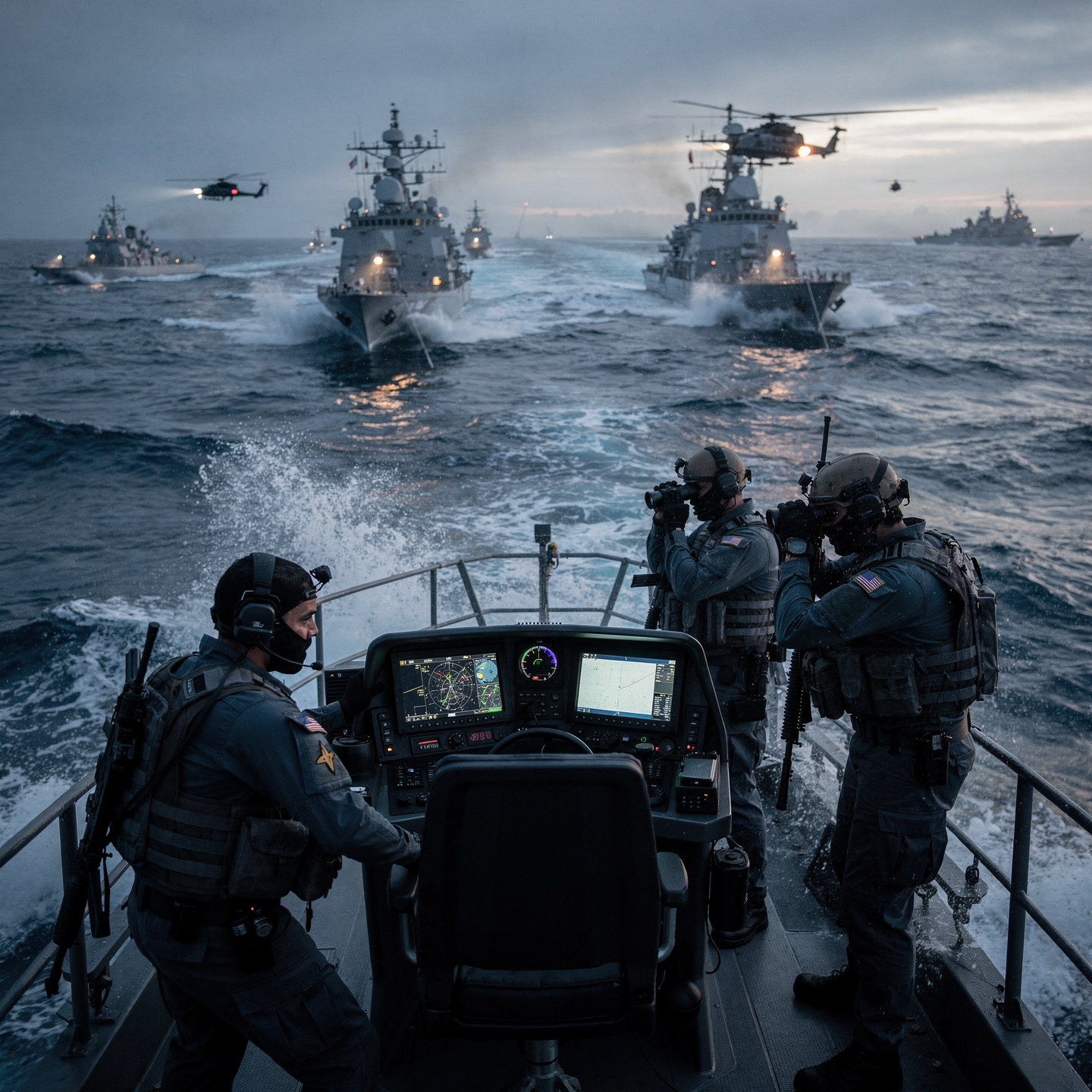
Master’s Degree in Naval Operations and Sea Warfare Tactics

Why this master’s programme?

The Master in Naval Operations and Sea Warfare Tactics

Offers comprehensive training in the field of modern naval strategy and combat. This program equips professionals to plan, direct, and execute complex operations in today’s maritime environment, characterized by technological evolution and diversification of threats. You will learn to master the latest naval warfare tactics, the use of advanced weapons systems, and maritime intelligence strategies, preparing you to lead and make critical decisions in high-pressure situations.

Differentiating Advantages

  • Realistic Combat Simulations: Experience complex scenarios with cutting-edge technology.
  • Strategic Analysis: Develop skills to assess threats and plan effective responses.
  • Leadership at Sea: Learn to manage teams and resources in challenging environments.
  • International Maritime Law: Understand the legal implications of naval operations.
  • Expert Network: Connect with leading professionals in the field of maritime defense.
Operaciones

Master’s Degree in Naval Operations and Sea Warfare Tactics

Availability: 1 in stock

Who is it aimed at?

  • Naval officers seeking specialization in the planning and execution of complex naval operations in wartime environments.
  • Commanders and future commanders who wish to master naval warfare tactics, resource management, and strategic decision-making in high-pressure situations.
  • Naval intelligence analysts who need to deepen their knowledge of maritime threats and defense and attack strategies.
  • Naval engineers and technicians interested in understanding the operation and integration of weapons and defense systems in the context of wartime operations.
  • Maritime security professionals who aspire to lead teams in protecting national interests and responding to crises in the mar.

Flexibility and adaptability
 Designed for working professionals: flexible online methodology, with 24/7 access to materials, discussion forums and personalized tutoring.

Operaciones

Objectives and skills

Mastering comprehensive resource management in maritime conflict scenarios:

Prioritize navigational and crew safety by implementing emergency procedures, damage management, and effective communication coordination in hazardous situations.

Develop innovative and adaptive naval combat strategies:

Integrate predictive analysis of enemy behavior and operational environment modeling to optimize resource allocation and maneuver execution.

Lead and coordinate complex naval operations with efficiency and precision:

Plan and execute coordinated maneuvers (combat, rescue, interdiction) integrating air, land and underwater platforms, optimizing resources and minimizing risks.

Analyze and anticipate maritime threats to protect national interests:

Integrate maritime intelligence, surveillance and reconnaissance (ISR) information, assess vulnerabilities and develop proactive contingency plans.

Optimize interoperability between naval units and allied forces:

Standardize communication protocols and data systems to facilitate real-time information exchange during joint operations.

Assess and mitigate operational risks to ensure mission success:

“Identify threats (internal/external, human/technical), implement security barriers and contingency plans, and conduct periodic drills to validate effectiveness.”

Study plan – Modules

  1. Operational Analysis Models in Complex Naval Environments: Fundamentals and Applications in Multidimensional Combat
  2. Naval Maneuver Theory: Advanced Concepts of Kinematics and Dynamics in Tactical Fleets
  3. Interunit Coordination: Secure Communication Protocols, Encryption, and Real-Time Satellite Links
  4. Tactical Formations: Evaluating Advantages and Disadvantages in Offensive, Defensive, and Containment Deployments
  5. Route Optimization and Strategic Positioning Using War Simulators and Predictive Modeling
  6. Crisis Management and Decision-Making Under Pressure: Command and Control Models in Hostile and Multidimensional Scenarios
  7. Implementation of C4ISR (Command, Control, Communications, Computers, Intelligence, Surveillance, and Reconnaissance) Systems for Naval Interoperability
  8. Countermeasures
  9. Electronic and Signals Warfare: Jamming, Spoofing, and Defense Against Adversarial Electronic Warfare

    Application of Drones and Unmanned Vehicles in Support of Tactical Maneuvers and Real-Time Reconnaissance

    Historical and Contemporary Case Studies on Naval Maneuvering and Coordination in Multidimensional Conflicts, with Critical Analysis of Results and Lessons Learned

  1. Fundamentals of Maritime Intelligence: Concepts, Objectives, and Areas of Application in Naval Operations
  2. Intelligence Sources: ISR (Intelligence, Surveillance, and Reconnaissance), HUMINT, SIGINT, IMINT, and OSINT in the Naval Context
  3. Electronic Surveillance Systems: Surface and Air Radar, Active and Passive Sonar, ESM/ELINT, and Electro-Optical Technologies
  4. Multisensor Integration: Fusion of Data from Air, Naval, and Satellite Platforms for Real-Time Tactical Wedge Creation
  5. Intelligence Processing and Analysis: Predictive Analytics Models, Artificial Intelligence, and Machine Learning Applied to Naval Warfare
  6. Command and Control (C2) Networks in Maritime Intelligence: Architecture, Secure Protocols, and Tactical Information Flow
  7. Electronic Countermeasures (ECM) and Electronic Warfare (EW): Detection and Deception and neutralization of adversary surveillance systems

    Tactical application of intelligence in offensive and defensive operations: planning and execution based on real-time intelligence

    Monitoring of asymmetric and unconventional threats: piracy, maritime terrorism, and hybrid conflicts

    Information management and security: naval cyber intelligence, cryptography, and protection against cyberattacks in electronic surveillance systems

    Risk assessment and decision-making: simulations of tactical scenarios subject to maritime intelligence

    International regulations and legal aspects: intelligence, surveillance, and respect for maritime law in conflict zones

    Historical and current case studies: post-operational analysis of naval intelligence and lessons for continuous improvement

    Practical training in advanced simulators: handling electronic surveillance systems and analysis in simulated tactical environments

    Emerging technological innovations: use of maritime drones, autonomous systems, and big data in naval intelligence

  1. Fundamentals of Naval Maneuvers in Multifactorial Scenarios: Group Dynamics, Three-Dimensional Space, and Environmental Conditions
  2. Threat Analysis and Risk Assessment: Identification of Asymmetric, Conventional, and Electronic Threats in Naval Operations
  3. Design and Application of Boarding and Defense Tactics in Multidimensional Maritime Combat
  4. Interflotilla Coordination: Advanced Protocols for Secure Communication, Encryption, and Real-Time Operational Synchronization
  5. Implementation of Tactical Formations: Line, Wedge, Circle, and Squadron, Adapted to Electronic Warfare Scenarios and Surprise Counterattacks
  6. Strategic Use of Sensors and Naval Intelligence Systems for Concealment and Deception Maneuvers
  7. Electronic Countermeasures and Cyber ​​Warfare: Integration into the Planning and Execution of Naval Tactical Maneuvers
  8. Planning and Execution of Evasion and pursuit in restricted and oceanic waters

    Coordination of combined units: air-sea-land integration in multi-domain operations with an emphasis on interoperability and reaction times

    Post-operational evaluation: analysis of results and feedback using state-of-the-art simulators and tactical wargaming

  1. Electronic Warfare (EW) Fundamentals in the Naval Sphere: Concept, Objectives, and Historical Evolution
  2. Types of Electronic Warfare: Electronic Attack (EA), Electronic Protection (EP), and Electronic Support Warfare (ES)
  3. Architecture and Components of Electronic Detection and Countermeasures Systems on Warships
  4. Advanced Sensor Integration: Multifunction Radars, Radar Warning Systems (RWRs), Communication Interceptors, and Passive Electronic Receivers
  5. Active and Passive Countermeasures: Jamming, Deception, Suppression, and Neutralization of Enemy Signals in Maritime Environments
  6. Tactical Application of Electronic Warfare in Naval Superiority and Area Denial Operations
  7. Interaction and Synchronization of EW Systems with Weapon Systems: Anti-Ship Missiles, Guided Naval Artillery, and CIWS Systems
  8. Cyber ​​Defense in Naval Warfare: Cyber ​​Threats in Command and Control Networks Control, SCADA systems, and secure communications

    Cyber ​​defense methodologies: detection, response, mitigation, and recovery from attacks on naval platforms

    Combat logistics in hostile electronic environments: maintenance, upgrading, and redundancy of EW and cybersecurity equipment

    Joint planning of naval operations with integration of electronic warfare and cyber defense in multi-domain scenarios

    Analysis of historical cases and field studies on the impact of electronic warfare and cyber defense in modern naval conflicts

    Advanced simulation and wargaming: development of practical exercises for the tactical application of EW and cyber defense in naval units

    International regulations and naval doctrine related to the use of the electromagnetic spectrum and cybersecurity in maritime conflicts

    The future of naval electronic warfare: technological trends, artificial intelligence, automation, and spread spectrum warfare

  1. Fundamentals of Naval Logistics: Principles, Objectives, and Relevance in High-Intensity Operations
  2. Strategic Resource Planning: Needs Analysis, Efficient Allocation, and Prioritization in Multifactorial Scenarios
  3. Advanced Supply Management: Maritime Supply Chain, Provisioning and Storage Systems on Ships and Naval Bases
  4. Maintenance and Repair Operations at Sea: Technical Protocols, Preventive and Corrective Planning, and Management of Critical Equipment and Parts
  5. Application of Emerging Technologies: Automated Systems, Telemetry, and the Use of Artificial Intelligence for Logistics Optimization
  6. Fuel and Energy Management in Naval Fleets: Consumption Calculation, Secure Storage, Refueling in Adverse Conditions, and Energy Efficiency Strategies
  7. Transport and Tactical Movements: Convoy Coordination, Logistics Support Maneuvers, and Secure Communications for Resource Transfer
  8. Crisis and Contingency Management: Response Models Rapid response, emergency plans, and management of limited resources under operational stress.

    Risk assessment in hostile maritime environments: situational analysis, identification of logistical vulnerabilities, and threat mitigation.

    International regulations and operational standards: compliance with military and civil agreements, interoperability in naval coalitions.

    Personnel logistics and medical support: deployment of personnel, onboard medical management, and protocols for combat care.

    Advanced simulation and training: use of virtual platforms for logistical preparedness in complex and adverse scenarios.

    Real-time monitoring and control: integrated logistics management systems, data analysis, and operational decision-making based on situational intelligence.

    Post-operational evaluation: performance metrics, efficiency analysis, and lessons learned for continuous improvement.

  1. Fundamentals of Tactical Coordination in Naval Operations: Key Concepts and Historical Evolution
  2. Advanced Maneuver Models in Multidimensional Contexts: Space, Time, and Electromagnetic
  3. Integration of Combined Forces: Surface, Subsurface, Air, and Cyberspace for Tactical Superiority
  4. Application of C4ISR (Command, Control, Communications, Computers, Intelligence, Surveillance, and Reconnaissance) Systems in Maneuver Planning and Execution
  5. Optimization of Operational Synchronization: Sequencing, Timing, and Resource Management in Dynamic Naval Combat Scenarios
  6. Secure Communication and Liaison Protocols in Hostile Environments: Cryptography, Electronic Warfare, and Resistance to Jamming
  7. Employment of Force Dilution and Concentration Tactics: Risk and Benefit Analysis in Advanced Naval Maneuvering
  8. Managing Asymmetric and Multiform Combat Scenarios: Identification and Neutralization of hybrid threats

    Digital simulation and modeling for the preparation and adjustment of integrated strategies: cutting-edge tools and methodologies

    Case studies of multinational operations and inter-arms cooperation: lessons learned and best practices for effectiveness in modern naval combat

  1. Fundamentals of tactical navigation: movement vectors, drift calculation, and correction in adverse conditions
  2. Hydrodynamic and aerodynamic models: analysis of forces acting on ships and naval platforms in complex maneuvers
  3. Advanced interpretation of nautical charts and digital cartography: tactical applications for dynamic multi-threat environments
  4. Planning and execution of evasion and positioning maneuvers in restricted waters and narrow channels
  5. Optimization of heading and speed control algorithms using integrated inertial navigation and GNSS systems
  6. Application of state-of-the-art simulators for the recreation of operational scenarios and real-time decision-making
  7. Dynamics of interaction between naval units: formation tactics, safe separation, and concentration of
  8. Force
  9. Advanced assessment of the impact of oceanographic and meteorological conditions on the tactical effectiveness of maneuvers
  10. Strategic use of detection and tracking technologies for continuous maneuver adjustment: radar, AIS, electro-optical and acoustic systems
  11. Inter-arms coordination procedures and secure communication in high-precision tactical maneuvers
  12. Methodologies for conducting operational exercises and subsequent critical review and lessons learned analysis
  13. Risk management and contingency protocols during maneuvers in hostile scenarios and environments with asymmetric threats
  14. Implementation of international standards and specific regulations for naval maneuvers in international and sovereign waters
  15. Integration of artificial intelligence and automation in the optimization of tactical maneuvers under electronic warfare scenarios
  16. Historical case studies and Contemporary studies on highly complex maneuvers: critical analysis and practical applications
  1. Fundamentals of Asymmetric Warfare in the Maritime Domain: Definition, Characteristics, and Historical Evolution
  2. Analysis of Unconventional Threats in the Maritime Theater: Insurgency Tactics, Use of Asymmetric Technology, and Non-State Actors
  3. Application of Advanced Tactical Intelligence: Collection of SIGINT, HUMINT, and IMINT Data for the Identification of Emerging Threats
  4. Electronic Countermeasures and Cyber ​​Warfare in the Naval Domain: Detection, Neutralization, and Mitigation of Attacks on Command and Control Systems
  5. Joint and Combined Operations: Integration of Naval Forces with Special Forces, Air, and Ground Units in Asymmetric Scenarios
  6. Maritime Threat Neutralization Tactics: Design and Execution of Counterterrorism Operations, Interdiction, and Blocking of Illicit Shipping Routes
  7. Advanced Employment of Naval Unmanned Platforms (UUVs, USVs) for Surveillance, Reconnaissance, and Attack in Asymmetric environments
  8. Use of electronic warfare for spectrum control: interference, selective jamming, and signals warfare on the high seas

    Planning and execution of rescue and evacuation operations in asymmetric maritime conflict contexts

    Study of contemporary cases of asymmetric confrontation at sea: critical analysis and lessons learned for the formulation of future doctrines

  1. Fundamentals of Advanced Naval Maneuvering: Hydrodynamic Principles, Resistance to Forward Movement, and Tactical Response
  2. Multidimensional Threat Analysis: Target Identification, Classification, and Prioritization in Complex Environments
  3. Integrated Naval Force Coordination: Technological Interoperability, Combined Doctrines, and Secure Communications
  4. Maneuvering Strategies in Three-Dimensional Space: Surface, Subsurface, and Air Dominance in Modern Naval Combat
  5. Evasion and Offensive Positioning Tactics: Use of Cover, Electronic Deception, and Signals Warfare
  6. Employment of Advanced Floating Formations: Operational Advantages, Flexibility, and Resilience Against Kinetic and Asymmetric Threats
  7. Real-Time Command and Control: C4ISR Systems for Decision-Making Under Pressure and in High-Uncertainty Environments
  8. Optimizing Operational Synchronization: Temporal and Spatial Synchronization Techniques in joint multi-domain actions
  9. Application of artificial intelligence and automation in naval maneuvers and tactics: simulation, prediction, and autonomous execution
  10. Analysis of contemporary case studies: critical evaluation of recent naval operations and tactical lessons for the future
  1. Fundamentals and Advanced Concepts in Naval Warfare Systems: Definition, Classification, and Applications in Naval Warfare
  2. Design and Architecture of Integrated Systems: Integration of Sensors, Platforms, and Command and Control (C2) Systems in Multidimensional Maritime Environments
  3. Theory and Practice of Naval Tactical Analysis: Use of Geospatial Intelligence, Threat Analysis, and Operational Risk Assessment
  4. Integration and Optimization of Advanced Sensors: Multifunction Radar, Solid-State Sonar, Electro-Optical Systems, and Electronic Signals (ESM/ELINT)
  5. Automation and Decision Support Systems: Artificial Intelligence Algorithms, Machine Learning, and Real-Time Simulation for Naval Warfare Scenarios
  6. Secure Communication and Data Transfer in Naval Operations: Cryptographic Protocols, Redundant Data Links, and Cybersecurity in Shipboard Systems
  7. Operations in Multidimensional Environments: Surface, Subsurface, airspace, and cyberspace: integrated tactical challenges and solutions

    Deployment and coordination of naval warfare units: distributed command and control strategies, interoperability between allied platforms, and real-time resource management

    Advanced simulation and modeling of naval combat scenarios: visualization tools, interpretation of results, and tactical application for training and planning

    Design, development, and presentation of the final project: complete development of a high-precision integrated naval warfare system with applied tactical analysis in a realistic multidimensional environment, including comprehensive technical documentation, contingency plans, and proposals for technological innovation

Career prospects

“`html

  • Naval Officer: Planning and execution of naval operations, resource and personnel management.
  • Naval Intelligence Analyst: Collection, analysis, and dissemination of strategic information for decision-making.
  • Naval Strategist: Development of plans and strategies for maritime defense and security.
  • Naval Electronic Warfare Specialist: Operation and maintenance of electronic warfare systems, countermeasures, and signals analysis.
  • Maritime Special Operations Officer: Leadership and participation in special operations in maritime environments.
  • Maritime Security Advisor: Risk assessment, development of security plans, and consulting for government and private organizations.
  • Naval Defense Researcher: Development of new technologies and strategies for defense Maritime.
  • Teacher/Instructor at Naval Academies: Training future officers and specialists in naval operations and warfare tactics.

“`

Entry requirements

Academic/professional profile:

Bachelor’s degree in Nautical Science/Maritime Transport, Naval/Marine Engineering or a related qualification; or proven professional experience on the bridge/in operations.

Language proficiency:

Functional Maritime English (SMCP) recommended for simulations and technical materials.

Documentation:

Updated CV, copy of qualification or seaman’s book, national ID/passport, motivation letter.

Technical requirements (for online):

Device with camera/microphone, stable internet connection, monitor ≥ 24” recommended for ECDIS/Radar-ARPA.

Admissions process and dates

Online
application

(form + documents).

Academic review and interview

Admissions decision

Admissions decision

(+ scholarship offer if applicable).

Place reservation

(deposit) and enrolment.

Induction

(access to the virtual campus, calendars, simulator guides).

Scholarships and financial support

  • Advanced Maritime Strategies: Master modern naval tactics and operational planning in today’s maritime environment.
  • War Simulations: Participate in realistic simulations to test your leadership and decision-making skills under pressure.
  • Intelligence Analysis: Learn to interpret data and assess threats to anticipate enemy movements and protect your forces.
  • Cutting-Edge Naval Technology: Familiarize yourself with the most advanced weapons systems, sensors, and platforms used in naval warfare.
  • Leadership and Crisis Management: Develop the skills necessary to lead teams in high-risk situations and make critical decisions in real time.
Prepare to lead with confidence in the complex and challenging maritime domain.

Testimonials

Frequently asked questions

Yes. The itinerary includes ECDIS/Radar-ARPA/BRM with harbor, ocean, fog, storm, and SAR scenarios.

Online with live sessions; hybrid option for simulator/practical placements through agreements.

It focuses on both, large-scale strategy and tactics at the individual unit level.

Recommended functional SMCP. We offer support materials for standard phraseology.

Yes, with a relevant degree or experience in maritime/port operations. The admissions interview will confirm suitability.

Optional (3–6 months) through Companies & Collaborations and the Alumni Network.

Simulator practice (rubrics), defeat plans, SOPs, checklists, micro-tests and applied TFM.

A degree from Navalis Magna University + operational portfolio (tracks, SOPs, reports and KPIs) useful for audits and employment.

  1. Fundamentals and Advanced Concepts in Naval Warfare Systems: Definition, Classification, and Applications in Naval Warfare
  2. Design and Architecture of Integrated Systems: Integration of Sensors, Platforms, and Command and Control (C2) Systems in Multidimensional Maritime Environments
  3. Theory and Practice of Naval Tactical Analysis: Use of Geospatial Intelligence, Threat Analysis, and Operational Risk Assessment
  4. Integration and Optimization of Advanced Sensors: Multifunction Radar, Solid-State Sonar, Electro-Optical Systems, and Electronic Signals (ESM/ELINT)
  5. Automation and Decision Support Systems: Artificial Intelligence Algorithms, Machine Learning, and Real-Time Simulation for Naval Warfare Scenarios
  6. Secure Communication and Data Transfer in Naval Operations: Cryptographic Protocols, Redundant Data Links, and Cybersecurity in Shipboard Systems
  7. Operations in Multidimensional Environments: Surface, Subsurface, airspace, and cyberspace: integrated tactical challenges and solutions

    Deployment and coordination of naval warfare units: distributed command and control strategies, interoperability between allied platforms, and real-time resource management

    Advanced simulation and modeling of naval combat scenarios: visualization tools, interpretation of results, and tactical application for training and planning

    Design, development, and presentation of the final project: complete development of a high-precision integrated naval warfare system with applied tactical analysis in a realistic multidimensional environment, including comprehensive technical documentation, contingency plans, and proposals for technological innovation

Request information

  1. Complete the Application Form.

  2. Attach your CV/degree certificate (if you have it to hand).

  3. Indicate your preferred cohort (January/May/September) and whether you would like the hybrid option with simulator sessions.

    An academic advisor will contact you within 24–48 hours to guide you through the admission process, scholarships, and compatibility with your professional schedule.

Please enable JavaScript in your browser to complete this form.
Click or drag a file to this area to upload.

Faculty

0
    0
    Tu carrito
    Tu carrito esta vacíoRegresar a la tienda
    Scroll to Top


